
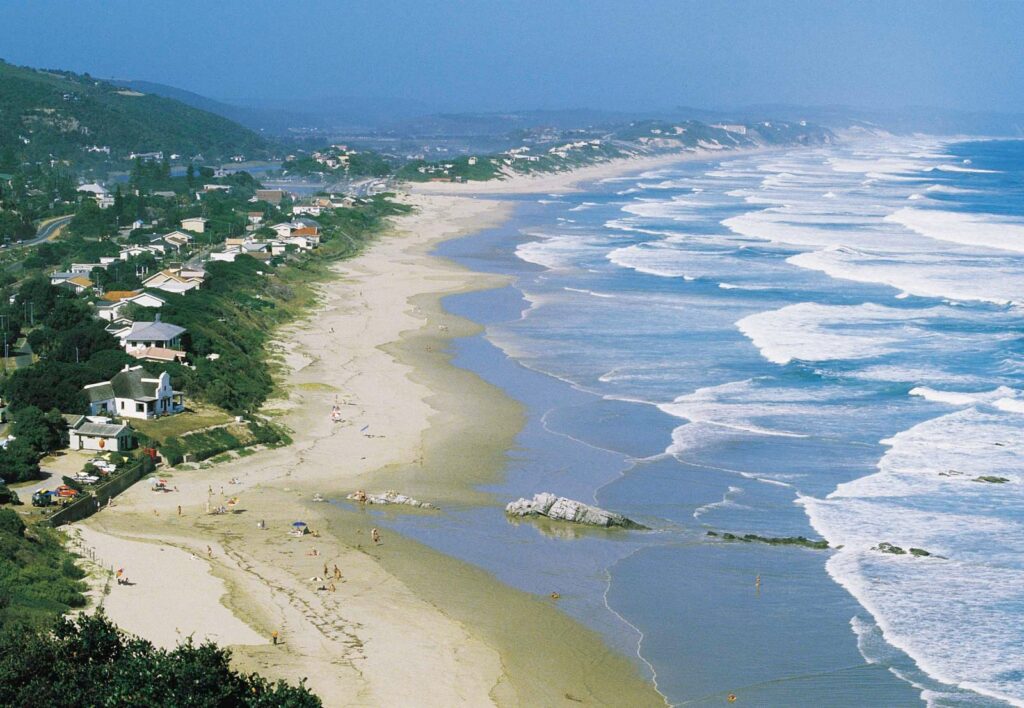
Hero image: The Garden Route coastline — Photo: South African Tourism from South Africa / Wikimedia Commons, CC BY 2.0
This Cape Town Garden Route itinerary covers ten days, which is the point at which combining the two stops being a compromise. At seven you are choosing between the city and the coast. At ten you can give Cape Town four nights, break the drive east instead of enduring it in one go, and still have four unhurried nights on the Garden Route itself.
The hardest decision in this trip is not which towns to visit. It is how many times you unpack. This route uses four bases in ten days. Most versions of it use six or seven, which is why people come home needing a holiday.
In this guide
- The shape of this Cape Town Garden Route itinerary
- What this route is not
- Road conditions at the time of writing
- Days 1–4: Cape Town
- Day 5: the drive east, and Mossel Bay
- Days 6–7: Knysna, via Wilderness
- Days 8–9: Plettenberg Bay
- Day 10: fly out, or drive back
- Where Oudtshoorn fits
- What this route costs you in driving
- Alternatives and swaps
- Planning notes for this Cape Town Garden Route itinerary
- Destination guides for this route
- Where to go next
- Official sources
The shape of this Cape Town Garden Route itinerary
| Days | Base | What kind of days these are |
|---|---|---|
| 1–4 | Cape Town — 4 nights | Three full sightseeing days and one flex day. No moving. |
| 5 | Mossel Bay — 1 night | A transit day with a reason to stop, not a motel beside a road. |
| 6–7 | Knysna — 2 nights | A short transit morning through Wilderness, then a full day here. |
| 8–9 | Plettenberg Bay — 2 nights | Half an hour’s drive, then a full day. The eastern end of the route. |
| 10 | Departure | Fly from George, or start the drive back to Cape Town. Both are covered. |
Four bases across this Cape Town Garden Route itinerary. Three days out of ten involve moving accommodation, and two of those three are short drives. Everything else is a day that starts where the previous one ended.
What this route is not
- It is not a same-day loop. The Garden Route is roughly six hours from Cape Town on the N2 before stops. If you must return overland, that is a full day, and Day 10 treats it as one.
- It is not a Winelands trip. The Winelands appear as one day out of Cape Town, not as a base. If wine is a main reason you are coming, use the 7-day Cape Town, Winelands and Whale Coast route and treat the Garden Route as a separate journey.
- It does not cross the Klein Karoo mountains. See the road conditions below. The passes that make that crossing work are not currently dependable, and the route is built so it does not need them.
- It is not the maximum number of places reachable in ten days. It is the number you can reach and still enjoy.
Road conditions at the time of writing
Checked 21 August 2026 — temporary, and deliberately kept separate from the route itself
Chapman’s Peak Drive is closed following the rockfall of 24 April 2026; its official status page was timestamped 21/8/2026 10:50:50. Meiringspoort is closed with severe flood damage. Swartberg Pass was closed by snow on 9 August 2026 until further notice, and was separately under about four weeks of stop-and-go repairs per the provincial notice of 6 August 2026; no confirmation of reopening was found. Montagu Pass has been closed since the 2023 winter storms, with the province deprioritising repairs because the Outeniqua Pass exists. The Outeniqua Pass (N12), which this route uses between George and Oudtshoorn, carries no current closure notice.
None of the closed roads is required by this itinerary. The Peninsula day uses Ou Kaapse Weg or Constantia Nek in place of Chapman’s Peak. The drive east is the N2. Oudtshoorn, where it appears at all, is reached from George over the Outeniqua Pass and left the same way — not across the Swartberg and not through Meiringspoort.
That is deliberate. When those roads reopen this route does not need rewriting: Chapman’s Peak simply becomes a better Peninsula day, and the Klein Karoo crossing becomes available as an extension. Check the Western Cape Department of Infrastructure updates and the Chapman’s Peak status page before you travel.
A routing app showing a road as passable does not prove it is open or suitable. Navigation software routinely offers roads that are closed, gravel, or unsuitable for a hire car.
Days 1–4: Cape Town
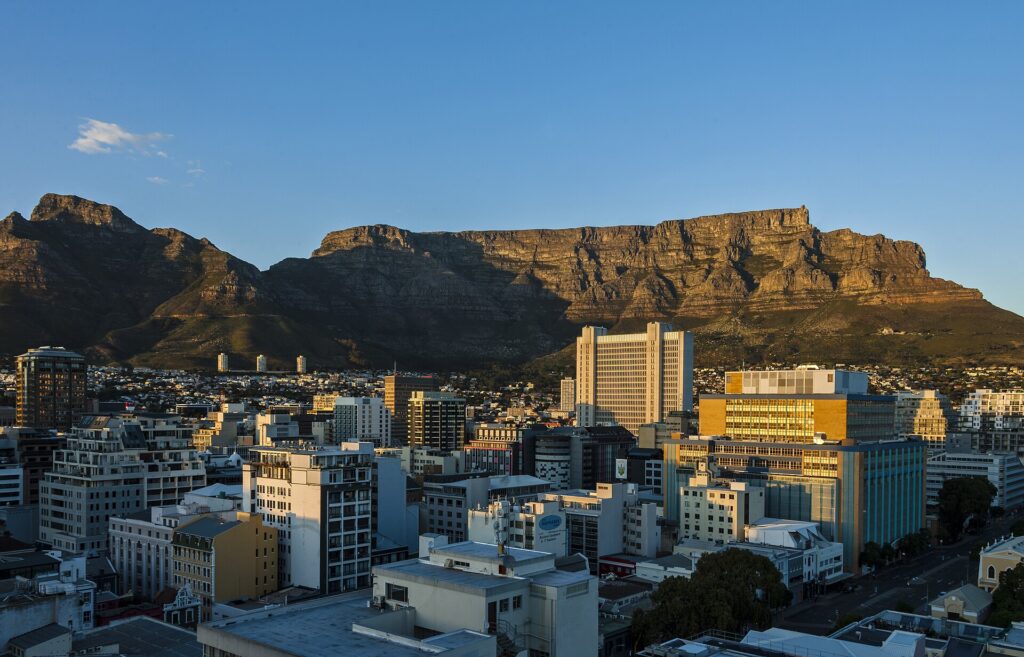
One base, four nights. Do not move hotels inside Cape Town. Where to stay in Cape Town compares the areas properly; for these four days you do not strictly need a car either, so consider collecting the hire car on the morning of Day 5 — see Cape Town without a car.
Day 1 — arrive, and do nothing ambitious
Most long-haul flights land in the morning, and most people overestimate what they will manage afterwards. Walk the City Bowl — Company’s Garden, the museum district, Bo-Kaap — or take the V&A Waterfront if you want somewhere easy with food and a view.
Do not book Table Mountain for Day 1. You want the flexibility to take the mountain on the clearest morning of the four, and that is rarely the day you land.
Day 2 — Table Mountain, then the Atlantic Seaboard
Go up Table Mountain early, on whichever of your first two mornings looks best rather than on a schedule — wind closes the cableway and the tablecloth cloud arrives without much notice. Afterwards the Atlantic Seaboard: the Sea Point promenade, Camps Bay, and sunset somewhere facing west. One significant thing plus one easy thing is a full day here.
Day 3 — the Cape Peninsula
The best day in Cape Town, and a genuinely full one: out along the Atlantic side, over Ou Kaapse Weg or through Constantia Nek while Chapman’s Peak is closed, down to Cape Point, then the penguins at Boulders and back up the False Bay side through Simon’s Town and Kalk Bay.
The Cape Peninsula day trip covers the loop in detail, including which direction to drive it and where the day usually goes wrong. Leave early — this is the day that punishes a slow start.
Day 4 — the flex day
Three good options, and no wrong answer:
- Robben Island — a half-day, weather-dependent, and best booked well ahead. Pair it with the Waterfront or the District Six Museum. If the Robben Island crossing is cancelled for weather, this is also the day with room to absorb that.
- A Winelands day — Stellenbosch for town-plus-wine, Franschhoek for a food-led day, or Constantia if you would rather not leave the city. Settle who is driving before you settle where to go.
- A slow city day — Kirstenbosch, a museum, a beach. After three full days this is a better idea than it sounds, and it protects Day 5.
Whichever you choose, sleep in Cape Town that night
Day 5 is a driving day. Starting it from a Winelands guesthouse saves nothing — you come back through the city’s traffic anyway, or take a slower inland road. Pack the night before and leave early.
Day 5: the drive east, and Mossel Bay
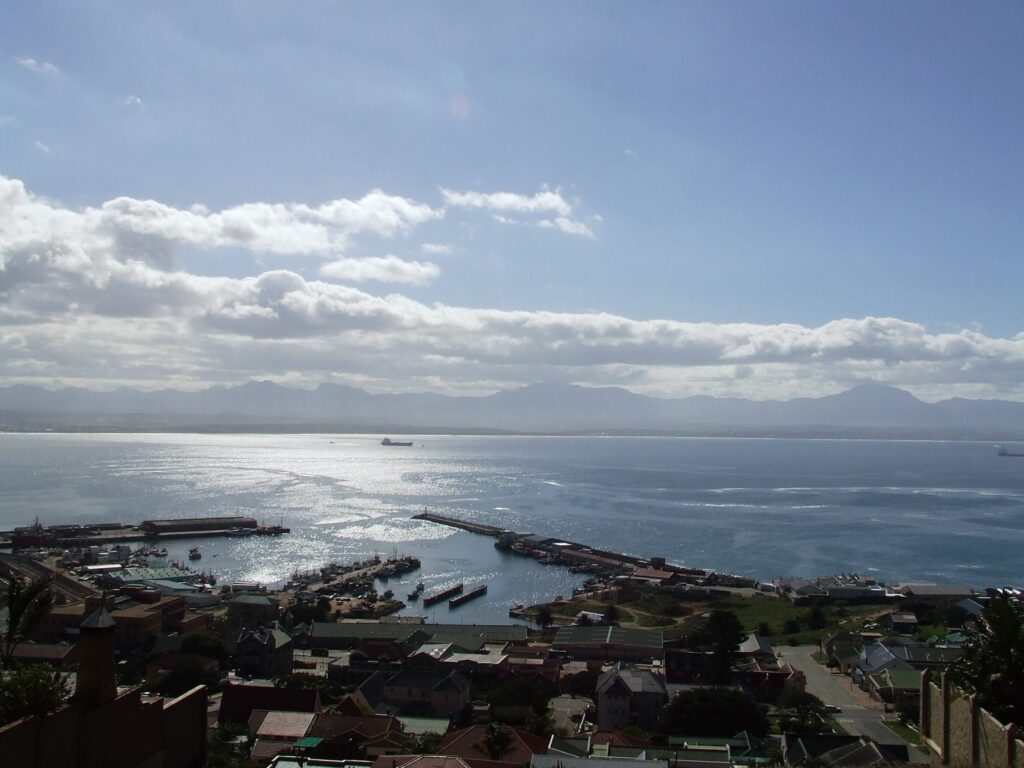
This is a transit day, and it should be treated as one. Cape Town to Mossel Bay is roughly four hours as a free-flow route time before stops — which in practice, with breakfast, fuel, a leg-stretch and one photograph, is most of a day. Do not also try to see something.
The route is the N2 over Sir Lowry’s Pass, through Botrivier and the Overberg wheat country, past Swellendam under the Langeberg, and on east. Swellendam is the natural coffee stop and it is a genuinely pretty one.
Why Mossel Bay rather than pushing on
Because the alternative is arriving in Knysna after dark at the end of a six-hour drive, on the first day of the road-trip half of your holiday. Mossel Bay sits about two-thirds of the way and turns one exhausting day into two comfortable ones.
It also earns the stop on its own terms. It has a working harbour, water more sheltered than the open surf further east, and the Pinnacle Point caves on the headland — an inscribed component of a UNESCO World Heritage property, “The Emergence of Modern Human Behaviour: The Pleistocene Occupation Sites of South Africa”, inscribed in 2024, recording human occupation from roughly 170,000 to 40,000 years ago. Access is managed, so check arrangements ahead rather than turning up.
One night is right. Mossel Bay is a route-break with substance, not a base to build days around.
Days 6–7: Knysna, via Wilderness
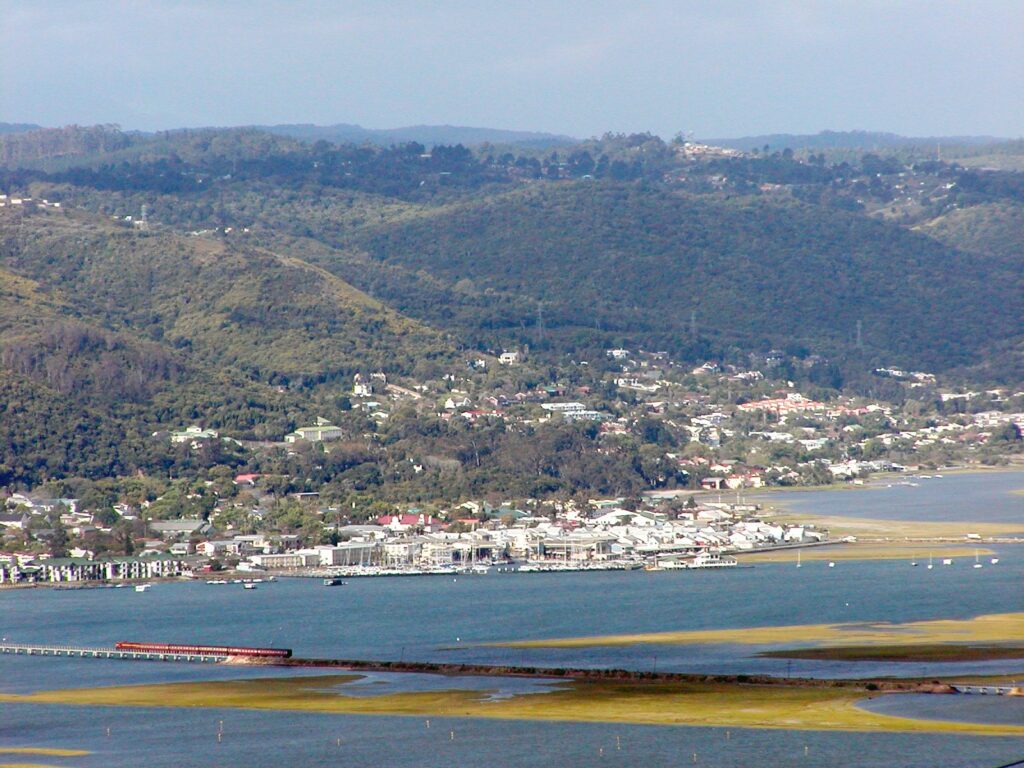
Day 6 — a short drive, and the lakes
Mossel Bay to Knysna is about an hour and a half free-flow, and this is the day to spend some of it. George is passed rather than stopped at — it is the region’s transport hub and airport rather than a sightseeing town, and it is worth knowing that mainly because you may fly out of it on Day 10.
Wilderness is where to stop. The road, the old railway line, the lagoon and the beach are all squeezed into the same narrow gap between the Outeniqua foothills and the sea, and behind the dunes sits a chain of estuarine lakes that SANParks manages as part of the Garden Route National Park. Stop at Dolphin Point, walk the lagoon, and take a short forest trail if the weather is behaving.
Wilderness beach, if anyone is thinking of swimming
George Municipality has no lifeguards on any of its beaches from 7 April 2026 until 30 November 2026, a notice that names Wilderness Main Beach, the Lagoon, the Steps and Leentjiesklip specifically. Cover resumes on 1 December. The municipality attributes eighty per cent of ocean rescues to rip currents. Outside the guarded window this is a beach to walk on.
Arrive in Knysna in the afternoon with time to find your feet.
Day 7 — Knysna properly
A full day, and Knysna gives you three quite different things to spend it on. The estuary is a large, almost enclosed tidal lagoon — boat trips, sheltered water, and the sandbanks that make it look the way it does from above. The Heads, the narrow gap between two sandstone cliffs where the estuary meets the sea, take ten minutes and are worth every one of them. And the indigenous forest behind the town has marked walks from twenty minutes to all day.
Knysna is also the best-equipped town on the route — restaurants, supermarkets, pharmacies — which matters more than it sounds halfway through a road trip.
Days 8–9: Plettenberg Bay
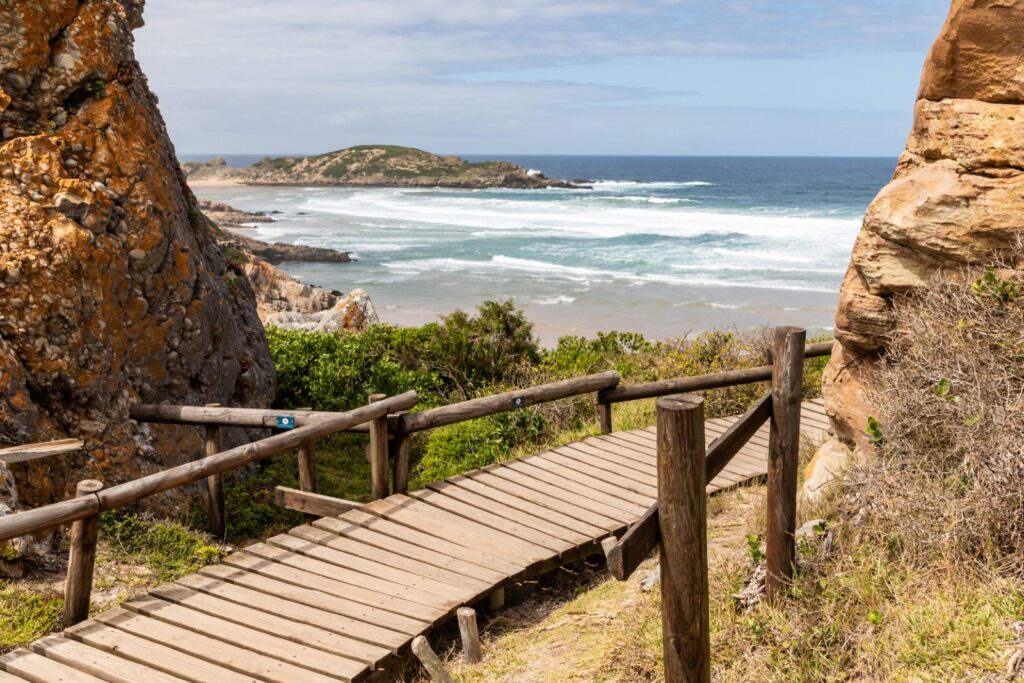
Day 8 — half an hour east, then the beach
Knysna to Plettenberg Bay is about thirty minutes. This is the easiest moving day of the trip, which is deliberate — by Day 8 you want one.
Plett is the beach town of the Garden Route: a wide open bay, several kilometres of sand, and water warm enough to swim in, which the Atlantic side of the Cape emphatically is not. It has an unusual concentration of Blue Flag beaches — for the 2025/26 season WESSA awarded full status to six in the Bitou municipal area, including Lookout Beach and Nature’s Valley. Blue Flag is awarded season by season, so check the current list rather than assuming.
Day 9 — Robberg, and the eastern end
Robberg Nature Reserve is the reason to give Plett two nights. It is a rocky peninsula running four kilometres into the sea, with a resident Cape fur seal colony, seabird breeding sites and Stone Age archaeology. CapeNature publishes three circuits and they are not interchangeable:
| Circuit | Distance | Notes |
|---|---|---|
| The Gap | 2.1 km, about 30 minutes | The easiest. Takes in a mudstone cleft exposing evidence of the break-up of Gondwana. |
| Witsand | 5.5 km, about 2 hours | Moderate, along the northern ridge above the seal colony. |
| The Point | 9.2 km, about 4 hours | Strenuous. CapeNature states it is not suitable for young children. |
A day conservation fee applies and CapeNature reviews its tariffs and gate times, so confirm current rates with the reserve. With the afternoon, either Nature’s Valley and the western edge of Tsitsikamma — about forty-five minutes east, and the point at which the Garden Route stops being a coast road and becomes forest — or simply the beach.
This is the eastern end of a ten-day trip. Tsitsikamma’s suspension bridges, Storms River and the Eastern Cape reserves beyond are all real, and all belong to a longer itinerary. Trying to add them here is how the last two days stop being a holiday.
Day 10: fly out, or drive back
Two honest versions, and they lead to different bookings on Day 1.
Option A — fly out of George
Plett to George airport is about an hour and a half free-flow. This is the better ending, and it is the reason to price an open-jaw booking at the start: into Cape Town, out of George, with a one-way hire car. One-way drop-off fees are real and worth quoting alongside the flight difference, but the trade is a whole day of your holiday, and a day here is worth more than the fee usually is.
Option B — drive back to Cape Town
About six hours free-flow on the N2, which with stops is a full day. Do it in one go rather than adding a night somewhere — a rushed extra base at the end of a trip is the worst of both. Leave early, break at Swellendam or Mossel Bay, and expect the last stretch over Sir Lowry’s Pass into Cape Town traffic to be slower than the map suggests.
If you are driving back and have an extra day
The genuinely good version of the return is not a rushed sprint — it is a night on the Whale Coast, breaking the drive at Hermanus or Stanford. That makes it an eleven-day trip. If you have eleven days, do that. Where to stay on the Cape Whale Coast compares the bases.
Where Oudtshoorn fits
Honestly: not in ten days, not as a base. We have a guide to Oudtshoorn and it is a place worth going to, but including it here would cost a Garden Route night and add a mountain pass in each direction, and the itinerary would be worse for it.
There are two ways to have it anyway:
- As a day trip from Knysna or George, replacing Day 7. Over the Outeniqua Pass from George is about an hour from George, or roughly an hour and three-quarters from Knysna, each way. That is a long day for the Cango Caves and a change of landscape, and it costs you Knysna. Some people will consider that a fair trade; most will not.
- As an eleventh and twelfth night. If the trip stretches, Oudtshoorn is a good two-night extension between the Garden Route and the drive home — a genuine change from coast to dry Klein Karoo.
The route matters here
The obvious-looking loop — Oudtshoorn north over the Swartberg to Prince Albert, or east through Meiringspoort — is not currently available. Both are closed or unreliable, as set out above. Reach Oudtshoorn over the Outeniqua Pass and leave the same way, or approach it along the R62 from the west on a different trip. The Cango Caves themselves reopened in July 2026 after flood-related rockfalls closed the access road from May; confirm current tour options before committing a day.
What this route costs you in driving
All figures are approximate free-flow route times before stops — before traffic, roadworks, weather, coffee and photographs. Treat them as the floor, not the estimate.
| Leg | Free-flow time | Day |
|---|---|---|
| Cape Town → Mossel Bay (N2) | about 4 hours | Day 5 |
| Mossel Bay → Knysna, via Wilderness | about 1 hour 30 | Day 6 |
| Knysna → Plettenberg Bay | about 30 minutes | Day 8 |
| Plettenberg Bay → George airport | about 1 hour 30 | Day 10, Option A |
| Plettenberg Bay → Cape Town (N2) | about 6 hours | Day 10, Option B |
| Optional: George → Oudtshoorn (Outeniqua Pass) | about 1 hour each way | Extension only |
Total driving across ten days: roughly seven hours if you fly out of George, or about twelve if you drive back. That is a modest amount for a road trip of this length, and it is modest precisely because the route uses four bases instead of seven.
Alternatives and swaps
| Instead of… | Try… | When that is better |
|---|---|---|
| Day 4 in Cape Town | A Hermanus day trip | Roughly June to November, when whale watching from the cliff path is at its most reliable. Leave early. |
| Mossel Bay on Day 5 | Wilderness for the night | You want lakes and quiet rather than a harbour town, and you are happy with an extra hour of driving on Day 5. |
| Two nights in Plett | A third night in Knysna, day-tripping to Plett | You prefer forest and estuary to beach, or you want fewer moves still. |
| Knysna as the middle base | Wilderness as the middle base | Travelling with young children who want a lagoon rather than a town. |
| Day 7 in Knysna | A day trip to Oudtshoorn over the Outeniqua Pass | The Klein Karoo interests you more than the estuary, and you accept a long day for it. |
| Driving back on Day 10 | Flying out of George | Almost always. Price the open-jaw booking before you assume it is expensive. |
What we would not swap: the four nights in Cape Town. Every version of this trip that goes wrong goes wrong by cutting the city to three nights to buy a fourth Garden Route night, and then losing a Cape Town day to weather.
Planning notes for this Cape Town Garden Route itinerary
- You need a car for Days 5–10. There is no useful public transport along the Garden Route, and everything worth stopping for sits between the towns. Self-drive Western Cape covers hire, fuel and passes; driving in South Africa covers the road rules that catch visitors out.
- Consider hiring only from Day 5. Four days of Cape Town parking is a cost and an irritation, and the city works well without a car.
- Book Robben Island and Table Mountain ahead, and keep both flexible for weather.
- Direction of travel matters for light. Driving east in the morning and west in the afternoon puts the sun behind you both ways.
- Season. The Garden Route is green because it rains, in any month. December and January are the South African holidays — busiest and most expensive. See best time to visit Cape Town for the city end.
- Accommodation. Where to stay in Cape Town and where to stay on the Garden Route cover the base decisions this itinerary assumes you have already made.
- Travelling with children? Garden Route with kids covers pacing, beaches and which walks suit which age.
Destination guides for this route
- Cape Town — and the City Bowl, V&A Waterfront, Atlantic Seaboard and Table Mountain.
- Cape Point, Simon’s Town, Hout Bay and Muizenberg & Kalk Bay — the Peninsula day.
- Robben Island — for the Day 4 option.
- Swellendam — the stop on the drive east.
- Mossel Bay, George, Wilderness, Knysna and Plettenberg Bay — the Garden Route half.
- Oudtshoorn — the optional extension.
Where to go next
- 14 days: the Western Cape road trip — if you have two weeks, this route becomes part of a much better trip.
- 7-day Garden Route itinerary — if you are flying straight into George and skipping Cape Town.
- 7 days: Cape Town, Winelands and the Whale Coast — if wine and whales matter more than the Garden Route.
- All Western Cape itineraries — from three days to fourteen.
- Cape Town to the Garden Route — the drive itself, in more detail than this page gives it.
- Travel planning — costs, seasons, safety and what to pack.
Official sources
- Western Cape Department of Infrastructure — provincial road and pass status. Check on the morning you travel.
- Chapman’s Peak Drive — the official timestamped status page.
- Table Mountain National Park (SANParks) — Cape Point, Boulders, permits and alerts.
- Garden Route National Park (SANParks) — the Wilderness, Knysna and Tsitsikamma sections.
- CapeNature — Robberg Nature Reserve — the three circuits, fees and gate times.
- George Municipality — beach lifeguard seasons.