

Hero image: The Franschhoek valley — Photo: User:Da_Legend / Wikimedia Commons, Public domain
Franschhoek is the smallest and most enclosed of the three main Cape Winelands towns, and the easiest to understand: a flat valley floor under vineyards, a wall of mountains around three sides, and one main street running down the middle of it. What it lacks in size it makes up for in concentration — this is where a great deal of South African fine dining happens.
It is about an hour from Cape Town, twenty-five minutes from Stellenbosch over the Helshoogte Pass, and thirty from Paarl.
Where to stay and what to book in Franschhoek
Places to stay in the valley, plus the tram and the guided days that make tasting here straightforward.
Places to stay
Mont Rochelle Hotel and Vineyard, Franschhoek
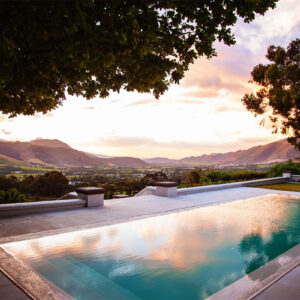
A 26-room hotel set in its own vineyard on the slopes above the Franschhoek valley.
View Property DetailsLa Petite Ferme, Franschhoek Pass
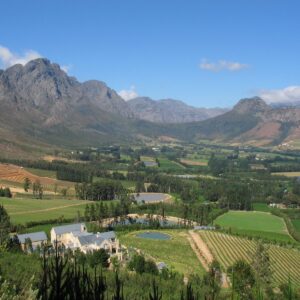
A small family-run wine farm on the Franschhoek Pass, looking down the length of the valley.
View Property DetailsGrande Provence Heritage Wine Estate, Franschhoek
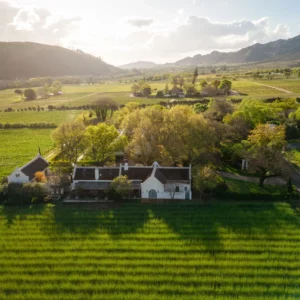
A 47-acre working wine estate with an art gallery and two restaurants on the Franschhoek main road.
View Property DetailsLe Franschhoek Hotel & Spa, Franschhoek
A large four-star hotel and spa on the edge of the Franschhoek valley, with a complimentary shuttle to the village.
View Property Details


Browse all Cape Winelands accommodation
Tours and experiences
From Cape Town: Franschhoek Wine Tram Hop-on Hop-off
The valley’s hop-on hop-off tram and tram-bus loop — the neatest solution to drinking and driving in Franschhoek.
View Tour DetailsCape Town: Stellenbosch&Franschhoek Wine Tour with Tasting
The two best-known Winelands towns in one day, with the Helshoogte Pass in between.
View Tour DetailsCape Town: Full-Day Winelands Tour with Wine Tastings & Food
Tastings built around food rather than beside it — pairings, a proper lunch and a slower day.
View Tour DetailsPrivate Tour: Cape Winelands to Stellenbosch & Franschhoek
The Winelands at your own pace, with the estates chosen for you rather than for the group.
View Tour Details
In this guide
Franschhoek in brief
- What it is — a small wine and food town at the closed end of a mountain valley.
- Founded — 1688, by French Huguenot refugees granted land at the Cape. The name means “French corner”.
- Known for — restaurants, cap classique and red wine, art galleries, and the wine tram.
- Time needed — a full day as a trip from Cape Town; two nights to do it without rushing.
- Getting around — the village is walkable; the estates are not. You need a car, a driver or the tram.
- Watch out for — booking. Restaurants and popular tastings fill weeks ahead in season.
The Huguenot story
In 1688 a group of French Protestant refugees — Huguenots — who had fled France after the revocation of the Edict of Nantes were granted land in this valley by the Dutch East India Company. They brought viticultural knowledge with them, and the farm names still carry the evidence: La Motte, La Provence, Cabrière, Dieu Donné, Bourgogne.
Within a generation or two the community had been absorbed and the language largely lost, which was Company policy rather than accident. What survived was the farm names, the surnames, and a set of family lines that run through South African history since.
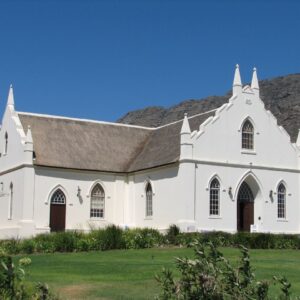
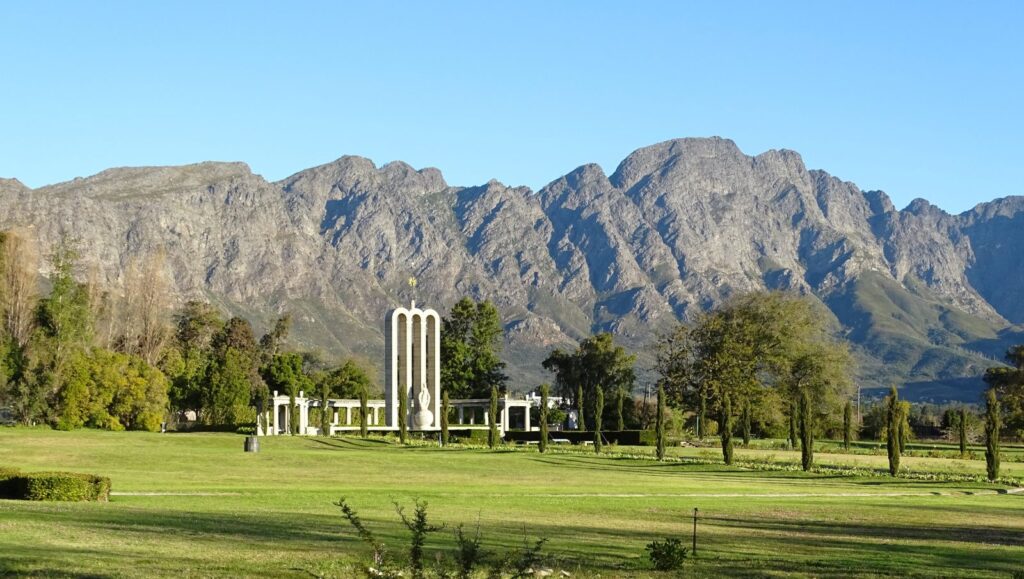
At the top of the main road, the Huguenot Monument marks the settlement with three linked arches, and the adjoining Huguenot Memorial Museum holds the genealogical and cultural record. Both are worth twenty minutes even if you are not usually a museum person, if only because they explain the valley’s names.
The village
Franschhoek is essentially one long street, Huguenot Road, running from the monument at the closed end of the valley down towards the turn-off for Stellenbosch and Paarl. Along it are restaurants, galleries, wine shops, delis and a run of Cape Dutch and Victorian buildings, with the mountains visible at both ends. It takes about twenty minutes to walk from one end to the other, and that walk is one of the pleasant things to do here.
It is also, by South African standards, expensive and heavily oriented to visitors. That is worth knowing rather than being disappointed by: this is a village of about fifteen thousand people that receives a very large number of day-trippers, and the main street reflects it.
The wine
The valley is narrow and enclosed, with vineyards running up onto the slopes on both sides, and the mountains give it cooler night temperatures than the open ground around Paarl. In practice Franschhoek is known for cap classique — South African bottle-fermented sparkling wine — along with syrah, cabernet and semillon, but the range across thirty-odd producers is wide.
Tasting here works the same way it does elsewhere in the Winelands, with one difference: the estates are close together and several are within walking or cycling distance of the village, which is not true of Stellenbosch or Paarl. Booking is increasingly expected, particularly for anything with food attached.
A note on how we cover this: we do not write individual estates up as attractions. Which farms are worth your afternoon depends on what you drink, and tasting-room arrangements change constantly. Use the valley’s own current listings and book directly.
The wine tram
The Franschhoek Wine Tram is a hop-on hop-off system using open-sided trams and buses to link a set of estates around the valley, sold as a day ticket on one of several colour-coded lines. It solves the drinking-and-driving problem neatly and it is popular for exactly that reason.
The lines, the participating estates and the timetable change from season to season, and the operator’s own site is the only reliable source for what is running on the day you want to travel. Book ahead in high season, and pick a line by which estates are on it rather than by name. If you would rather set your own pace, a hired driver for the afternoon does the same job with more flexibility and is often comparable in cost for three or four people.
Eating
Franschhoek’s reputation for food is not marketing. For a village of this size the density of serious kitchens is genuinely unusual, running from tasting-menu restaurants on wine estates to bakeries and bistros on the main street. It is the single best reason to stay the night rather than drive back to Cape Town.
Practicalities: book, and book early for the well-known places — weeks ahead in December and January, and at weekends year-round. Lunch is often easier to get than dinner and is arguably the better meal here, because you eat looking at the valley. If you are driving afterwards, plan a driver.
Getting out of the tasting rooms
The valley is a good deal more than wine, and a day that includes some walking is a better day.
- Mont Rochelle Nature Reserve — the mountain reserve directly above the village, with trails and long views back down the valley. It is open sunrise to sunset all year, a day permit is required, and permits are sold at the gate, at the Franschhoek information bureau or online. It is not a SANParks reserve, so a Wild Card does not work here.
- Franschhoek Pass — the road climbing out of the closed end of the valley towards Villiersdorp and Theewaterskloof. One of the finest short passes in the Cape and a fifteen-minute drive to the top for the view. It can close after storms or fire.
- Boschendal — a large historic farm on the Stellenbosch side of the valley, with gardens, food and family activities as well as wine.
- Cycling — the valley floor is flat and several estates are within easy riding distance. Bikes are hired in the village.
- Galleries — the main street has a real concentration of them, and it is a genuine part of the town rather than tourist filler.
Day trip or overnight?
As a day trip from Cape Town it works, but it is a long day. Reckon on an hour each way, two estates, and lunch. You will not eat dinner here and you will be watching the clock over the second tasting.
Overnight is much better, and two nights is better still. Staying lets you eat properly, walk in the morning, and use the tram or a driver without worrying about the return leg. Two nights also makes it sensible to combine Franschhoek with Stellenbosch or Paarl rather than choosing between them.
A useful shape: arrive late morning, one estate and a long lunch, afternoon walk or the monument, dinner in the village, and the pass and a second estate the next morning before moving on.
Getting there and getting around
By car — from Cape Town the N1 to the Klapmuts turn-off and then the R45, or the more scenic route through Stellenbosch and over Helshoogte. Both are about an hour. From Paarl it is half an hour on the R45 across the Berg River valley.
Without a car — there is no useful scheduled public transport into the valley. Realistic options are a day tour from Cape Town, a hired car with driver, or e-hailing from Stellenbosch or Paarl, which is workable but not always reliable for the return trip late in the evening.
In the valley — the village is walkable end to end. For the estates, use the tram, a bicycle, or a driver.
When to come
Summer, December to March — hot, dry and busy. The valley can be genuinely warm because the mountains trap the heat. Everything is open, everything is booked, and prices are at their highest. Harvest runs from about February into April.
Autumn, April and May — arguably the best window. The vines colour, the crowds thin, the light is good and the weather is still reliable.
Winter, June to August — wet, green and cold, with snow on the higher peaks some years. Fires in restaurants, quiet tasting rooms and lower rates. A number of smaller places close or reduce hours, so check.
Spring, September to November — wildflowers, new growth, and increasingly busy towards November.
Where to stay in Franschhoek
Franschhoek has a lot of accommodation for its size, and it skews upmarket: country-house hotels, wine-estate lodges and guesthouses, with more modest guesthouses and self-catering cottages on the streets behind the main road. Staying in the village itself is the sensible choice if you want to walk to dinner. Staying on an estate outside the village gives you the setting but commits you to driving or a taxi for every meal.

Find accommodation in Franschhoek
Staying the night is what turns Franschhoek from a rushed day trip into a proper visit — and it solves the driving problem after dinner.
Browse places to stay in FranschhoekAffiliate link. We may earn a commission if you book through it, at no additional cost to you. See our affiliate disclosure.
Franschhoek, Stellenbosch or Paarl?
The three towns form a triangle and they are genuinely different.
- Franschhoek — smallest and most enclosed. Best food, most walkable, most expensive, least to do outside eating and drinking.
- Stellenbosch — a proper university town with museums, a historic core and the widest range of estates. The best single choice if you can only visit one.
- Paarl — the largest and least touristed, with granite mountains, monuments and a working-town character. The best value.
They are all within half an hour of each other, so if you have two nights you do not have to choose. Base yourself in one and drive to the others.
Nearby, and what to do next
- Cape Winelands tours — Franschhoek-focused tours and Wine Tram products compared.
- Where to stay in the Cape Winelands — when Franschhoek is the right place to sleep, and when it is not.
- Cape Winelands day trip — when Franschhoek is the right choice, and when it is not.
- Stellenbosch — twenty-five minutes over the Helshoogte Pass.
- Paarl — thirty minutes on the R45.
- Cape Winelands overview — how the whole region fits together.
- Theewaterskloof and Villiersdorp — over the Franschhoek Pass, and the back way towards the Cape Overberg.
- Cape Town — an hour west.
- Western Cape itineraries — where a Winelands night fits into a longer route.
Official sources
- Franschhoek Wine Valley — the official destination body, for estates, events and current visitor information.
- Mont Rochelle Nature Reserve — permits, hours and trail information.
- Franschhoek Wine Tram — current lines, estates and timetables.
- Heritage Western Cape — provincial heritage context for the valley’s buildings.
- Wesgro — the provincial destination framework for the Cape Winelands region.
Where to stay, and what to book
Our Franschhoek accommodation page carries a short orientation to the area and a live availability map. For experiences, see Cape Winelands Tours.