

Hero image: Simon’s Town marina — Photo: Laika ac / Wikimedia Commons, CC BY-SA 2.0
Simon’s Town is the most complete historic town on the Cape Peninsula, and the only one whose reason for existing is still visible from the main road: it is a naval base, and has been one under three flags for close to three hundred years. Most visitors come for the penguins at Boulders and leave within the hour. The town itself repays a longer stop.
It sits on the False Bay coast of Cape Town, about forty-five minutes south of the city centre, and it is the last town of any size before the Cape of Good Hope section of Table Mountain National Park.
What to book in Simon’s Town
The tours that take in Boulders, the naval town and the peninsula road beyond it.
Tours and experiences
From Cape Town: Cape Point and Boulders Beach Half-Day Tour
The compressed version of the classic peninsula run: the penguin colony and the Cape itself, back in the city by…
View Tour DetailsFrom Cape Town: Cape Point & Boulders Beach Full-Day Tour
The unhurried version of the peninsula circuit, with time at the Cape rather than a photograph and a departure.
View Tour DetailsCape Town: Cape of Good Hope, Seals and Penguins Day Tour
The wildlife-led version of the peninsula day: a seal island boat, the penguin colony and the Cape.
View Tour Details

In this guide
- Simon’s Town in brief
- Why the town looks the way it does
- The historic mile
- The museums
- Luyolo, and the removals
- Boulders and the African penguins
- Beaches and swimming
- Getting to Simon’s Town
- Simon’s Town and Cape Point
- Where to stay in Simon’s Town
- Nearby, and what to do next
- Practical notes
- Official sources
Simon’s Town in brief
- What it is — a working South African Navy base with a historic town wrapped around it.
- The setting — a sheltered corner of False Bay, backed by steep mountain, facing east across the water.
- Best for — naval and social history, the penguin colony at Boulders, warm-water swimming, and a base for Cape Point.
- Time needed — two hours minimum for Boulders and the historic mile; a full day if you use the beaches and museums.
- Note — the water on this side of the peninsula is noticeably warmer than the Atlantic side.
Why the town looks the way it does
Simon van der Stel gave the bay its name in 1687, but the town proper begins in 1743, when the Dutch East India Company made it the official winter anchorage for its ships — Table Bay being dangerously exposed to the north-westerly gales. A magazine, hospital and barracks went up, followed by a bakery, butchery, carpenter’s shop and smithy.
The British Royal Navy took over in the 1790s and stayed for a century and a half, building the dockyard that still defines the waterfront. Between 1900 and 1910 they enlarged it substantially, including the Selborne graving dock. In 1957 the base transferred to the South African Navy under the Simon’s Town Agreement, and it remains the Navy’s principal base today.
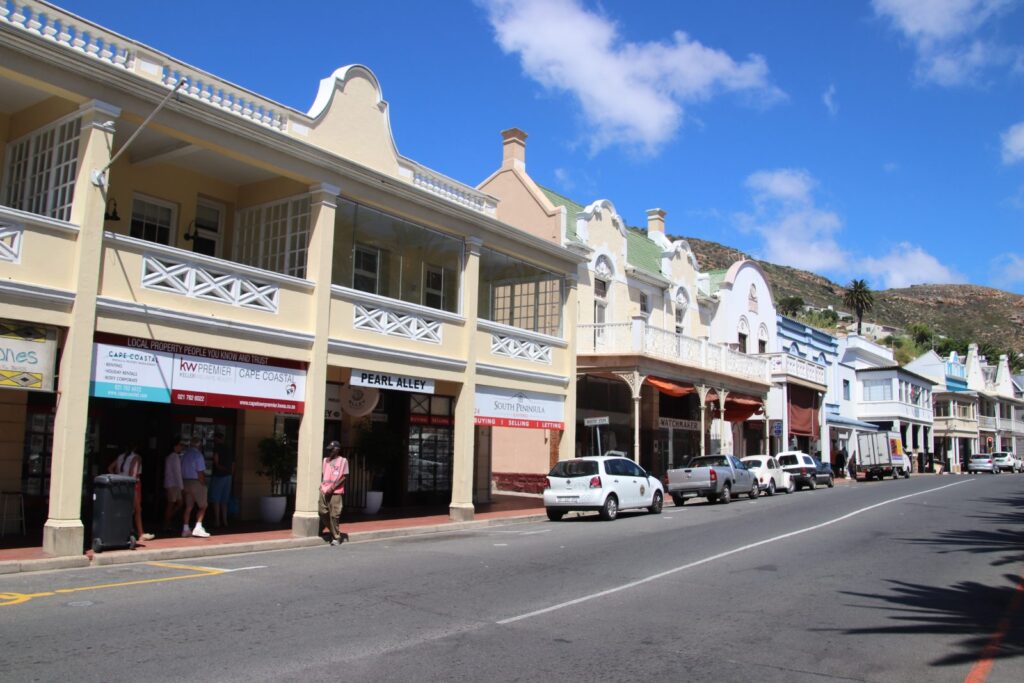
That is why the architecture is what it is: a tight strip of Georgian and Victorian buildings squeezed between the mountain and the sea, built for a service town rather than for holidaymakers.
The historic mile
The stretch of St George’s Street through the middle of town is known as the historic mile, and it is genuinely walkable in an hour. Jubilee Square, opening off the main road towards the yacht basin, is the centre of it: a raised terrace with cafes, craft shops and a statue of Just Nuisance, the Great Dane enlisted into the Royal Navy during the Second World War and buried with full military honours above the town. The story is a good deal odder and better than the souvenir version.
Behind the square the yacht basin and the naval dockyard sit side by side. The dockyard is an operational military facility, so photography restrictions apply along parts of the waterfront — look for signage and respect it.
The museums
- Simon’s Town Museum, in the old Residency — the town’s general history: naval, social and domestic, including the Just Nuisance material.
- South African Naval Museum, in an 1815 Royal Naval building inside the dockyard precinct — ships, submarines and South African naval history. Security procedures apply at the entrance.
- Heritage Museum — the history of the town’s Muslim community and their forced removal under apartheid.
- Warrior Toy Museum — a small, eccentric collection that works well with children.
Opening days and hours at all of these change, and at least one is usually closed on any given day. Confirm before making a special trip.
Luyolo, and the removals
Before Simon’s Town was declared a white group area, roughly 1,500 African residents of Luyolo were forcibly removed and resettled in Gugulethu on the Cape Flats. The town’s Muslim community was removed as well. Accounts from those who lived through it describe families loaded onto trucks with possessions left behind.
This is not a footnote to the naval history; it is part of the same story, and it is why a town of this age has the demographic shape it has today. The Heritage Museum and the Simon’s Town Museum both address it. If you visit the town’s heritage sites without encountering this, you have only seen half of it.
Boulders and the African penguins
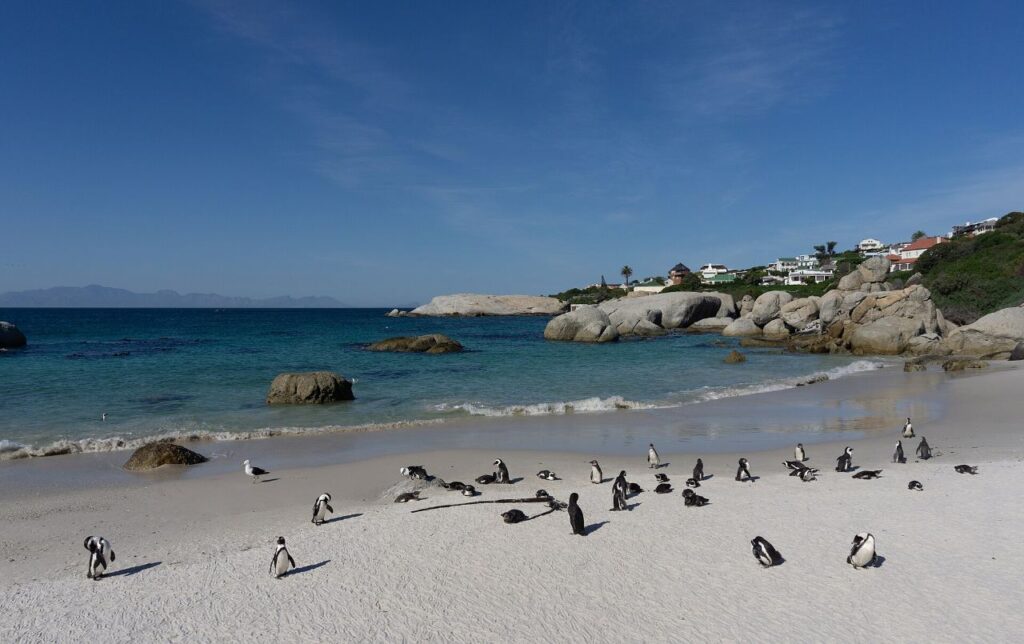
The penguin colony at Boulders, a couple of kilometres south of the town centre, is the reason most people come. It is part of Table Mountain National Park, and access is via boardwalks that keep visitors off the nesting ground. A SANParks conservation fee applies at the gate, and Cape Point and Boulders both operate as card-only, cash-free sites.
The animals are African penguins, and their situation is serious. In October 2024 the IUCN uplisted the species to Critically Endangered — the first penguin species anywhere to meet that threshold — after the breeding population fell below 10,000 pairs, a loss of about 97% of the historical population. The principal pressures are a shortage of the sardines and anchovies they feed on, competition from commercial purse-seine fishing near breeding colonies, and climate-driven changes in prey distribution.
That reframes the visit. This is not a novelty photo stop; it is one of the last accessible colonies of a species that conservationists have publicly warned could functionally disappear in the wild within about a decade if nothing changes. Behave accordingly:
- Stay on the boardwalks and behind the barriers.
- Do not touch, feed, chase or attempt to pose with the birds. They bite hard and the stress matters.
- Keep noise down and give nesting birds space, particularly in the breeding season.
- Never bring a dog anywhere near the colony or the adjacent beaches.
- Drive slowly on the roads around Boulders and Seaforth — penguins cross them.
Beaches and swimming
The great advantage of this side of the peninsula is water temperature. False Bay is materially warmer than the Atlantic seaboard, and swimming here is a pleasure rather than an endurance test.
- Seaforth — a small sheltered beach right beside the town, calm and good for families.
- Boulders Beach — a sheltered granite cove within the protected area; visitor controls and the conservation fee apply.
- Windmill Beach — a quieter local cove between the two, popular with snorkellers.
- Long Beach, Simon’s Town — the long stretch north of the town, exposed and used more for walking than swimming.
False Bay is shark habitat. Follow local signage and any shark-spotting arrangements in force, and treat the absence of a spotter as information rather than reassurance.
Getting to Simon’s Town
By car — the M3 south from the city, then the M4 coast road through Muizenberg, St James, Kalk Bay and Fish Hoek. It is one of the better drives in the city, tight against the water for much of the way, and it takes about forty-five minutes to an hour without traffic. Parking in the town is on-street and around Jubilee Square, and the Boulders car parks fill up in season.
By train — the Southern Line runs down the same coast, and the section from Fish Hoek to Simon’s Town is one of the most scenic suburban rail rides anywhere. Services have been through a long period of disruption. As of early 2026, direct weekday trains between Cape Town and Simon’s Town had been reinstated, with a Fish Hoek shuttle arrangement on Saturdays and no regular Sunday or public holiday service. Timetables and reliability change, so check the current schedule before you build a day around the train, and plan a fallback for the return leg.
By tour — most Cape Peninsula day tours stop here, usually briefly, between Chapman’s Peak and Cape Point.
Simon’s Town and Cape Point
Simon’s Town is the practical staging post for the Cape of Good Hope section, about twenty-five minutes further south. Fill up with fuel here, buy anything you need here, and time your arrival at the park gate rather than drifting down in the middle of the day when the car parks are at their worst.
If you are doing the classic peninsula loop, the sequence that works is Chapman’s Peak and Noordhoek in the morning, Cape Point in the middle of the day, then Boulders and Simon’s Town in the late afternoon on the way back — the light on False Bay is better then and the crowds have thinned.
Where to stay in Simon’s Town
Staying here makes real sense if the southern peninsula is the point of your trip. You get an early start at Cape Point before the tour buses, warm swimming beaches on the doorstep, a walkable town with restaurants, and a genuinely different atmosphere from the city. It is about an hour from the city centre and further from the Winelands, so it suits a two-or-three-night peninsula leg better than a whole Cape Town stay.
Accommodation is mostly guesthouses, B&Bs and self-catering apartments, with a cluster along the main road and above it on the mountain side. Rooms facing east over False Bay get the sunrise; rooms above the main road get less traffic noise.
Find accommodation in Simon’s Town
Staying here is how you reach the Cape Point gate before the coaches do, and it puts the warm False Bay beaches on your doorstep.
Browse places to stay in Simon’s TownAffiliate link. We may earn a commission if you book through it, at no additional cost to you. See our affiliate disclosure.
Nearby, and what to do next
- Cape Peninsula tours — the guided alternatives to driving the peninsula yourself.
- Cape Peninsula day trip — where Simon’s Town falls on the loop, and why timing matters.
- Cape Point and the Cape of Good Hope — twenty-five minutes south, inside Table Mountain National Park.
- Kalk Bay — a working fishing harbour with antique shops and restaurants, fifteen minutes north.
- Muizenberg — the surf beach and the colourful bathing huts, half an hour north.
- Fish Hoek — a long sheltered family beach, ten minutes north.
- False Bay and the Southern Peninsula — how the whole coast fits together.
- Hout Bay — across the peninsula on the Atlantic side, via Ou Kaapse Weg or Chapman’s Peak.
Practical notes
- Baboons — troops range through the southern peninsula and around Simon’s Town. Keep car windows shut, never carry visible food, and never feed them. A fed baboon is usually a dead baboon.
- Card only — the SANParks gates at Boulders and Cape Point do not take cash.
- Wind and weather — False Bay is sheltered from the summer south-easter far better than the Atlantic side, which is why this coast is often the right call on a windy day.
- Whales — southern right whales come into False Bay in the winter and spring months and can be seen from the coast road.
- Naval facility — respect photography restrictions around the dockyard.
Official sources
- SANParks — Table Mountain National Park — Boulders access, conservation fees and park rules.
- SANCCOB — African penguin conservation status and seabird rescue.
- South African History Online — Simon’s Town — the town’s history, including the removals.
- Cape Town train timetables — current Southern Line schedules.
- Cape Town Tourism — current destination information.
Where to stay, and what to book
Our False Bay & Southern Peninsula accommodation page carries a short orientation to the area and a live availability map. For experiences, see Marine & Wildlife Experiences.