

Hero image: Nithin bolar k, CC BY-SA 3.0, via Wikimedia Commons
Camps Bay is the beach most people picture when they picture Cape Town: a long stretch of pale sand, palm trees along the road, and a wall of mountain rising straight out of the suburb behind it. It is genuinely spectacular, and it is also busier, windier and more expensive than most visitors expect. This page covers what the beach is actually like, how to work around the wind and the parking, how Camps Bay differs from Clifton next door, and when it makes sense as a base rather than a day trip.
Camps Bay sits on the Atlantic Seaboard, about fifteen minutes from the City Bowl over Kloof Nek. It is part of Cape Town rather than a separate town, and the mountains behind it are the western face of the Table Mountain range.
Where to stay and what to book in Camps Bay
Three places to stay on the beach side of the Twelve Apostles, and what to do once you are there.
Places to stay
The Bay Hotel, Camps Bay
A full-service beachfront hotel on the Camps Bay strip, with the Twelve Apostles behind and the Atlantic across the road.
View Property DetailsPOD Camps Bay
A small, minimal design hotel on the slope above the Camps Bay strip — quiet nights, a short walk down…
View Property DetailsTwelve Apostles Hotel & Spa, Oudekraal
Alone on the Oudekraal coast road inside the national park, with the Twelve Apostles behind and open ocean in front.
View Property Details

Browse all Cape Town accommodation
Tours and experiences
Tandem Paragliding in Cape Town
A tandem flight off the slopes above the city, landing on the Atlantic seaboard — weather permitting.
View Activity DetailsTandem Paragliding Flight with the Experts, Cape Town
A pilot-led tandem flight over the city, sold on experience rather than novelty.
View Activity DetailsCape Town: Lion’s Head or Table Mountain Guided Hike
The spiral climb up Lion’s Head — shorter than Table Mountain, and the best view back at it.
View Tour Details
In this guide
- Camps Bay in brief
- Why Camps Bay is worth your time
- The beach itself
- The wind, and how to plan around it
- Camps Bay or Clifton?
- Eating and the evening
- Getting to Camps Bay and parking
- Does Camps Bay work as a base?
- Where to stay in Camps Bay
- Nearby, and what to do next
- Fitting Camps Bay into an itinerary
- Practical notes
- Official sources
Camps Bay in brief
- What it is — a residential beach suburb with a single restaurant strip facing the sea.
- Setting — directly below the Twelve Apostles, the serrated southern end of the Table Mountain range.
- The water — open Atlantic, cold all year. Most people paddle rather than swim.
- Best for — sunset, a long walk on sand, a drink facing the sea, and quick access to Table Mountain.
- Least good for — quiet, cheap parking, warm swimming, or shelter on a windy summer afternoon.
- Typical visit — two to four hours, or one night if you are staying here.
Why Camps Bay is worth your time
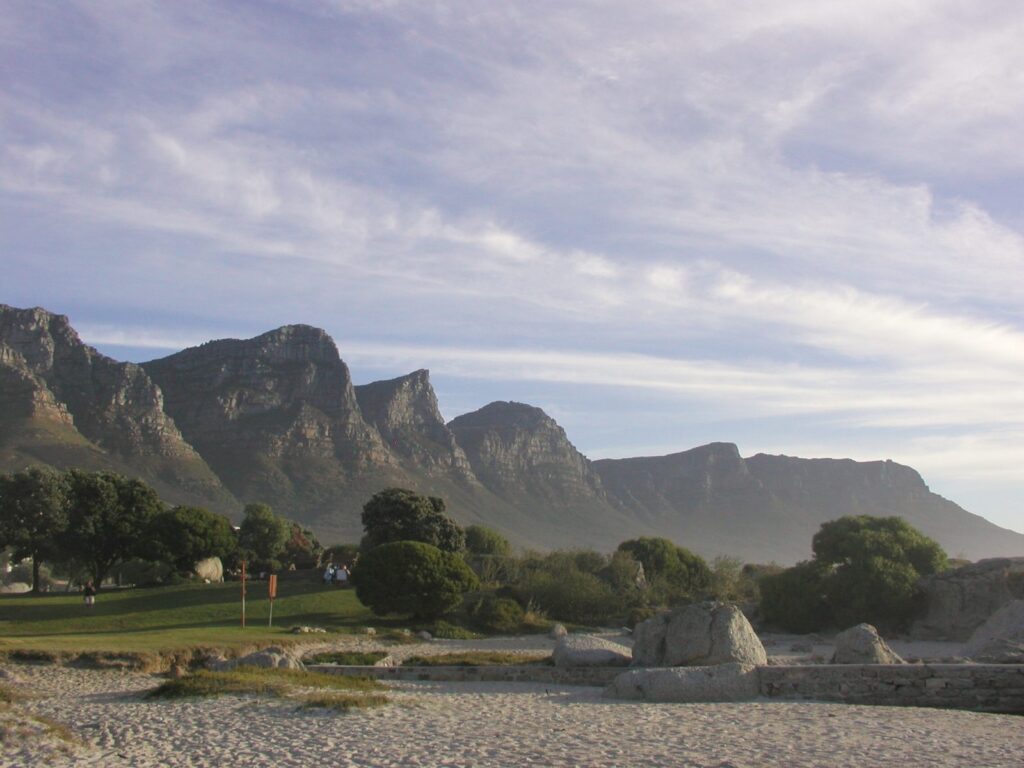
The reason to come is the geometry. Very few city beaches anywhere have a mountain range of this scale standing immediately behind them, and the Twelve Apostles — the run of buttresses along the western face of the Table Mountain chain — hold the last light long after the beach itself has gone into shadow. Late afternoon is when the place makes sense.
The second reason is that it is easy. You can be on the sand twenty minutes after leaving the city centre, the promenade is flat and walkable, and everything you might want — coffee, a swim, a meal, a sunset — sits within one block of the beach.
The beach itself
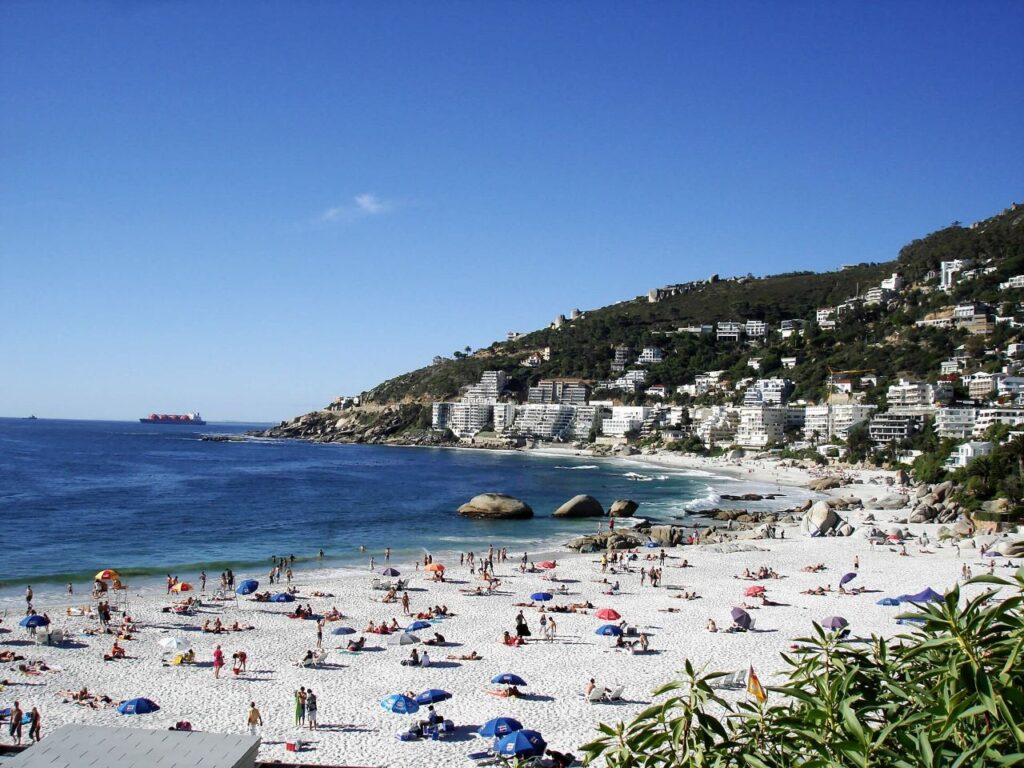
Camps Bay beach is wide, pale and backed by a grass verge, a low wall and a line of palms. Granite boulders break the sand into sections, which is useful — they give you something to sit against and they cut the wind at ground level. There are usually lifeguards on duty in season, and the beach has repeatedly held Blue Flag status, including for the 2025/26 season. Blue Flag is awarded annually and is worth checking rather than assuming.
The water is cold. This is the Atlantic side of the peninsula, where the Benguela system brings up deep, cold water along the coast, and no amount of sunshine changes it. Expect to gasp. Most people go in to their knees and come out again, and that is the normal way to use this beach. If you want to actually swim, the False Bay side at Muizenberg or Fish Hoek is markedly warmer.
There is also no meaningful shade and there is surf. Do not treat Camps Bay as a safe paddling pool for small children: it is an open ocean beach with shore break and rip currents, and swimming outside the flagged and patrolled area is a bad idea. If lifeguards are not on duty, treat the water as unpatrolled.
The wind, and how to plan around it
Cape Town’s summer wind is the south-easter, and it is the single biggest variable in a Camps Bay day. On a strong south-easter afternoon the beach can be genuinely unpleasant — sand in everything, umbrellas inverted, the sea whipped white. On a still day it is close to perfect. The wind is usually strongest from late morning into the afternoon and often drops in the evening.
Two practical responses. First, check the forecast the morning of, not the week before; Cape Town wind forecasts are reasonably reliable a day out. Second, keep a False Bay alternative in your back pocket — when the south-easter is blowing hard on the Atlantic side, the sheltered corners of False Bay are often calm, and the reverse is true in winter when the north-wester comes through.
Camps Bay or Clifton?
They are two minutes apart and they are not the same experience.
- Clifton is four separate coves separated by granite outcrops, reached down long flights of steps. Those outcrops make Clifton noticeably more sheltered when the south-easter is up, which is why locals go there on windy days. The trade-off is the stairs, almost no parking, and nothing much at beach level — no restaurant strip, limited facilities.
- Camps Bay is one long open beach with the road, the restaurants and the promenade right there. Easier with a pram, a cooler box or limited mobility; more exposed when it blows.
- In short — windy day, go to Clifton. Still day or sunset drinks, stay at Camps Bay.
Eating and the evening
Victoria Road along the beachfront is a single strip of restaurants, bars and hotel terraces, almost all of them angled at the sunset. It is the most concentrated sundowner scene in Cape Town and it is priced accordingly. Bookings are worth making for anything between about 18:00 and 20:00 in summer, particularly for a table with a sea view.
If you want the view without the bill, buy something to take away and sit on the grass verge or the sand. Plenty of people do exactly that, and the sunset is identical.
Getting to Camps Bay and parking
By car — from the city centre the direct route is up Kloof Nek Road and over the saddle between Table Mountain and Lion’s Head, then down Camps Bay Drive. The scenic alternative runs along the coast through Sea Point, Bantry Bay and Clifton on Victoria Road. Both take roughly fifteen to twenty-five minutes depending on traffic.
Parking is the weak point. There is street parking along Victoria Road and in the side streets, and in high summer and over the December holidays it fills completely. Arriving mid-afternoon on a hot Saturday and expecting a space near the beach is optimistic. Come earlier, or park several streets back and walk down. Informal parking attendants operate along the strip; a small tip is customary.
By bus — MyCiTi routes 106 and 107 connect Camps Bay with the Civic Centre station in the city centre. Timetables change, so check the current schedule on the MyCiTi site before relying on a late return.
Walking and running — the beachfront promenade is flat and pleasant. It does not connect all the way to the Sea Point promenade; the coastal road between them has narrow pavements in places.
Does Camps Bay work as a base?
It works well if your trip is centred on the mountain and the Atlantic coast, if you are happy to drive, and if you want to end most days with the sea in front of you. You are close to the Table Mountain lower cableway station, close to Lion’s Head, and positioned at the top of the Atlantic coast road that runs south to Hout Bay and Chapman’s Peak.
It works less well if you want to walk to restaurants and bars other than the strip, if you are travelling without a car, or if most of your itinerary is on the False Bay side or in the Cape Winelands. It is also one of the more expensive parts of the city to sleep in, and in mid-summer the combination of traffic and parking makes coming and going a chore. Many visitors get the best of it by staying elsewhere and coming here for one late afternoon.
Where to stay in Camps Bay
Accommodation here is mostly self-catering apartments and villas on the slopes behind the beach, plus a small number of hotels and guesthouses on or just off Victoria Road. Two things are worth knowing before you book. Addresses on the upper slopes have better views and worse walkability — the hill is steep. And a road-facing room on Victoria Road will hear the strip until late on summer nights, so ask about aspect if you are a light sleeper.
Find accommodation around Camps Bay
Camps Bay fills over the December holidays and rates move a long way between seasons. Compare what is available before you fix your dates.
Browse places to stay in Camps BayAffiliate link. We may earn a commission if you book through it, at no additional cost to you. See our affiliate disclosure.
Nearby, and what to do next
- Cape Town beaches — how Camps Bay compares with the city’s other beaches.
- Table Mountain — the lower cableway station is about ten minutes away by car, and the Twelve Apostles you are looking at are the same range.
- Hout Bay — roughly twenty minutes south along the coast road, with a working harbour, a beach and the start of Chapman’s Peak Drive.
- Clifton — four sheltered coves immediately north, better on a windy day.
- Sea Point — the long promenade, tidal pools and a much wider range of restaurants, about ten minutes north.
- City Bowl — museums, Company’s Garden and the historic centre, fifteen minutes over Kloof Nek.
- Atlantic Seaboard overview — how the whole coast from Green Point to Llandudno fits together.
Fitting Camps Bay into an itinerary
Camps Bay is an afternoon, not a day. The pattern that works best is to spend the morning on Table Mountain or in the city, come over the nek in the afternoon, walk the beach, and stay for sunset. If you are driving the peninsula, Camps Bay is the natural first stop heading south before Hout Bay and Chapman’s Peak. Our 5-day Cape Town itinerary and the self-drive guide both use it that way.
Practical notes
- Valuables — do not leave anything visible in a parked car anywhere on the Atlantic Seaboard. This is ordinary city practice, not a Camps Bay-specific warning.
- Sun — there is no shade on the sand and the UV index is high. Bring cover.
- Cash — parking attendants and some beach vendors prefer small notes or coins.
- Winter — May to August is quiet, often clear and cold, and the strip stays open. A winter walk here with the mountains dusted in cloud is one of the better free things to do in Cape Town.
- Sea safety — swim between the flags, and only when lifeguards are on duty.
Official sources
- City of Cape Town — beaches, lifeguard seasons, Blue Flag status and coastal by-laws.
- Cape Town Tourism — current destination information for the city and its beaches.
- MyCiTi — current bus routes, stops and timetables.
- SANParks — Table Mountain National Park — the protected area behind the suburb.
Where to stay, and what to book
Our Camps Bay & Oudekraal accommodation page carries a short orientation to the area and a live availability map.