

Cape West Coast
Paternoster, Langebaan and the Cederberg — fishing villages, a vast lagoon, ancient rock art and the spring wildflower season.
Hero image: Fishing Village, Paternoster, Western Cape, South Africa (20511984221).jpg by South African Tourism, CC BY 2.0, via Wikimedia Commons.
The Cape West Coast runs north from Cape Town along a cold, wind-scoured Atlantic shoreline into increasingly dry country. It is the quietest of the province’s coastal regions and the one that changes most dramatically with the season: for a few weeks in late winter and early spring the semi-desert inland of the coast produces one of the world’s great wildflower displays.
The coast itself is defined by whitewashed fishing villages, the enormous Langebaan Lagoon, and a food culture built around crayfish, mussels and open-air beach restaurants. Inland, the Cederberg mountains offer rock formations, San rock art and some of the darkest night skies in South Africa.
Cape West Coast at a glance
- Main towns
- Langebaan, Paternoster, Saldanha, St Helena Bay, Darling, Clanwilliam, Citrusdal, Lambert’s Bay
- From Cape Town
- About 1 hour to Langebaan; 1.5 hours to Paternoster; 2.5–3 hours to Clanwilliam
- Suggested stay
- Two nights on the coast; add two or three for the Cederberg
- Best time
- August and September for wildflowers; summer for beaches, though the wind is strong
- Landscape
- Atlantic beaches, Langebaan Lagoon, strandveld, sandstone mountains, citrus valleys
- Signature routes
- The N7 north, the R27 coastal road, and the Cederberg gravel roads
In this Cape West Coast guide
Why visit the Cape West Coast
Our West Coast destination guides: Langebaan for the lagoon, the West Coast National Park and the Postberg flower season, and Paternoster for the fishing village, Cape Columbine and the best eating on this coast. Inland, Clanwilliam covers the rooibos district and the N7, and the Cederberg covers the mountain wilderness behind it. Coast and mountains pair naturally into a four- or five-night loop north from Cape Town.
Three distinct draws. West Coast National Park and Langebaan Lagoon form a large protected wetland of real ornithological importance and unusual turquoise water. Paternoster and the smaller fishing villages give a strong sense of place with very little development. And the Cederberg is a genuine mountain wilderness within three hours of a major city, with rock art that is thousands of years old.

Main towns and places
Langebaan and West Coast National Park
Langebaan sits on a lagoon so sheltered and shallow that the water is a startling blue-green. The adjoining West Coast National Park, managed by SANParks, protects the lagoon, salt marshes and strandveld, and includes the Postberg section, which opens to the public only during the flower season. It is a major site for migratory waders.
Paternoster
The best-known of the fishing villages: flat-roofed whitewashed cottages above a long beach, a working fishing fleet, and a disproportionate number of good restaurants. It has become popular and can be busy in season, but the village form has largely been protected.
Darling
Inland on the R315, a small farming town known for its spring flower reserves and a long-standing theatre tradition. A common first or last stop on a flower-season loop.
Clanwilliam and the Cederberg
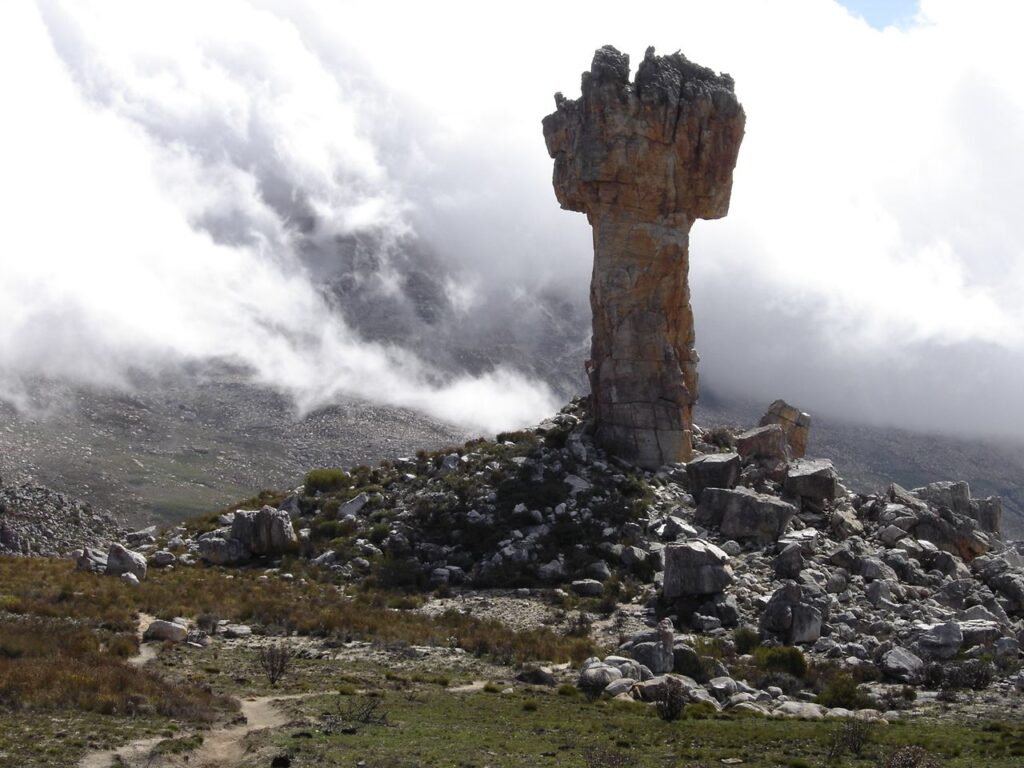
Clanwilliam, on the Olifants River, is the base town for the Cederberg Wilderness Area, managed by CapeNature. This is the northern interior of the region rather than the coast — sandstone mountains, cedar trees, more than 2,500 San and Khoi rock art sites, and Rocklands, an internationally known bouldering area. Roads inside the range are gravel and some require high clearance.
Access is restricted in 2026. A wildfire in December 2025 and floods in May 2026 have left Areas B and C of the wilderness closed until further notice, with the Algeria campsite, the Uitkyk Pass and the direct Clanwilliam to Algeria road all closed. The Wolfberg routes and the Maltese Cross cannot be confirmed as reopened. Read the Cederberg guide for the current position before planning.
Lambert’s Bay and the northern coast
Further north, Lambert’s Bay has a large Cape gannet breeding colony on Bird Island, reached by a short causeway. Beyond that the coast runs on towards the Olifants River mouth and the Namaqua border.
The wildflower season
The flowers are the region’s headline event, typically concentrated in August and September, and driven by the previous winter’s rainfall. Timing and intensity vary considerably from year to year, and there is no way to guarantee a good display in advance. Flowers open in response to sunlight, so a bright day in the middle of the day is best, and they tend to face the sun — which affects the direction you drive.
Getting there and around
The R27 runs up the coast from Cape Town to Langebaan and Saldanha; the N7 runs inland towards Citrusdal, Clanwilliam and eventually Namibia. Both are good tarred roads. Cederberg access roads are gravel and can be rough; a higher-clearance vehicle is helpful, though not always essential for the main routes. Distances between fuel stops grow noticeably north of Clanwilliam.
The region is strongly wind-affected. The south-easter blows hard in summer and the coast is genuinely cold for swimming year-round — this is Benguela current water. See the self-drive guide for gravel-road and remote-route advice.
Best time to visit
August and September for flowers, accepting the crowds that come with them. Summer for beach weather, though expect strong wind and cold water. Autumn and late spring are pleasant and quiet. The Cederberg is best in spring and autumn; midsummer is very hot and midwinter can bring snow on the high ground.
Destination guides on the Cape West Coast
- Western Cape wildflower season — when the season runs, why some years are far better than others, and where to go.
- Langebaan — the lagoon, West Coast National Park and the Postberg flower season.
- Paternoster — the fishing village, Cape Columbine and the best food on the coast.
- Clanwilliam — rooibos country on the N7, the flower season and the gateway to the mountains.
- The Cederberg — wilderness, rock art and bouldering, with current fire and flood closures explained.
Nearby regions
Read next
- Best time to visit the Western Cape — the West Coast flower window, the wind, and the Cederberg’s different clock.
Official sources for the Cape West Coast
Opening hours, entry fees, permit rules, park closures and seasonal access all change, and we do not republish them here as fixed facts. Before you travel, check the operators and conservation authorities directly:
- West Coast National Park (SANParks) — park access and the annual wildflower season.
- CapeNature — Cederberg Wilderness Area and Rocherpan.
Plan a West Coast trip
Combine the coast with the Cederberg, or time a trip around the flower season.
Where to stay, and what to book
Our Cape West Coast Accommodation accommodation page carries a short orientation to the area and a live availability map.