

Hero image: Photo: Chris Parker from South Ealing, UK / Wikimedia Commons, CC BY-SA 2.0
Mossel Bay has an image problem. It is the first Garden Route town you reach from Cape Town, it has a working harbour and an industrial edge, and the standard itinerary treats it as a place to refuel before the good bit starts. That reading is wrong on the facts, and it has been wrong since 2024 in a way most guidebooks have not caught up with.
The Pinnacle Point Site Complex on the headland here is an inscribed component of a UNESCO World Heritage property — “The Emergence of Modern Human Behaviour: The Pleistocene Occupation Sites of South Africa”, inscribed in 2024. The caves record human occupation from roughly 170,000 to 40,000 years ago, with systematic shellfish exploitation, heat-treated stone tools and ground ochre. This is one of the most important places on earth for understanding what made us modern, and it is about four and a half hours from Cape Town on a good road.
Where to stay in Mossel Bay
Places to stay at the western end of the Garden Route, on and above the bay.
Places to stay
Protea Hotel by Marriott Mossel Bay
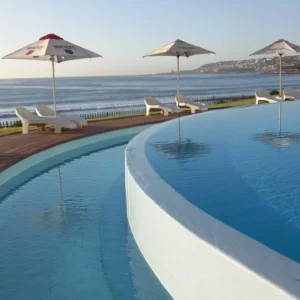
A thirty-eight room hotel in an 1846 landmark above Santos Bay in Mossel Bay, with a pool deck and the…
View Property DetailsDiaz Ocean View Hotel & Spa, Mossel Bay
A four-star hotel above Diaz Beach in Mossel Bay with sea-facing rooms, a heated indoor pool, a spa and direct…
View Property DetailsDiaz Hotel and Resort, Mossel Bay
A beachfront resort on Diaz Beach at Mossel Bay with ocean-facing balconies in every room, a pool terrace and self-catering…
View Property Details


In this guide
- Mossel Bay in brief
- Pinnacle Point and the origins of us
- The Dias museum complex
- The Post Office Tree
- The lighthouse and the cliff trail
- Beaches and the bay
- Marine wildlife, stated carefully
- The harbour, and the town
- How to spend a day in Mossel Bay
- Eating in Mossel Bay
- When to come
- Where to stay in Mossel Bay
- Mossel Bay, George and the Cape Town approach
- Nearby, and what to do next
- Practical notes
- Official sources
Mossel Bay in brief
- What it is — a working port and holiday town on a large sheltered bay, at the western end of the Garden Route.
- Known for — the Dias museum complex, the Cape St Blaize lighthouse and cliff trail, Blue Flag beaches, and the Pinnacle Point archaeology.
- Best for — history and swimming. The bay faces east and is more sheltered than anywhere further along the route.
- Time needed — a night, or a long half-day if you are passing. Two if you want the Point of Human Origins tour.
- The catch — this is a real town with a real port, not a resort. Some of it is industrial and it does not apologise for that.
The official tourism body calls it the gateway to the Garden Route, and geographically that is the western end. The Western Cape Provincial Treasury records a population of 140,075 at the 2022 census, the second largest in the Garden Route after George, with tourism accounting for about 16 per cent of local GDP and peaking hard in school holidays.
Pinnacle Point and the origins of us
The caves at Pinnacle Point are not a casual attraction and cannot be visited on a whim. Access is by guided tour, by appointment only — the official position is that the sites are not open to the public without a guide. Getting down involves roughly two hundred stairs in each direction on steep wooden stairways and boardwalks, and reasonable fitness is required. Book through the Point of Human Origins experience.
What is down there justifies the stairs. There are 54 heritage sites on the headland, including caves and open shell middens; Cave 13B is the most significant, with Caves 5 and 6 under continuing research covering roughly 90,000 to 50,000 years ago. The wider story is about the Palaeo-Agulhas Plain — the now-drowned coastal shelf that people lived on when sea levels were lower. Pinnacle Point was declared a Western Cape provincial heritage site in 2012 and inscribed by UNESCO in 2024.
Cape St Blaize Cave, by contrast, is free and takes ten minutes. It sits below the lighthouse, easily reached from the Point car park, with interpretive boards on site, and it was the location of some of South Africa’s first Middle Stone Age excavations. If the guided tour does not fit your trip, this is the accessible version of the same story.
The Dias museum complex
The Bartolomeu Dias Museum Complex opened in 1989 and is run by the Western Cape Government’s Department of Cultural Affairs and Sport. It is not one museum but a walled precinct: the Granary as reception, the Maritime Museum, the Shell Museum and aquarium, the Post Office Tree, a chapel, a padrão, a reconstructed freshwater spring, an ethno-botanical garden, the Munro’s Hoek cottages and a Muslim burial site.
One important caveat: the caravel replica cannot currently be boarded. The museum’s own notice says it is temporarily closed for boarding until further notice for safety reasons, though it can still be viewed from outside. Local tourism material still invites visitors to explore it; the museum’s own notice is the one to believe. The ship itself is a full-scale replica of Dias’s 1488 caravel, built near Oporto and sailed to Mossel Bay over three months in 1988, then partly disassembled and lifted into the museum building through an opening in the rear wall.
Published hours are Monday to Friday 09:00 to 16:45 and weekends and public holidays 09:00 to 15:45, with admission R30 for adults and R20 for students and pensioners who are South African citizens. Note that the provincial government’s own facility page still carries a 2023 closure notice that the museum’s site contradicts — phone 044 691 1067 before travelling.
The Post Office Tree
The story is genuinely good and worth telling accurately. In 1500 Pedro d’Ataíde, separated from Cabral’s fleet, put in here and left a letter in a sailor’s shoe tied to a milkwood tree. It was found in July 1501 by the captain of the fourth Portuguese fleet, who left a stone inscription in return. The boot-shaped postbox beside the tree was placed by the local tourism organisation in 1963, and mail posted there still gets a commemorative frank.
The museum states the tree is a declared provincial heritage site. We have not been able to confirm the declaration date or gazette reference — the national heritage register was unreachable throughout our checks — so we are reporting the operator’s wording rather than upgrading it. You will also see it called South Africa’s first post office; the museum frames the franking as commemorating that idea, which is a weaker and more honest claim.
The lighthouse and the cliff trail

Cape St Blaize lighthouse was commissioned in 1864 and is operated by Transnet National Ports Authority. TNPA publishes visiting hours of Monday to Friday 10:00 to 15:00, says visitors may climb the tower, and asks that you call 044 690 3015 ahead. There is a self-catering cottage on the property. TNPA does not publish an entry fee, and one point is worth flagging: a private restaurant at the site sells a “Lighthouse Experience” at R100 including a drink. That is a commercial package, not the official admission.
The St Blaize Trail runs 13.5 km along the cliffs between the lighthouse and Dana Bay, following roughly the 30-metre contour, and takes about six hours in either direction. It is graded moderate and the official safety advice is specific: do not hike alone, carry water because there is none on the trail, wear proper shoes, watch for puff adders basking on the path, and be aware the route crosses the Pinnacle Point golf course where flying balls are a real hazard. Cell reception is not guaranteed and the exits are a long way from roads. Arrange transport at the far end before you start.
Beaches and the bay
Mossel Bay faces east into a large sheltered bay, which makes the swimming here calmer than anywhere else on the Garden Route. In the 2025/26 season, WESSA awarded full Blue Flag status to four beaches — De Bakke, Hartenbos, Klein Brak and Glentana — with Santos, Suiderkruis and Tweekuilen holding pilot status rather than full Blue Flag. That distinction matters: Santos is the main town beach and is very widely described elsewhere as a Blue Flag beach, which for that season it was not. Blue Flag runs season by season and the 2026/27 list has not yet been announced, so treat the list as historic rather than current.
Marine wildlife, stated carefully
Mossel Bay sells boat trips, seal viewing and white shark cage diving, and it is worth being precise about what is actually established rather than marketed.
Boat-based whale watching and white shark cage diving are both licensed activities here under national permit — the Department of Forestry, Fisheries and the Environment names Mossel Bay alongside Gansbaai as a town structurally shaped by the cage-diving industry. Along the South African south coast broadly, southern right and humpback whales occur roughly between June and December, and bottlenose, humpback and common dolphins are present. There is a Cape fur seal colony on Seal Island, which is a designated marine and coastal protected area.
What no official source publishes is any sighting probability, success rate or seasonal certainty for Mossel Bay specifically. We are not going to supply one. The whale season figures above are regional rather than local, and the year-round Bryde’s whale population that gets attributed to this coast is documented at Knysna and Plettenberg Bay, not here. Great white numbers at Mossel Bay are genuinely contested and no official source quantifies them — understate rather than overstate, and be sceptical of any operator who does otherwise.
The one hard rule worth knowing: under the boat-based whale watching regulations gazetted in 2008, non-permitted people and vessels may not approach a whale closer than 300 metres, and must withdraw to that distance if a whale surfaces nearer. Only permit holders may go closer. Book a permitted operator.
The harbour, and the town
Mossel Bay is a working port — petroleum products through offshore mooring points, five fishing quays, an offshore supply base and a ship-repair slipway. That is not scenery, and it is part of why the town has a different texture from Knysna or Plett. It also means the harbour area is genuinely interesting rather than merely decorative, and the food here leans hard on what comes off the boats.
There is no current official notice on water quality or swimming. A mass fish mortality in the Hartenbos Estuary in January 2026 was initially reported as a sewage discharge; the municipality subsequently stated it resulted from natural ecological conditions — oxygen depletion in a closed estuary during hot weather — and not from pollution or infrastructure failure. The mouth was breached to restore oxygen and no swimming advisory was issued. It is seven months old and resolved.
How to spend a day in Mossel Bay
If you have one day here and no guided tour booked, the town centre does the work. Start at the Dias museum complex when it opens — the Maritime Museum, the Post Office Tree and the Granary sit inside one walled precinct, and an hour and a half covers them properly. Walk out to the Point afterwards; it is close enough that Mossel Bay does not require you to move the car.
At the Point, the Cape St Blaize lighthouse is open on weekdays and Cape St Blaize Cave sits below it, free and signposted, with interpretive boards explaining what was excavated there. That combination — a working nineteenth-century lighthouse above a Middle Stone Age occupation site — is the most Mossel Bay thing there is, and it takes under an hour.
Give the afternoon to either the water or the cliffs. Swim at De Bakke or Santos, both a short walk from the centre and both far more sheltered than anything east of here, or walk the first section of the St Blaize Trail out along the cliff top and turn back when you have had enough — you do not have to commit to all 13.5 km. If you would rather be on the water, the harbour runs boat trips out towards Seal Island.
With two days, add the guided Point of Human Origins tour at Pinnacle Point, which needs booking ahead and is the single most remarkable thing in the area. With half a day, do the museum and the lighthouse and drive on — Mossel Bay rewards a short visit better than most towns because everything worth seeing sits within a few hundred metres of everything else.
Eating in Mossel Bay
Mossel Bay eats better than its reputation, and for a straightforward reason: this is a working fishing port, not a resort that has fish trucked in. Five fishing quays operate out of the harbour, and the restaurants along the Point and around the harbour edge are supplied from a few hundred metres away. Line fish, calamari and mussels are the things to order, and the town takes its name from the mussels for good reason.
The oyster question is worth settling. You will be offered oysters all along this coast, and those served in Mossel Bay are generally cultivated Pacific oysters grown at Saldanha Bay or Gqeberha rather than harvested locally — the same is true in Knysna, where the myth of estuary farming is even more entrenched. That is not a reason to avoid them; it is a reason not to pay a premium for a provenance story.
Practically, the Point and the harbour are where most visitors eat, and the setting does much of the work — several places look straight out over the bay towards the lighthouse. The older streets above the town hold the less obvious places and the better value. Mossel Bay is a real town of 140,000 people rather than a holiday strip, so it has ordinary supermarkets, ordinary bakeries and ordinary prices, which is a genuine advantage over the eastern Garden Route in December.
One seasonal note: tourism here peaks hard in South African school holidays, and restaurants at the Point book out over Christmas and New Year in a way they do not at any other time of year. Outside those weeks you can generally walk in.
When to come
Mossel Bay is drier and sunnier than the eastern Garden Route — it sits at the transition between the winter-rainfall Cape and the all-year rainfall of the forest belt, which is why the vegetation changes so visibly as you drive east. February to April is the best combination of warm sea and light crowds. December and early January are packed and priced accordingly; the Provincial Treasury’s own profile notes how sharply tourism here peaks in school holidays.
Water restrictions were imposed in January 2026 and lifted in May 2026 after heavy Garden Route rainfall. The Wolwedans Dam has been at or above 100 per cent through August 2026 and the municipality currently lists no restrictions.
Where to stay in Mossel Bay
Check availability in Mossel Bay
Mossel Bay runs from beachfront hotels at Santos and The Point to guesthouses above the bay and self-catering along the Hartenbos and Klein Brak stretch. It is generally better value than the towns further east for the same standard.
See Mossel Bay stays on Booking.comAffiliate link. We may earn a commission if you book through it, at no additional cost to you. See our affiliate disclosure.
Mossel Bay has a wide spread — beachfront hotels at Santos and The Point, guesthouses in the older streets above the bay, self-catering along the Hartenbos and Klein Brak stretch, and private game lodges in the hinterland at Botlierskop and Gondwana that are booked experiences rather than public reserves. It is generally better value than Knysna or Plett for the same standard, which is the practical argument for basing here and driving east.
Mossel Bay, George and the Cape Town approach
Coming from Cape Town, Mossel Bay is where the Garden Route actually starts: routing gives about 390 km and four and a half hours free-flow on the N2, which realistically means five and a half to six with a stop. That makes it the natural first night for anyone driving from Cape Town rather than flying — arriving here tired at dusk is a great deal better than pushing on to Knysna in the dark.
Eastward, George is about 52 km and forty minutes, with Great Brak River and its estuary roughly twenty minutes along the way. Wilderness is an hour, Knysna about an hour and a half. All free-flow figures with no stops.
Nearby, and what to do next
- 10 days: Cape Town and the Garden Route — why Mossel Bay is worth a night on the drive east.
- Garden Route with kids — why Mossel Bay is worth a night when you are driving with children.
- Cape Town to the Garden Route — the drive from Cape Town, and where Mossel Bay sits on it.
- Where to stay on the Garden Route — choosing between Mossel Bay, George, Wilderness, Knysna, Plettenberg Bay and Oudtshoorn.
- George — forty minutes east, for the airport and the passes inland.
- Great Brak River — a historic village and estuary between the two, with a small local-history museum.
- Wilderness — an hour east, for the lakes and the lagoon.
- Swellendam — two hours west on the N2, and the obvious break if you are heading back towards Cape Town the inland way.
- Dana Bay — the far end of the St Blaize Trail, and a quieter beach than the town ones.
Planning the wider trip: our Garden Route itinerary starts from this end of the route, Self-Drive Western Cape covers the N2 drive from Cape Town, Where to Stay in the Western Cape covers accommodation, and Things to Do covers the wider province.
Practical notes
- The caravel cannot be boarded — view it from outside, and phone the museum on 044 691 1067 before planning around it.
- Pinnacle Point is guided only — book ahead, and be ready for about 200 stairs each way.
- The lighthouse R100 is a restaurant package, not the official admission. TNPA publishes Mon–Fri 10:00–15:00; call 044 690 3015.
- The St Blaize Trail is committing — 13.5 km, no water, exits far from roads, and it crosses a golf course.
- No sighting guarantees — book permitted marine operators and treat promises as a warning sign.
Official sources
- Mossel Bay Municipality — urgent notices, water and beach information.
- Bartolomeu Dias Museum Complex — hours, admission and current closures.
- UNESCO World Heritage Centre — the Pleistocene Occupation Sites inscription.
- WESSA — Blue Flag beach awards.
- Department of Forestry, Fisheries and the Environment — marine permits and regulations.
Where to stay, and what to book
Our Mossel Bay accommodation page carries a short orientation to the area and a live availability map. For experiences, see Marine & Wildlife Experiences.