
The Garden Route is one of the easier long trips to do with children: the distances between towns are short, the road is good, and almost every stop has a beach, a lagoon or a forest attached to it. What it is not is automatic. Doing the Garden Route with kids well is mostly a question of where you sleep, how often you move, and how much you try to fit into a day.
This guide covers the bases that work for families, how to pace the trip realistically, and the safety points that matter more with children than without them.

In this guide
The short answer
For most families, Plettenberg Bay and Knysna are the two strongest bases, and a week split between them covers the Garden Route comfortably without repacking every night. Wilderness is the quieter, more nature-led alternative with an important beach caveat. Mossel Bay earns a night if you are driving from Cape Town and do not want to arrive exhausted. Oudtshoorn is an inland extension rather than part of the coast.
How many bases?
This is the decision that quietly determines whether the trip is enjoyable. Changing accommodation is the most expensive thing you can do with a family day — it costs a morning to pack and check out and an afternoon to unpack and find your feet, and small children handle it worse than adults expect.
- One week: two bases. Knysna and Plett, or Wilderness and Plett. That is one move in seven days.
- Ten days: three at most, and only if one of them is Oudtshoorn.
- Four or five days: one base. Knysna or Plett, and day-trip from it. Everything on the central Garden Route is within an hour.
The towns are close enough that a single base genuinely works: Knysna to Plett is half an hour, Wilderness to Knysna about forty-five minutes. You are not choosing which places to see — you are choosing where to unpack.
Mossel Bay
Mossel Bay is the first Garden Route town you reach from Cape Town, and the standard itinerary drives past it. With children, that is worth reconsidering for one reason above all: it breaks the drive. Cape Town to Knysna is around six hours before stops, which with a family means considerably more. Mossel Bay is roughly two-thirds of the way, and arriving somewhere at four in the afternoon rather than eight at night changes the tone of the whole first day.
It also has more to it than its reputation suggests. It has a working harbour, sheltered swimming compared with the open surf further east, and the Pinnacle Point caves on the headland are an inscribed component of a UNESCO World Heritage property — “The Emergence of Modern Human Behaviour: The Pleistocene Occupation Sites of South Africa”, inscribed in 2024, recording human occupation from roughly 170,000 to 40,000 years ago. Older children who have done anything on early humans at school find that genuinely interesting; access arrangements are managed and should be checked in advance rather than assumed.
Best for: the first or last night of a Cape Town round trip. Not: the base for the week.
Wilderness
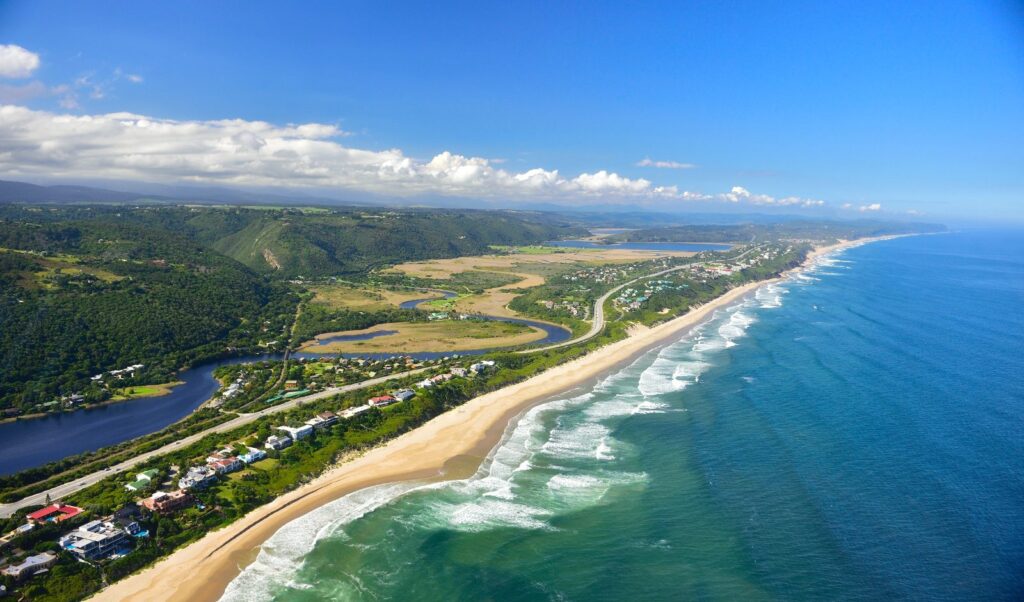
Wilderness is the calmest of the bases and the most nature-led. The village sits in the narrow gap between the Outeniqua foothills and the sea, wrapped around a river lagoon and backed by a chain of estuarine lakes that SANParks manages as part of the Garden Route National Park. For families that means flat-water paddling, short forest trails and a lagoon rather than a town.
The beach at Wilderness — read this before you go
Wilderness beach is long, open and beautiful, and it is not a casual swimming beach. George Municipality has no lifeguards on any of its beaches from 7 April 2026 until 30 November 2026, a notice that names Wilderness Main Beach, Wilderness Lagoon, the Steps and Leentjiesklip specifically. Cover resumes in December, with the fullest hours from mid-December to the end of February. The municipality states that eighty per cent of lifeguard rescues at ocean beaches are caused by rip currents, and the NSRI has run rip-current demonstrations at Wilderness itself. Outside the lifeguarded window, treat the ocean here as a beach to walk on, not one to let children swim at. The lagoon is the calmer option, and even there supervision is the point.
Best for: families with young children who want quiet, water that is not surf, and short walks. Not: families who want a town with things going on, or who are counting on ocean swimming outside summer.
Knysna
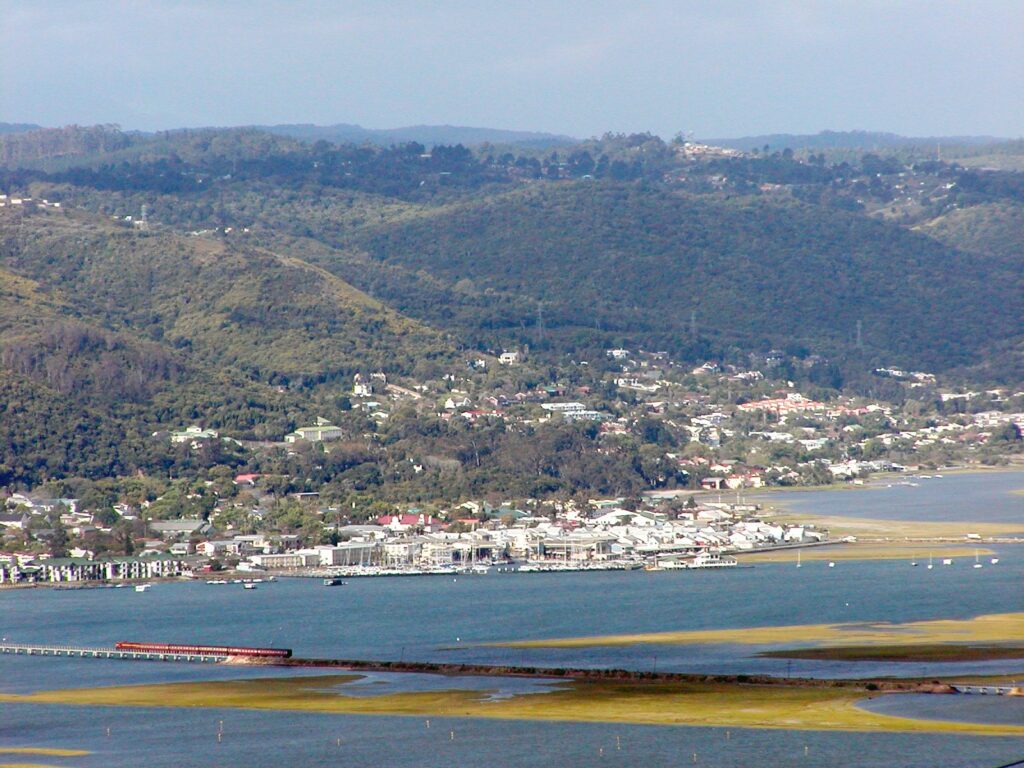
Knysna is the anchor of the Garden Route and, for families, the most useful single base. It sits roughly in the middle of the region, half an hour west of Plett and about forty-five minutes east of Wilderness, which means nothing on the central Garden Route is more than an hour away.
- The estuary. A large, almost enclosed tidal lagoon, which is to say sheltered water — boat trips, paddling and calm swimming spots, rather than surf.
- The Heads. The narrow gap between two sandstone cliffs where the estuary meets the sea. A viewpoint that takes ten minutes and impresses most children more than things that take two hours.
- The forests. Old-growth indigenous forest runs up the hills behind the town, with short marked walks as well as long ones. This is the easiest place on the route to do a forest walk that a six-year-old will actually finish.
- The practical stuff. The widest choice of restaurants, supermarkets, pharmacies and self-catering on the route. With children that matters more than it sounds.
Best for: the one-base week, mixed-age families, and anyone who wants a real town rather than a resort. Not: families whose priority is a long swimming beach outside the front door — Knysna faces inward onto the estuary, and the ocean beaches are a drive.
Plettenberg Bay
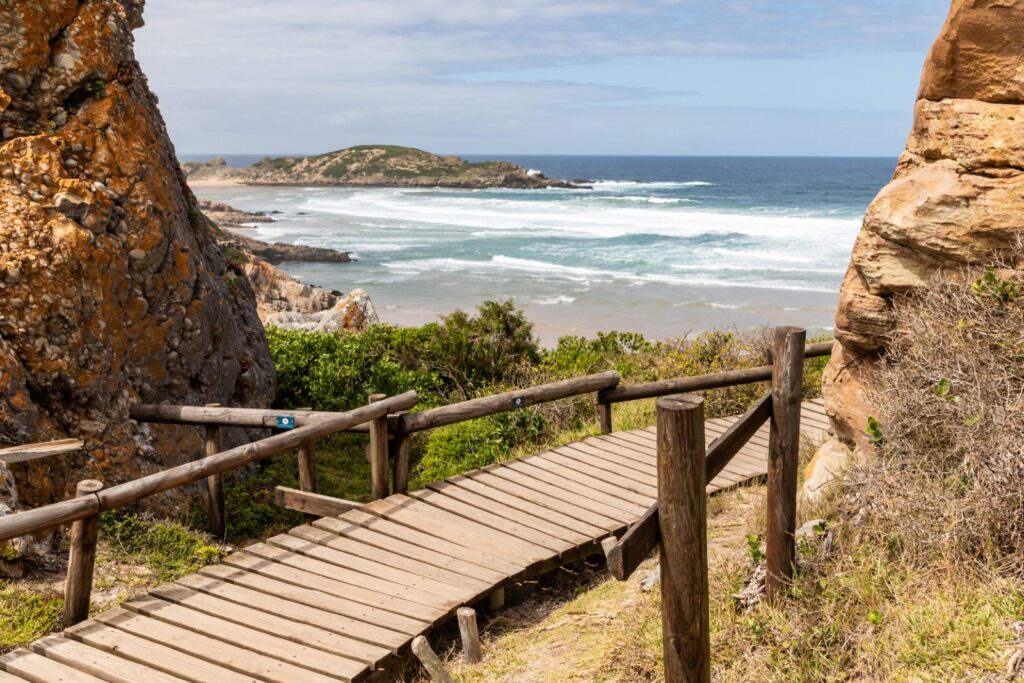
Plettenberg Bay is the beach town of the Garden Route, and for a lot of families it is the straightforward answer. A wide open bay, several kilometres of sand, water warm enough to swim in, and a rocky peninsula on the southern arm.
Plett has an unusual concentration of Blue Flag beaches. For the 2025/26 season WESSA, which runs the programme in South Africa, awarded full Blue Flag status to six beaches in the Bitou municipal area: Robberg V, The Dunes, The Waves, Singing Kettle, Nature’s Valley and Lookout Beach. Blue Flag is awarded season by season against water quality, safety, facilities and environmental management criteria, so treat that list as current rather than permanent, and check the season’s awards rather than assuming.
Robberg: not every route suits young children
Robberg Nature Reserve is the reason to prioritise Plett, and it has three circuits of very different difficulty. CapeNature publishes The Gap at 2.1 km and about thirty minutes — the easiest, and the one that works with small children. Witsand is 5.5 km and about two hours, moderate, along the northern ridge above the seal colony. The Point is 9.2 km and about four hours, strenuous, and CapeNature states explicitly that it is not suitable for young children. Do not let a family conversation about “doing Robberg” end without establishing which circuit is meant. A day conservation fee applies and CapeNature reviews its tariffs, so check current rates and gate times with the reserve.
Best for: beach-led family trips, and older children who can do a real coastal walk. Not: families who want forest and quiet more than sand and surf.
Oudtshoorn
Oudtshoorn sits inland over the Outeniqua mountains, in the Klein Karoo. It is a genuine change of scene — dry, hot in summer, and completely unlike the coast — and it is the usual add-on to a Garden Route trip rather than part of it.
The Cango Caves are the main draw. They were closed for much of 2026: flooding on 9 May 2026 caused rockfalls that made the access road impassable, the road reopened on 10 July 2026, and the caves held an official reopening on 24 July 2026. Checked 21 August 2026, they are open again — but the sequence is a reminder that access here depends on a mountain road, so confirm before committing a day to it.
Two tour types are usually offered, and the difference matters with children. Oudtshoorn Tourism describes a standard tour of about an hour through the larger chambers, rated easy, and a longer adventure tour covering more of the cave system, which requires a moderate level of fitness and is described as not suitable for anyone with claustrophobia or back problems. The longer route involves genuinely tight passages. Confirm current tour options, durations and any age or fitness restrictions directly with the caves before you arrive with a child who is expecting one and booked onto the other.
Oudtshoorn is also ostrich country, and this is where a family trip needs a little judgement. Farms in the area offer varying degrees of contact with the birds, and practices differ between operators. We are not going to endorse any particular animal experience here: if you are considering one, look at what the specific operator actually does with the animals rather than at the marketing, and be prepared to say no. Ostriches are large, fast and capable of injuring an adult, let alone a child.
Best for: a two-night inland extension, mainly for the caves and the change of landscape. Not: a Garden Route base — it is over a mountain pass from the coast, and the drive is not one to do repeatedly with children.
Realistic pacing
The rule this site applies to Cape Town applies just as well here, and it is the most useful thing on this page: a family day realistically holds one significant outing plus one small thing. Meals, naps, changing, and the drive back eat far more of the day than a map suggests.
- Driving. Keep single legs under about two hours where you can. Cape Town to the Garden Route is the exception and is best split — see Cape Town to the Garden Route for how.
- Beach time counts as the outing, not as filler. A half-day at a beach is a successful day with young children, and trying to add a forest walk to it usually is not.
- Weather. The Garden Route earns its name by raining. Any plan that assumes seven fine days will fail; have two indoor or low-effort options per base identified before you need them.
- Meals. Self-catering makes a family trip here dramatically easier, and the towns have good supermarkets. Restaurant dinners every night with small children is a different holiday.
- Ages. With a wide age spread, the pattern that works is one anchor activity everyone does, plus a split afternoon — rather than a compromise that suits nobody. A boat trip on the Knysna estuary and a beach afternoon will land better than one activity pitched at the middle.
- Do not stack activities. Two “must-dos” in a day is how a good trip becomes a tense one.
And none of this is a routine to be imposed. Families run differently, children differ enormously at the same age, and a plan that works for one will not survive contact with another. Use it as a check on an itinerary, not as a schedule.
Safety, honestly
Nothing here is meant to alarm anyone. These are the four things that most often catch families out on this stretch of coast.
- No beach is safe as an absolute. Lifeguard cover is seasonal and beach-specific, Blue Flag status is awarded season by season, and conditions change with the tide and the weather. Check what is lifeguarded, when, on the day — and treat an unguarded beach as a beach for walking.
- Rip currents are the actual risk, not sharks. George Municipality attributes eighty per cent of lifeguard rescues at its ocean beaches to rips. The standard advice if caught is to swim parallel to the shore rather than against the current, and to raise an arm rather than exhaust yourself.
- Match the walk to the child, not the reputation. Robberg’s Point circuit is four hours and CapeNature says outright it is unsuitable for young children; the Gap circuit is thirty minutes. Both are “Robberg”. The same applies to forest trails, which close after heavy rain.
- Wildlife is not a performance. Seals at Robberg, birds on the Wilderness lakes and whales offshore in season are all genuinely there and none of them is guaranteed on your day. Keep distance, keep to boardwalks and marked paths, and do not let a child approach an animal for a photograph.
This guide does not give medical advice and cannot. If anyone in your party has a condition that bears on swimming, heat, walking distance or confined spaces — the longer cave route in particular — that is a conversation for your own doctor before you travel, not for a travel page.
Which base suits your family
| If your priority is… | Consider… | Why |
|---|---|---|
| One base for the whole week | Knysna | Central, an hour from everything, and the best-equipped town on the route. |
| Beach days above all | Plettenberg Bay | A wide open bay, warm-enough water and an unusual concentration of Blue Flag beaches. |
| Young children and quiet | Wilderness | Lagoon, lakes and short trails — but read the lifeguard note before planning to swim in the sea. |
| Breaking the drive from Cape Town | Mossel Bay | Two-thirds of the way, sheltered water, and a first day that ends in daylight. |
| A real coastal walk with older children | Plettenberg Bay | Robberg, on the right circuit for their age and stamina. |
| Forest and boat trips | Knysna | Old-growth forest behind the town and sheltered estuary water in front of it. |
| A change of landscape | Oudtshoorn | The Klein Karoo and the Cango Caves, as a two-night extension rather than a base. |
| Ten days and mixed ages | Knysna + Plett, and one inland extension | Two moves in ten days, and a genuine change of scene in the middle. |
Editorial view. For a first Garden Route trip with children, we would base in Plettenberg Bay if the trip is about beaches and in Knysna if it is about everything else — and we would resist the urge to add a third base. The single biggest improvement most family itineraries here could make is not a better destination; it is one fewer move.
What to do next
- Where to stay on the Garden Route — read this next. It owns the accommodation decision, town by town, including how far ahead to book.
- Garden Route & Klein Karoo — the region as a whole.
- Garden Route itinerary: 7 days that actually work — a route to adapt rather than follow.
- Cape Town to the Garden Route — how to break the drive out here, which matters more with children.
- Knysna, Plettenberg Bay, Wilderness, Mossel Bay and Oudtshoorn — the destination guides for each base.
- Cape Town with kids — the other half of a family Cape trip.
Sources
- CapeNature — Robberg Nature Reserve — the three circuits, their distances, and the statement that the Point circuit is unsuitable for young children.
- SANParks — Garden Route National Park — the Wilderness lakes and forest sections, trails and closures.
- George Municipality — lifeguard seasons and beach safety for Wilderness and the George beaches.
- WESSA Blue Flag — the season-by-season beach awards.
- Oudtshoorn Tourism — Cango Caves — the two tour types and their stated fitness requirements.
- Western Cape Department of Infrastructure — the 2026 Cango Caves road closure and reopening.