
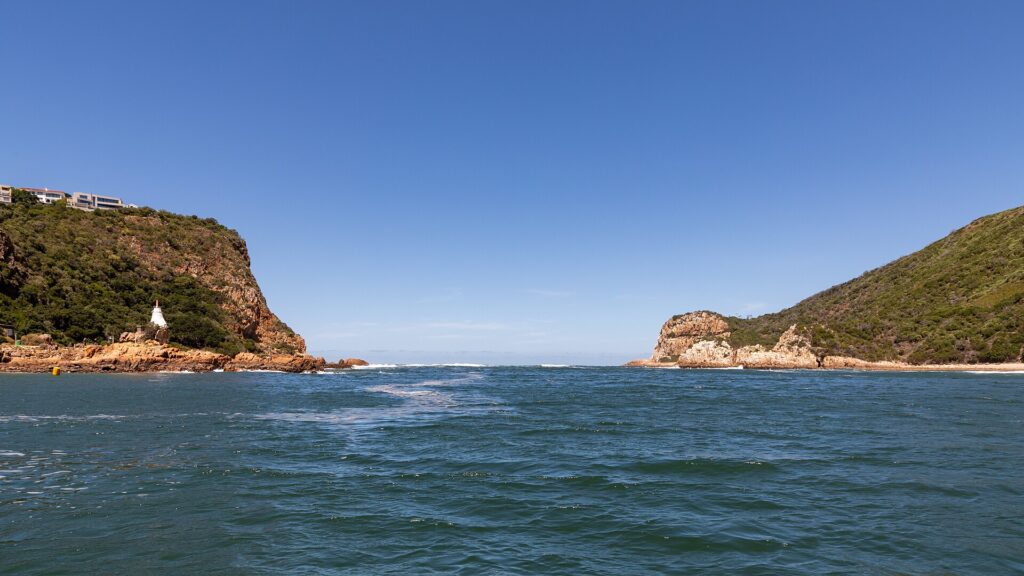
Hero image: Dietmar Rabich / Wikimedia Commons / “Knysna (ZA), Knysna River, East and West Head — 2024 — 2456” / CC BY-SA 4.0
Most published Garden Route plans move you every night. This 7 day Garden Route itinerary does the opposite: it uses two coastal bases and one inland night, so that the driving is short and you actually see the places rather than the N2 between them. It runs west to east, which is the usual direction from Cape Town, and it can be reversed without difficulty.
It assumes a hire car. There is no realistic public-transport version of this route, and the whole point of the Garden Route is the driving. If you take one thing from this Garden Route itinerary, take that: budget for the car before anything else.
In this guide
- Before you commit: what this route is not
- Driving distances, honestly
- The shape of this Garden Route itinerary
- Day 1 — arrive, and go no further than you have to
- Day 2 — Knysna: the water
- Day 3 — Knysna: the forest and the lakes
- Day 4 — over the mountains to Oudtshoorn
- Day 5 — the Swartberg Pass, then east to Plett
- Day 6 — Robberg
- Day 7 — the eastern end: Nature’s Valley and Tsitsikamma
- Alternatives and swaps to this Garden Route itinerary
- Planning notes for this Garden Route itinerary
- Destination guides for this Garden Route itinerary
- Where to go next
- Read next
- Official sources
Before you commit: what this route is not
- It is not a Cape Town trip. The Garden Route starts around four and a half hours east of Cape Town at Mossel Bay, and Knysna is closer to six. If you have seven days total, spend them here or there, not both.
- It is not a Big Five safari. There are private reserves along the way, but the Garden Route is forest, coast and mountain, not bushveld.
- It is not a dry-season destination. The Southern Cape gets rain in every month. Pack a layer and a jacket whatever the forecast says.
- It is not a fast road. The N2 is a good highway, but it is single carriageway in long stretches, with trucks and roadworks, and it backs up badly over the December holidays.
Driving distances, honestly
Route status — the inland leg may not be drivable
The inland leg of this itinerary (Days 4 and 5) depends on mountain roads that have been badly disrupted through 2026. Read this before you plan around it.
- Meiringspoort (N12) is closed. The Western Cape Department of Infrastructure reported it closed to all traffic after the May–June 2026 storms, with all twenty river crossings hit and four major sections washed away. The province is working towards temporary, access-controlled reopening; full reconstruction is a multi-year job.
- The Swartberg Pass (MR 369) has closed repeatedly — rockfall in March, storms in May, flood damage in June, stop-and-go repair control in early August, and a snow closure from both sides on 9 August 2026. We have found no official reopening notice since.
If both are down when you travel, the coastal week still works well on its own: see the swaps section for how to redistribute Days 4 and 5. Check status on the day through the Western Cape Government’s road closure updates. Position as at 19 August 2026.
We are not going to publish minute-by-minute drive times, because road conditions, roadworks and traffic on the N2 change and a stated figure ages badly. What we will say is the shape of it: the coastal legs on this route are short, generally under an hour between neighbouring towns, and the two long days are the inland run to Oudtshoorn and back, and the eastern excursion to Tsitsikamma. Check current times on a live routing service the morning you drive, and add margin in December.
That said, it helps to see the shape in numbers. The legs below were checked against a routing engine running on current OpenStreetMap road data in August 2026. They are free-flow figures with no stops, which is the one thing every published drive time gets wrong: nobody drives the Garden Route without stopping. Treat them as a floor, not an estimate, and add a third again for photographs, coffee, roadworks and the trucks on the N2.
| Leg | Distance | Free-flow driving |
|---|---|---|
| Cape Town → Mossel Bay (the usual start of the route) | 390 km | 4h35 |
| Cape Town → Knysna direct | 488 km | 5h50 |
| Mossel Bay → George | 52 km | 0h40 |
| George → Wilderness | 16 km | 0h20 |
| Wilderness → Knysna | 46 km | 0h45 |
| Knysna → Plettenberg Bay | 34 km | 0h35 |
| Knysna → Oudtshoorn (over the Outeniqua Pass) | 120 km | 1h50 |
| Oudtshoorn → Plettenberg Bay | 153 km | 2h20 |
| Plettenberg Bay → Storms River / Tsitsikamma | 61 km | 0h50 |
Two things fall out of that table. The first is that the coastal legs really are trivial — Knysna to Plett is a shorter drive than most people’s commute, which is why this Garden Route itinerary can afford to sit still for three nights at a time. The second is that the inland leg is the only genuinely long driving of the week, and that is before you add a mountain pass to it. If the Swartberg Pass is open on your Day 5, budget the whole day for it and do not also try to reach the eastern end.
These are also free-flow times on open roads. With the Swartberg Pass or Meiringspoort closed, the inland figures above do not hold at all — the detours are considerably longer, and that is the practical reason the coastal-only version of the week is the better plan while the passes are down.
The shape of this Garden Route itinerary
- Nights 1–3 — Knysna. Central, on the estuary, within reach of the forests and the lakes.
- Night 4 — Oudtshoorn. Over the mountains into the Klein Karoo.
- Nights 5–7 — Plettenberg Bay. Beaches, Robberg and the eastern end.
Three moves in a week. If you would rather move twice, drop the Oudtshoorn night and take the Cango Caves as a long day trip from Knysna — you lose the passes, which are the best part.

Day 1 — arrive, and go no further than you have to
However you reach the Garden Route — the long drive from Cape Town, or a flight into George — day one is a travel day and should be treated as one. Get to Knysna, check in, and walk. The waterfront and Thesen Islands are the obvious first evening, and the estuary at sunset is a good introduction to what the place actually is.

If you have driven from Cape Town, break the journey rather than pushing through. Mossel Bay and George are both on the way, and Mossel Bay in particular has the Dias museum complex and a working harbour worth an hour.
Day 2 — Knysna: the water
Give the whole day to the estuary. Take a boat out towards the Heads in the morning, when the water is usually calmest, and drive up the eastern Head afterwards for the view down onto the gap. Do not swim in the channel; the currents there are dangerous and the warnings are not decorative.
In the afternoon, either kayak the upper estuary or walk the lagoon edge. Eat oysters if you like oysters; the estuary farms them and every restaurant in town serves them.
Day 3 — Knysna: the forest and the lakes
Two options, and you can do both if you start early.
- The forests — the largest remaining tract of indigenous closed-canopy forest in the country, protected as part of Garden Route National Park. Pick a marked day trail from a SANParks forest access point. Some gates are card-only and a daily fee applies.
- Wilderness and the lakes — forty minutes west, a chain of lakes and estuaries behind the dunes, with easy walks and a completely different landscape. The Wilderness section of the park has short waterfall trails.
In summer, check for fire bans and trail closures before you set out. This is a fire landscape and the 2017 fire is still visible on the hills.
Day 4 — over the mountains to Oudtshoorn
This is the day the trip changes character. Drive north over the Outeniqua Pass and within an hour the forest and the rain are behind you and you are in the Klein Karoo: dry, hot, mountain-ringed and completely unlike the coast.
Book the Cango Caves in advance and time your tour for the middle of the day, when it is hottest outside and a steady 18°C underground. The Heritage Tour takes about an hour and suits everyone; the Adventure Tour takes about ninety minutes and involves genuine tight squeezes, and is not suitable for children under eight, for pregnant women, or for anyone with claustrophobia.
Spend the late afternoon on the feather-boom history rather than on an ostrich ride. The C.P. Nel Museum covers the boom and the crash properly, and if you do visit a farm, ask first what the tour involves — riding the birds is no longer considered acceptable practice and plenty of farms have dropped it.
Day 5 — the Swartberg Pass, then east to Plett
The Swartberg Pass is the single best drive on this itinerary: a nineteenth-century dry-stone road over a folded mountain range, inside a World Heritage-listed CapeNature reserve. It starts tarred and becomes gravel, and an ordinary car manages it slowly in normal conditions.
Check that it is open before you go. Cape passes close for snow, rockfall, flood and fire, and there is no fuel, no water and very little signal on it. The usual fallback, the tarred gorge road east through Meiringspoort, is not available at the time of writing — see the route-status note near the top of this page. If both are shut, treat Days 4 and 5 as a single out-and-back between the coast and Oudtshoorn on the R328 and drop the mountain crossing altogether, or skip the inland leg and use the swap set out further down.
Drive back over the mountains in the afternoon and on to Plettenberg Bay. This is the longest driving day of the week; start early and do not add anything to it.
Day 6 — Robberg
Give the morning to the Robberg peninsula. CapeNature offers three circular routes from the same car park: the Gap circuit at 2.1 km and about half an hour, the Witsand circuit at 5.5 km and about two hours, and the full Point circuit at 9.2 km and about four hours, which CapeNature states is not suitable for young children.
Practicalities: the reserve is open 07:00 to 18:00 with no entry after 17:00, a day conservation fee applies, there is no water on the trail, and there is almost no shade. Go early, both for the parking and because the wind usually gets up later. Stay back from the cliff edges — CapeNature warns about this explicitly — and keep your distance from the seals.
Spend the afternoon on the beach. The water on this side of the country is warm enough to swim in, which is not true anywhere near Cape Town.
Day 7 — the eastern end: Nature’s Valley and Tsitsikamma
Drive east for the last day. Nature’s Valley, half an hour from Plett inside Garden Route National Park, is a beach at the mouth of a lagoon with indigenous forest running down to it, and it is one of the finest stretches on the whole coast. The old Grootrivier pass down into it is worth taking slowly.
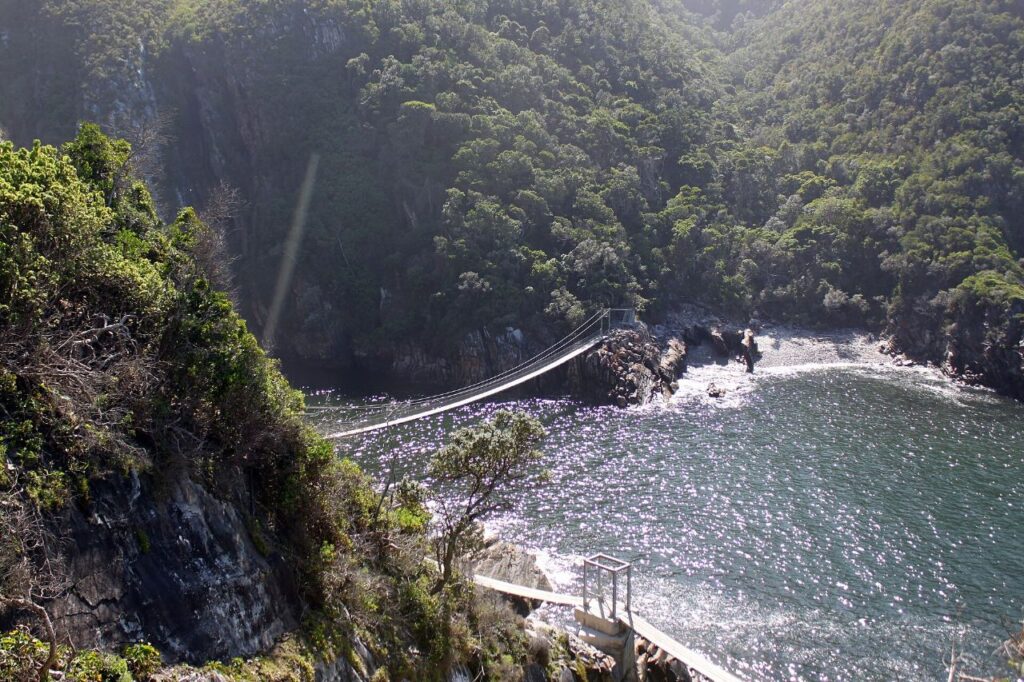
Further east, the Storms River Mouth section of Tsitsikamma has the suspension bridge over the river mouth and short coastal boardwalks. A conservation fee applies and SANParks gates in this region are increasingly card-only. It is about an hour and a half from Plett, so this is a full day rather than an afternoon.
If a long drive on your last day does not appeal, swap it for a Keurbooms River boat trip or canoe from just outside Plett — a forested river gorge, an easy half-day, and a much shorter round trip.
Alternatives and swaps to this Garden Route itinerary
- Fewer moves — drop Oudtshoorn, stay four nights in Knysna and three in Plett, and take the Cango Caves as a long day trip on the R328. You lose the passes, which makes this the sensible version of the week whenever the Swartberg Pass or Meiringspoort is shut.
- More Karoo — add a second inland night at Prince Albert, over the Swartberg on the Great Karoo side. This turns a 7-day route into a 9-day one.
- Arriving from Cape Town by road — add a night at Hermanus or Cape Agulhas on the way, and treat this as a 9- or 10-day trip. Our 7-day whale coast itinerary covers that leg.
- Route 62 instead of the N2 — come inland from Cape Town through the Klein Karoo, reach Oudtshoorn first, and reverse this itinerary. A better drive and a slower one.
- Marine wildlife — if whales matter, come between about June and November and build in a boat trip from Plett.
Planning notes for this Garden Route itinerary
- December and early January — the Garden Route fills completely, prices roughly double, and the N2 is slow. Book months ahead or come at another time.
- February to April — the best window: warm sea, settled weather, no crowds.
- Rain — possible in any month. This is not a Mediterranean climate.
- Card payments — SANParks and CapeNature gates in the Western Cape are increasingly card-only.
- Passes — check the status of the Swartberg Pass and Meiringspoort before you drive them, every time.
- Fire — obey bans absolutely, and check trail closures before a forest walk in summer.
Destination guides for this Garden Route itinerary
Each stop on this 7 day Garden Route itinerary has its own guide with the detail a day-by-day plan cannot carry — fees, gate hours, trail lengths, safety notes and where each town works as a base.
- Knysna — the estuary, the Heads, the forests and the fire history.
- Plettenberg Bay — the beaches and Robberg’s three circuits in full.
- Oudtshoorn — the Cango Caves, the ostrich history and the Swartberg Pass.
- Garden Route & Klein Karoo — the regional overview. We now have full guides to George, Wilderness and Mossel Bay as well.
- Self-drive Western Cape — car hire, road conditions, fuel and driving practicalities.
- All Western Cape itineraries — how this fits with the Cape Town and Whale Coast routes.
Where to go next
East of Tsitsikamma the Garden Route ends and the Eastern Cape begins, with Port Elizabeth and the malaria-free Big Five reserves around Addo about two hours further on. West, the road runs back through the Cape Overberg and the Whale Coast towards Cape Town. Many people fly into George or Port Elizabeth and out of the other, which removes the long backtrack entirely and is worth pricing.
Also useful: Cape Town to the Garden Route for getting to the start of this itinerary, Garden Route with kids for slowing it down for a family, Self-Drive Western Cape for the driving itself, Where to Stay in the Western Cape for how booking works along this coast, Things to Do for the wider province, and the Garden Route & Klein Karoo regional guide for everything this route passes through.
Read next
- 10 days: Cape Town and the Garden Route — the longer version, starting in Cape Town rather than George.
Official sources
- SANParks — Garden Route National Park — Wilderness, Knysna and Tsitsikamma sections, gate hours, fees and trail notices.
- CapeNature — Robberg, the Swartberg and current reserve alerts.
- Garden Route & Klein Karoo Tourism — the regional destination body.
- Wesgro — the provincial destination framework.
- Western Cape Government — provincial road and travel notices.