
Cape Winelands
Stellenbosch, Franschhoek and Paarl — Cape Dutch towns, mountain passes and South Africa’s oldest organised wine route, an hour from the city.
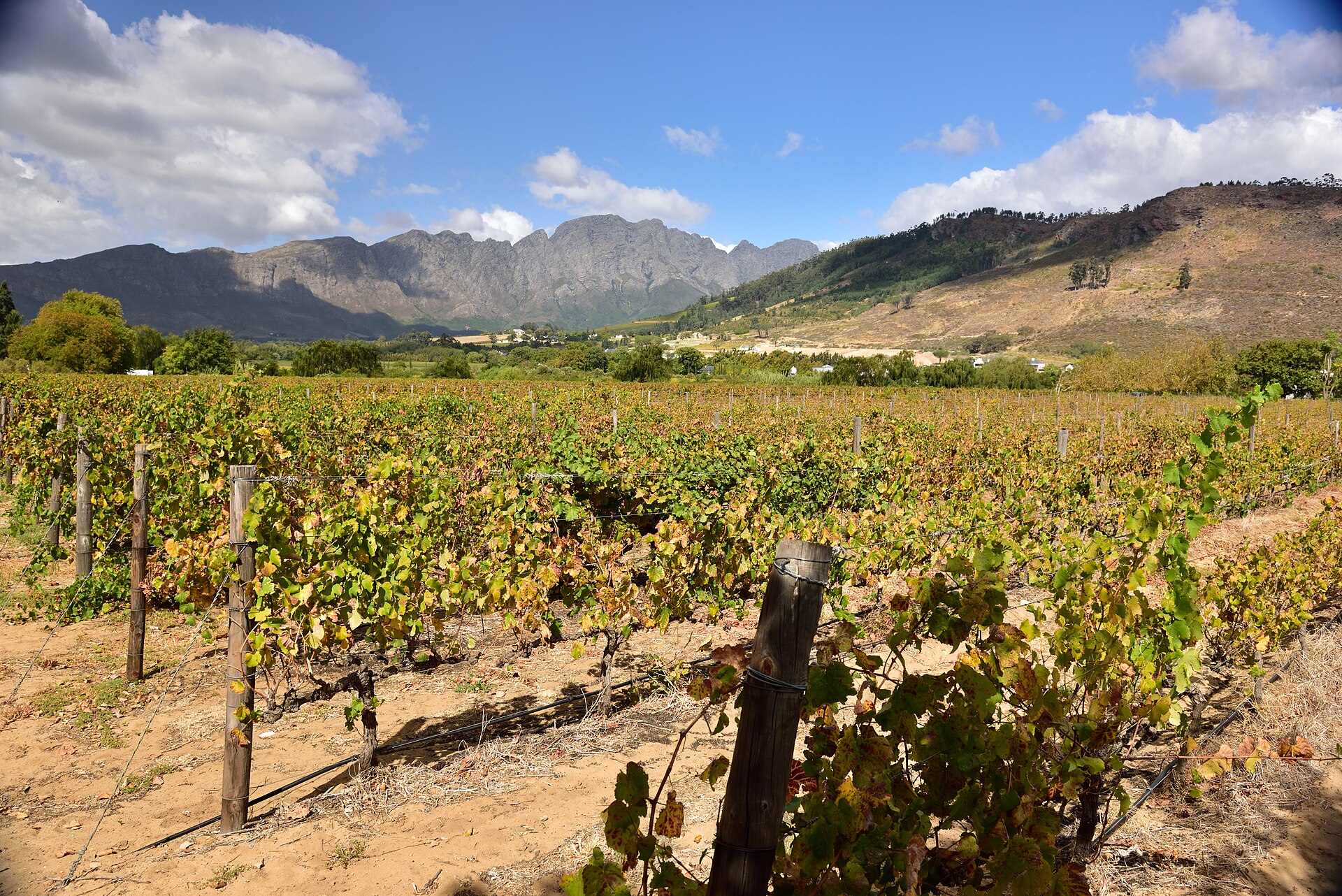
Hero image: Franschhoek vineyard, Western Cape, South Africa (20319683579).jpg by South African Tourism, CC BY 2.0, via Wikimedia Commons.
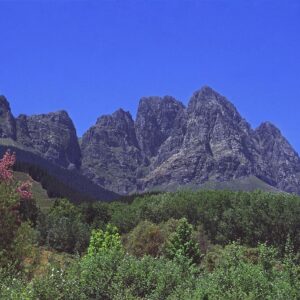
The Cape Winelands begin about 45 minutes from central Cape Town and rise quickly into a landscape of steep granite mountains, oak-lined streets and vineyards planted on valley floors and slopes. It is the most concentrated cluster of historic towns in South Africa, and the easiest region in the province to enjoy without long drives: Stellenbosch, Franschhoek and Paarl sit within half an hour of one another.
This is also where the province is most obviously a working agricultural landscape rather than a scenic backdrop. Harvest runs through the hottest months, the valleys have distinct microclimates, and the passes between them — Helshoogte, Franschhoek, Bain’s Kloof — are part of the appeal rather than just the connection.
Cape Winelands at a glance
- Main towns
- Stellenbosch, Franschhoek, Paarl, Wellington, Somerset West
- From Cape Town
- Roughly 45–60 minutes to Stellenbosch or Paarl by the N1 or N2
- Suggested stay
- Two to three nights; a day trip works but is rushed
- Best time
- February to April for harvest and autumn colour; September to November for green vineyards and settled weather
- Landscape
- Granite and sandstone mountains, valley vineyards, oak-shaded historic cores
- Getting around
- Self-drive, guided wine tour, or the Franschhoek wine tram; a designated driver is essential if tasting
Where to stay and what to book in the Cape Winelands
A starting point for planning: a few standout places to stay across the main wine towns, and the guided tours that make tasting days easy without a designated driver.
Places to stay
Lanzerac Hotel & Spa, Stellenbosch
A historic wine estate hotel in the Jonkershoek valley, minutes from central Stellenbosch.
View Property DetailsMont Rochelle Hotel and Vineyard, Franschhoek
A 26-room hotel set in its own vineyard on the slopes above the Franschhoek valley.
View Property DetailsGrande Roche Hotel, Paarl
A 24-suite country hotel in a restored Cape Dutch manor on the edge of Paarl.
View Property DetailsBabylonstoren, Simondium
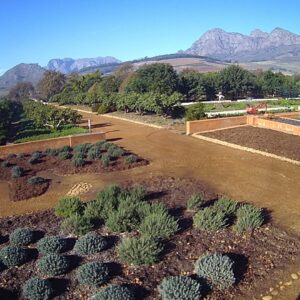
One of the oldest Cape Dutch farms, at the foot of the Simonsberg between Paarl and Franschhoek.
View Property Details


Browse all Cape Winelands accommodation
Tours and experiences
From Cape Town: Franschhoek Wine Tram Hop-on Hop-off
The valley’s hop-on hop-off tram and tram-bus loop — the neatest solution to drinking and driving in Franschhoek.
View Tour DetailsStellenbosch: Half-Day Wine Tour
The Winelands in half a day — two or three Stellenbosch estates without losing the whole day to it.
View Tour DetailsCape Town: Full-Day Winelands Tour with Wine Tastings & Food
Tastings built around food rather than beside it — pairings, a proper lunch and a slower day.
View Tour DetailsCape Town: Stellenbosch, Paarl, and Franschhoek Wine Tour
All three Winelands towns in a day — broad coverage, at the price of depth.
View Tour Details


In this Cape Winelands guide
Why visit the Cape Winelands
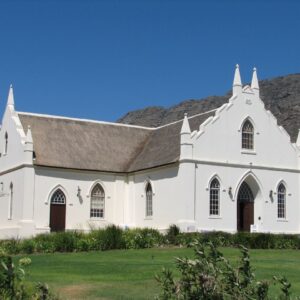
Three things set the region apart. The first is architectural: Stellenbosch and Franschhoek have intact Cape Dutch streetscapes, gabled homesteads and whitewashed werfs that exist nowhere else at this density. The second is the food, which is genuinely strong and not merely an accessory to the wine. The third is that the mountains are close enough to hike, so a wine-focused trip does not have to be sedentary.
The main towns
Stellenbosch
Named by Governor Simon van der Stel in 1679 and formally laid out in 1685, Stellenbosch is South Africa’s second-oldest European-founded town. It combines a walkable historic core along Dorp Street with a large university, which gives it an unusually young, busy character in term time. It is the most practical base in the region. See the full Stellenbosch guide.
Franschhoek
A narrow valley settled by French Huguenots from 1688, hemmed in by mountains on three sides and reached over the Helshoogte or Franschhoek passes. It is smaller and more single-street than Stellenbosch, heavily oriented to restaurants and tasting rooms, and the valley’s dead-end geography makes it feel more enclosed. The wine tram is a practical way to taste without driving.
Paarl and Wellington
Paarl sits below the huge granite domes that give it its name, on the Berg River. It is larger and more workaday than Stellenbosch or Franschhoek, with a very long main street and the Paarl Mountain Nature Reserve immediately above town. Wellington, just north, is quieter still and the gateway to Bain’s Kloof Pass.
Somerset West and the Helderberg
On the region’s southern edge, closer to False Bay, the Helderberg has its own wine ward and a cooler maritime influence. It is often overlooked but sits conveniently between the Winelands and the coast.
Wine: how it actually works
The Stellenbosch Wine Route, established in 1971, was South Africa’s first organised wine route and the model for the rest. Stellenbosch is best known for Cabernet Sauvignon and Bordeaux-style red blends, alongside Chenin Blanc; Pinotage was bred at Stellenbosch University, where Professor Abraham Izak Perold made the cross of Pinot Noir and Cinsaut in November 1924.
Practical points: many estates now ask you to book tastings, particularly at weekends and over harvest; tasting fees are common and are sometimes waived against a purchase; and larger estates often have restaurants that need booking well ahead. Opening days vary, and a number of smaller producers close on Sundays.
Beyond the tasting rooms
Jonkershoek Nature Reserve above Stellenbosch and the Paarl Mountain Nature Reserve both offer serious hiking with mountain views; Jonkershoek is managed by CapeNature and may require booking or a permit, so check before arriving. There is strong mountain biking across the region, several good museums including the Stellenbosch Village Museum and the Rupert Museum, and botanical gardens at Stellenbosch University.
Mountain passes and routes
The Helshoogte Pass links Stellenbosch to Franschhoek past Boschendal; the Franschhoek Pass climbs out of the valley’s closed end towards Villiersdorp and Theewaterskloof Dam; and Bain’s Kloof Pass from Wellington is one of the finest 19th-century mountain roads in the country. The R44 connects Stellenbosch north to Paarl and south to Somerset West.
Eastward, the Winelands connect naturally to Route 62 and the Klein Karoo, and southward over Sir Lowry’s Pass to the Overberg and the Whale Coast. See the self-drive guide for pass conditions and driving times.
Best time to visit
February to April covers harvest and then autumn vine colour, and is arguably the region’s best window. Summer is hot and dry, with December and January busiest. Winter, roughly June to August, is green, wet and quiet, with fireplaces and low-season rates; the mountains are at their most dramatic. Note that the Cape’s high fire season runs through the dry summer months and can close mountain trails at short notice.
Where to stay in the Cape Winelands
Basing yourself in one winelands town and driving out from it usually works better than moving every night. Compare what is available across the region.
Browse places to stay in the Cape WinelandsAffiliate link. We may earn a commission if you book through it, at no additional cost to you. See our affiliate disclosure.
Destination guides in the Cape Winelands
- Stellenbosch — the historic university town and the widest range of estates.
- Franschhoek — the Huguenot valley, the food, the tram and Mont Rochelle.
- Paarl — granite domes, the language monument and the best value of the three.
Nearby regions
Route guides: the 5 day Cape Town itinerary gives the Winelands two nights of their own, and the 7 day Whale Coast itinerary adds the Overberg to the same trip.
Read next
- Cape Winelands tours — guided wine days compared by town, format and what is included.
- Best time to visit the Western Cape — harvest, summer heat and winter rain in the Winelands.
- Where to stay in the Cape Winelands — Stellenbosch, Franschhoek or Paarl, compared on evenings, food and driving.
- 14 days: the Western Cape road trip — where two Winelands nights fit into a fortnight.
- Cape Winelands day trip — Stellenbosch, Franschhoek or Constantia, and which one your trip should choose.
Official sources for the Cape Winelands
Opening hours, entry fees, permit rules, park closures and seasonal access all change, and we do not republish them here as fixed facts. Before you travel, check the operators and conservation authorities directly:
- Cape Town Tourism — regional visitor information and current events.
- CapeNature — mountain reserves and hiking permits around the wine valleys.
Plan a Winelands trip
Pair the Winelands with Cape Town, or run east on Route 62 into the Klein Karoo.
Where to stay, and what to book
Our Cape Winelands Accommodation accommodation page carries a short orientation to the area and a live availability map. For experiences, see Cape Winelands Tours.