
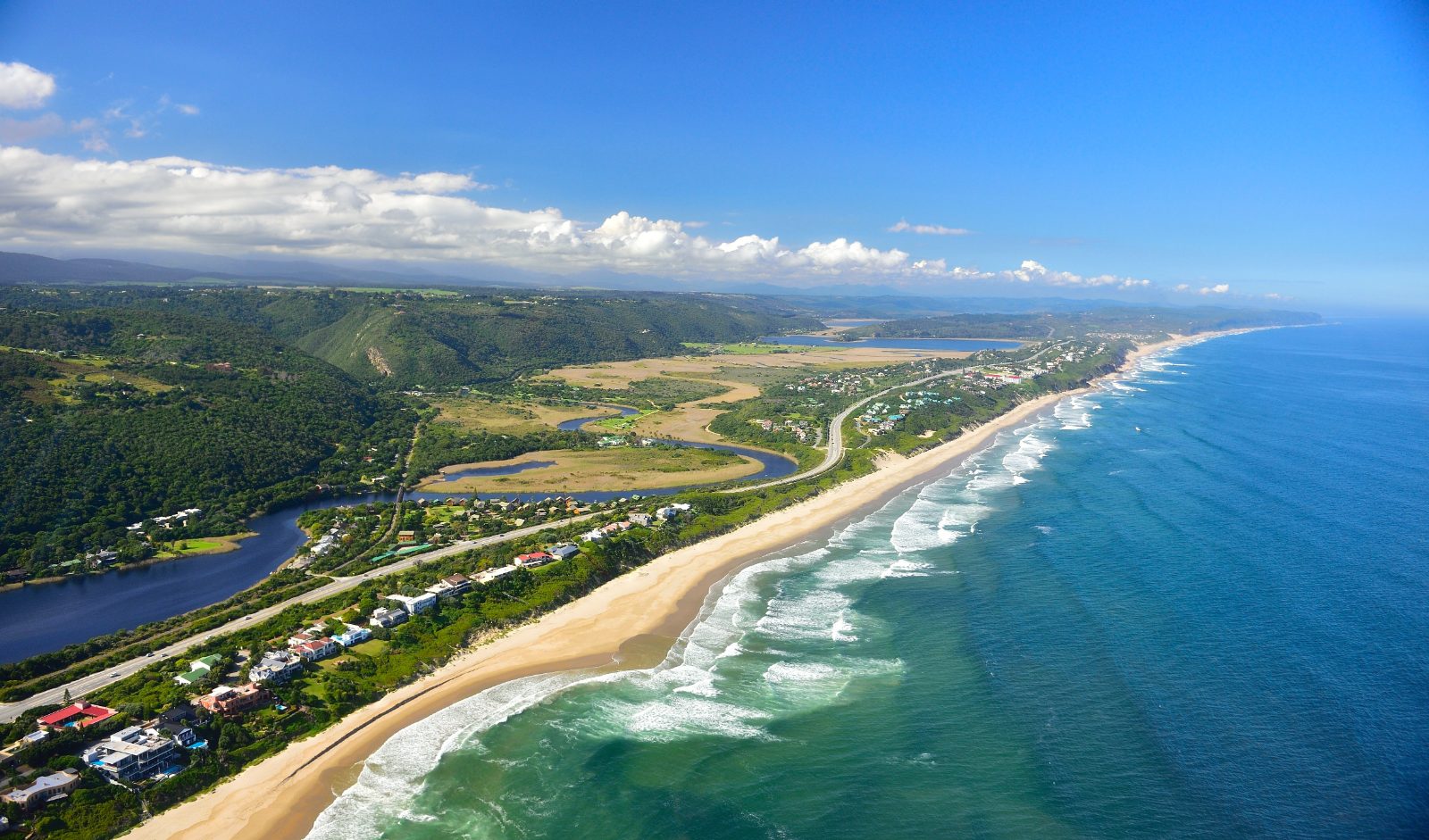
Hero image: Photo: South African Tourism from South Africa / Wikimedia Commons, CC BY 2.0
Wilderness is the stretch of the Garden Route where the road, the railway line, the lagoon and the beach are all squeezed into the same narrow gap between the mountains and the sea, and it is the easiest good place on the route to miss. The N2 runs straight through it. Most people see the view from Dolphin Point, take a photograph, and carry on to Knysna.
That is a mistake, because Wilderness is not really a village — it is the front door to a wetland system of international importance. Behind the dunes sit three interconnected estuarine lakes, Rondevlei, Langvlei and Island Lake, linked by the Serpentine channel to the Touw River estuary. SANParks manages all of it as the Wilderness section of the Garden Route National Park, and the lakes are a Ramsar wetland, site number 524, designated in June 1991 and covering 1,300 hectares. There is no other place on this coast quite like it.
Where to stay in Wilderness
Somewhere to stay between the lakes, the lagoon and the long beach.
Places to stay
Views Boutique Hotel & Spa, Wilderness
A five-star boutique hotel on the dune above Wilderness beach, with sea-facing suites, a restaurant and a spa.
View Property DetailsMoontide Guest Lodge, Wilderness
A nine-room guest lodge on the tidal Touw River in Wilderness, inside the Garden Route National Park, with canoes and…
View Property DetailsFairy Knowe Hotel, Wilderness
A fifty-room riverside hotel on the Touw River at Wilderness, with family rooms, a pool, canoes and a restaurant on…
View Property DetailsANEW Resort Wilderness, Garden Route
A large family resort in palm-shaded gardens at Wilderness, with two pools, tennis and padel courts, a restaurant and apartments.
View Property Details


In this guide
- Wilderness in brief
- The lakes, and why they matter
- Birding on the lakes
- The trails, and which ones are actually open
- Paddling: available, but not always
- The beach, and the lifeguard problem
- Viewpoints, and the bridge
- Staying in the park
- Floods: the thing to understand about this place
- Where to stay in Wilderness
- Wilderness, George and Knysna
- Nearby, and what to do next
- Practical notes
- Official sources
Wilderness in brief
- What it is — a small settlement between the Outeniqua foothills and the sea, wrapped around a river lagoon and backed by a chain of lakes.
- Known for — paddling the Touw, forest trails to waterfalls, birding on the lakes, and a beach that is far more serious than it looks.
- Best for — slowing down. This is a place to spend two days doing three things, not a place to tick off.
- Time needed — two nights. One is enough to see it and not enough to use it.
- The catch — the beach has no lifeguards for most of the year, the trails close after heavy rain, and the weather here does what it likes.
The lakes, and why they matter
The Wilderness lakes are the reason this section of the park exists. Three permanent coastal lakes connect through shallow channels and floodplain to the Touw estuary, with Swartvlei to the east forming a second system. SANParks describes the first three lakes and their channels as an internationally proclaimed Ramsar wetland of global importance to birds, and the Ramsar listing records 285 plant species and 32 fish species alongside a flood-control function.
One detail explains a lot about how the place behaves: the mouth of the Touw estuary is artificially managed, with the sand sill maintained between roughly 2.1 and 2.4 metres above sea level under an environmental authorisation. When the mouth closes and heavy rain arrives, water backs up. That is why Wilderness floods, and why it floods properly.

Birding on the lakes
If you keep a list, this is the stop that earns the detour. SANParks maintains three hides — Rondevlei, the Malachite Kingfisher hide at Langvlei, and the Gallinule hide on the Touw River. Rondevlei and Langvlei carry major concentrations of Great Crested Grebe, and SANParks lists red-knobbed coot, little grebe, Cape shoveler, yellow-billed duck and reed cormorant among the commonly seen birds. The forested hillsides above hold cuckoo hawk, crowned eagle, forest buzzard, black and red-breasted sparrowhawk and African goshawk.
SANParks publishes no total species count for the section, so we are not going to invent one. The Gallinule hide was on the closure list after the 2024 floods, which is the pattern here: infrastructure gets damaged, then repaired, and the park does not always publish an all-clear.
The trails, and which ones are actually open
The Wilderness trails are named after kingfishers, which is charming and mildly confusing. What SANParks currently publishes:
- Half-collared and Giant Kingfisher Trail — about 7 km, roughly three and a half hours. The best-known walk here. It crosses the Touw by a manually operated pontoon at Ebb-and-Flow, then follows the river through forest, ending with a boardwalk section to a waterfall.
- Brown-hooded Kingfisher Trail — 5 km, two to three hours, up the Duiwe River valley to another waterfall.
- Cape Dune Mole-Rat Trail — a 6 km loop with a 3 km option that overlaps it.
- Bosduif Loop — about 1 km, an hour, branching off the Half-collared.
- Woodville Big Tree circular walk — 2.1 km, forty-five minutes, at the big yellowwood inland.
A Pied Kingfisher Trail of about 10 km appears in the SANParks brochure PDF but is absent from the current trails page, so treat it as unconfirmed. The Half-collared Kingfisher Trail closed on 10 June 2026 after heavy rain left sections waterlogged and reopened on 8 July 2026 after repairs. SANParks does not run a live per-trail status feed for Wilderness, and the May 2026 closures have no published all-clear. Check the park notifications page and phone the Wilderness office on 044 877 1197 before you drive out to any of them.
Paddling: available, but not always
Canoe hire is the signature Wilderness activity and SANParks runs it from reception at Ebb-and-Flow Rest Camp, with the classic route a slow paddle up the Touw between forested banks, and an alternative up the Serpentine to Island Lake. Swartvlei is also used. Guided cruises operate from the same point.
It is a standing offering rather than a guaranteed one, and this is where a lot of published advice goes wrong. Paddling has been suspended repeatedly and for different reasons: all water-based activities were closed in May 2026 under an Orange Level 8 severe-weather warning with 100 to 200 mm forecast; Island Lake was closed from March to May 2025 after a blue-green algal bloom, with SANParks warning that such events may recur; and canoeing was on the closed list after the April 2024 floods. Do not plan a trip around a paddle without phoning 044 877 1197 on the day.
The beach, and the lifeguard problem
Wilderness beach is long, open and genuinely beautiful, and it is not a casual swimming beach. This is the single most important practical thing on this page.
George Municipality has no lifeguards on any of its beaches from 7 April 2026 until 30 November 2026. The notice names Wilderness Main Beach, Wilderness Lagoon, the Steps and Leentjiesklip specifically. In season the pattern is 1 to 13 December 09:00 to 17:00, 13 December to end of February 07:00 to 19:00, and March to early April at weekends and holidays only. Wilderness Main Beach and Leentjiesklip are lifeguarded Blue Flag beaches within that window; the Lagoon and the Steps only in December and January.
The municipality states that eighty per cent of lifeguard rescues at ocean beaches are caused by rip currents, and if caught you should swim parallel to the shore. The NSRI has run green-dye demonstrations of rip currents at Wilderness specifically. SANParks’ own wording is that it is preferable to swim at Wilderness beach when a lifeguard is on duty. Between April and December there is no such thing. The lagoon is the calmer option, and a walk is always available. NSRI Station 23 Wilderness: 082 990 5955.
Note that George Municipality’s tourism brochure still says lifeguards are on duty seven to seven in season — the statutory notice overrides it. Position as at 19 August 2026.
Viewpoints, and the bridge
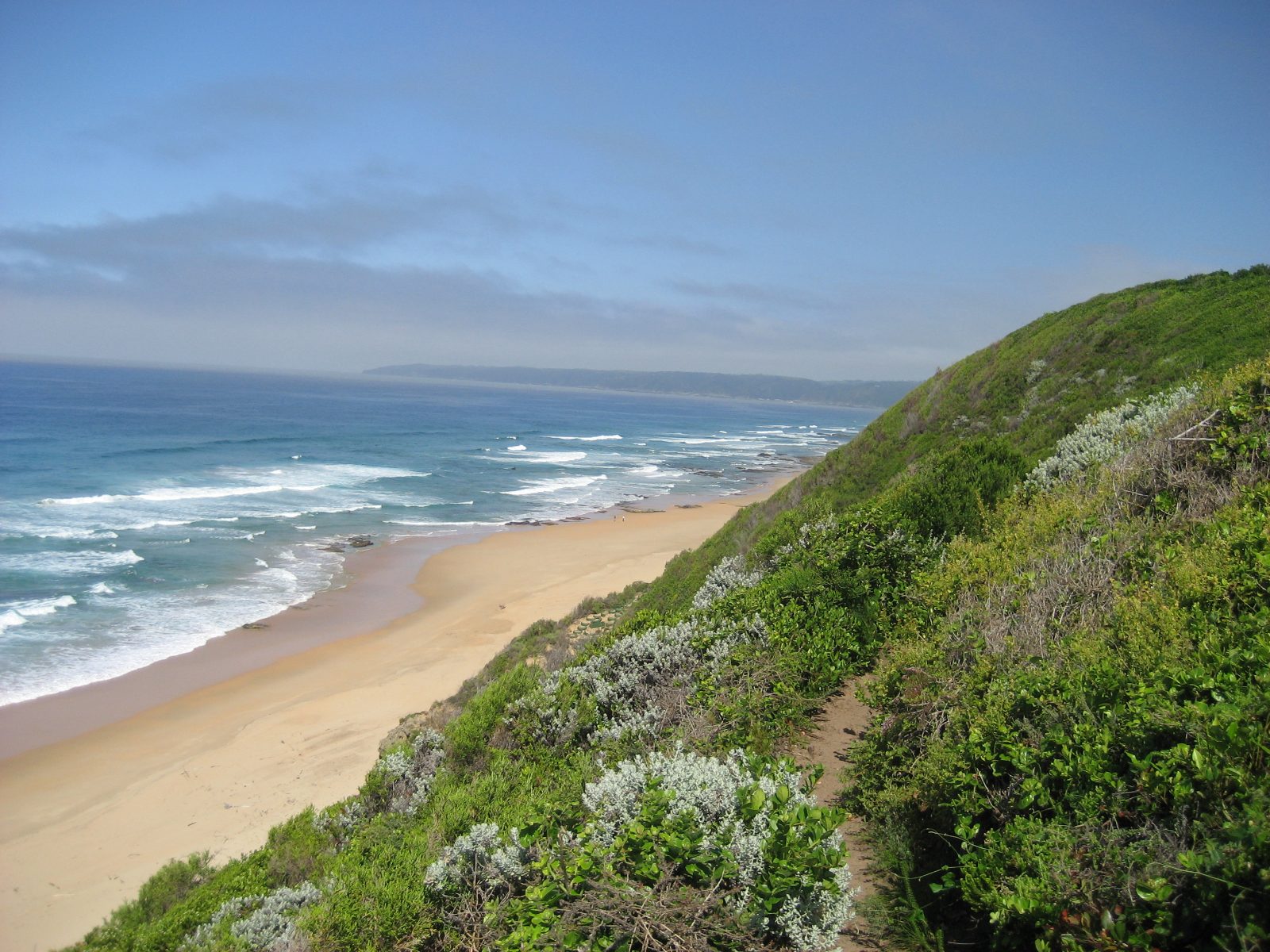
Dolphin Point sits on the Kaaimans Pass section of the N2 and gives the high view over the beach that everyone photographs. Map of Africa is reached by a signposted gravel road up at Wilderness Heights and looks down on a river meander that does, from the right angle, resemble the continent; the grassy field there is used as a picnic site and a paragliding launch. Neither viewpoint is part of the national park and no official source names a managing authority for either, so we are not publishing hours or access rules for them.
The Kaaimans River railway bridge below is the most photographed piece of engineering on the Garden Route, and it was declared a provincial heritage site by Heritage Western Cape in October 2022. The line it carries has been out of service since flood damage in 2006. The Outeniqua Choo-Tjoe is not a bookable activity: the operator’s own site describes work to establish what reinstating the line would require, and publishes no service date.
Staying in the park
Ebb-and-Flow Rest Camp is the obvious base if you want to be inside the park rather than beside the N2. SANParks runs log cabins on stilts and riverside camping on the Touw, 34 permanent units in all, two of them wheelchair-accessible. There is coin laundry but no shop and no ATM — Wilderness village is 2 km away and George 15 km. Book through SANParks central reservations on 012 428 9111. The camp stayed open through the May 2026 floods even while the activities around it were shut.
Conservation fees for the Wilderness section, valid to 31 October 2026, are R61 for South African adults and R30 for children aged two to eleven, R124 and R62 for SADC visitors, and R235 and R118 for international visitors. Note that Wilderness has its own fee band, separate from Knysna and Tsitsikamma.
Floods: the thing to understand about this place
Wilderness sits at the bottom of a catchment with a managed estuary mouth, and it floods. In April 2024 more than 200 mm fell in six hours on a spring high tide; campers at Ebb-and-Flow were evacuated to forest cabins and the camp and all area trails closed. In May 2026 the park closed all water-based activities and hiking under a severe-weather warning, and by 8 May reported roads eroded and inaccessible in several places, with mudslides and fallen trees. By 12 May the section was offline entirely, with phone lines and email down.
None of this makes Wilderness a bad destination — the same water is why the place looks the way it does. It does mean that a Wilderness day should be planned loosely, with the trail or the paddle as the intention rather than the appointment.
Where to stay in Wilderness
Check availability in Wilderness
Wilderness is small: guesthouses and self-catering along the lagoon and up the hillside, plus SANParks’ own cabins and camping at Ebb-and-Flow, which are booked separately through the park. The lagoon-facing places go first.
See Wilderness stays on Booking.comAffiliate link. We may earn a commission if you book through it, at no additional cost to you. See our affiliate disclosure.
Wilderness is small and its accommodation reflects that: guesthouses and self-catering along the lagoon and up the hillside, a handful of larger properties, and SANParks’ own cabins and camping at Ebb-and-Flow. There is no resort strip. The village fills over December and the Easter weekend, and the good lagoon-facing places go first.
Wilderness, George and Knysna
Wilderness sits between the two, and where it fits depends on what you want from the week. George is about 16 km and twenty minutes west — near enough that flying into George and driving straight to Wilderness is the standard move, and near enough that George’s hospitals, supermarkets and car hire are effectively Wilderness’s too. Knysna is 46 km and about forty-five minutes east.
If you are choosing one base for the central Garden Route, Knysna is the more practical answer: it has more beds, more restaurants and more to do in bad weather. Wilderness wins on a different measure. It is quieter, it is closer to the water, and it is the only place on this coast where you can paddle a river through forest in the morning and walk an empty beach in the afternoon without moving the car. Two nights here and three or four in Knysna is a better week than five in either.
Nearby, and what to do next
- Garden Route with kids — Wilderness as a family base, including the lifeguard seasons.
- Cape Town to the Garden Route — how the drive from Cape Town works and what it costs in time.
- Where to stay on the Garden Route — choosing between Mossel Bay, George, Wilderness, Knysna, Plettenberg Bay and Oudtshoorn.
- George — twenty minutes west, for the airport, the passes and anything you need to buy.
- Knysna — forty-five minutes east, for the estuary and the indigenous forests.
- Mossel Bay — about an hour west, at the start of the route.
- Woodville Big Tree and the Hoekwil back roads — inland from the lakes, and a good wet-weather drive.
- Sedgefield and Swartvlei — the next lake system east, on the way to Knysna.
Planning the wider trip: our Garden Route itinerary includes this stretch, Self-Drive Western Cape covers the N2 and the passes, Where to Stay in the Western Cape covers accommodation across the province, and Things to Do covers the rest.
Practical notes
- No lifeguards until 30 November 2026 on any George beach, Wilderness included. Treat the sea accordingly.
- Phone before you walk or paddle — 044 877 1197. Trail and water-activity status changes with the weather and SANParks does not publish a live feed.
- Conservation fees apply in the park section and expire 31 October 2026.
- Buy food in George — Wilderness village is small and the rest camp has no shop.
- Rain in every month — this is not a dry-season destination and never has been.
Official sources
- SANParks — Garden Route National Park notifications, trails, fees and Ebb-and-Flow.
- George Municipality — lifeguard notices, beach and water information.
- Ramsar Sites Information Service — the Wilderness lakes listing.
- NSRI — sea rescue and water-safety guidance.
Where to stay, and what to book
Our Wilderness accommodation page carries a short orientation to the area and a live availability map. For experiences, see Garden Route Tours & Activities.