

Stellenbosch
Oak-shaded Cape Dutch streets, a large university and South Africa’s oldest wine route — fifty kilometres and a world away from Cape Town.
Hero image: Oak trees, Dorp Street, Stellenbosch.jpg by Steven Morrow, CC BY-SA 3.0, via Wikimedia Commons.
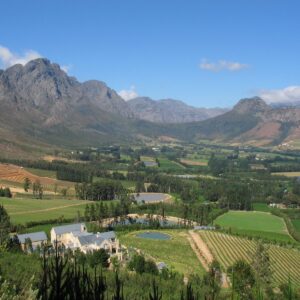
Stellenbosch sits about 50 km east of Cape Town in a valley ringed by granite mountains, and it is the most practical base in the Cape Winelands. Wesgro puts the drive at around 45 minutes. It combines three things that rarely coexist: an intact historic core, a serious wine region on its doorstep, and a large working university that keeps the town from becoming a museum piece.
Simon van der Stel named the place in 1679 and it was formally laid out in 1685, making it the oldest town in South Africa after Cape Town. Both dates are used as the founding year, which is why you will see them quoted inconsistently. What survives from that period is unusual: Dorp Street holds one of the longest rows of surviving old buildings of any major town in southern Africa, still with its leiwater furrows running alongside.
Stellenbosch at a glance
- Region
- Cape Winelands, Western Cape
- From Cape Town
- About 50 km, roughly 45 minutes by the N1 or N2 and the R310
- Population
- Municipality roughly 175,000–180,000; the town and immediate suburbs around 100,000
- Suggested stay
- Two nights minimum; three if you want to taste properly and walk the town
- Best time
- February to April for harvest and autumn colour; September to November for green vineyards
- Known for
- Cape Dutch architecture, the Stellenbosch Wine Route, Stellenbosch University, Pinotage
- Getting around
- The historic core is walkable; a designated driver, guided tour or e-bike is needed for the estates
Where to stay and what to book in Stellenbosch
Four places to stay in and around the town, and the wine days that work best without driving yourself.
Places to stay
Lanzerac Hotel & Spa, Stellenbosch
A historic wine estate hotel in the Jonkershoek valley, minutes from central Stellenbosch.
View Property DetailsSpier Hotel and Wine Farm, Stellenbosch
A large working wine farm on the R310, 20 to 25 minutes from Cape Town International.
View Property DetailsDelaire Graff Lodges and Spa, Stellenbosch
Vineyard lodges with private heated pools high on the Helshoogte Pass between Stellenbosch and Franschhoek.
View Property DetailsMajeka House, Paradyskloof Stellenbosch
A small design-led boutique hotel in Paradyskloof, a few minutes south of central Stellenbosch.
View Property Details


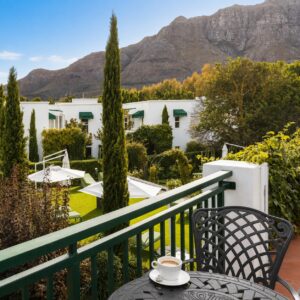
Browse all Cape Winelands accommodation
Tours and experiences
Stellenbosch: Half-Day Wine Tour
The Winelands in half a day — two or three Stellenbosch estates without losing the whole day to it.
View Tour DetailsCape Town: Stellenbosch&Franschhoek Wine Tour with Tasting
The two best-known Winelands towns in one day, with the Helshoogte Pass in between.
View Tour DetailsCape Town: Stellenbosch, Paarl, and Franschhoek Wine Tour
All three Winelands towns in a day — broad coverage, at the price of depth.
View Tour DetailsPrivate Tour: Cape Winelands to Stellenbosch & Franschhoek
The Winelands at your own pace, with the estates chosen for you rather than for the group.
View Tour Details


In this Stellenbosch guide
Why visit Stellenbosch
The town works on several levels at once. You can spend a morning walking a compact grid of eighteenth and nineteenth-century buildings, an afternoon tasting at estates a few minutes’ drive away, and an evening in a restaurant scene that is genuinely good rather than merely adequate. Behind all of it are mountains you can hike into, which is what stops a Winelands trip from becoming purely indulgent.
It is also a working town rather than a resort. Term time fills the streets with students; harvest fills the roads with tractors. Both are worth planning around.
The historic core
Dorp Street
The town’s defining street, originally the wagon road to the Cape and formally designated in 1710 as one of the four elements of the 1685 layout. It runs long and straight beneath old oaks, lined with whitewashed Cape Dutch, Georgian and Victorian facades. Oom Samie se Winkel, a surviving traditional trading store, is the best-known single address on it.
Die Braak
The village green, which took shape after 1777 when the Dutch East India Company put a powder magazine on its western edge. It was originally the military exercise ground and is now framed by oaks and bordered by the Rhenish Church of 1823 and St Mary’s of 1852.
The VOC Kruithuis
The powder magazine itself, completed in May 1777, is the only surviving Dutch East India Company powder magazine in South Africa. It was declared a national monument in 1940 and now displays firearms, cannon and uniforms. Open Monday to Friday, 09:00 to 16:30, closed at weekends and on public holidays, with a nominal entry fee of around R10.
Stellenbosch Village Museum
Four period houses on Ryneveld Street, each restored to a different era of the town’s development, with their gardens: Schreuderhuis of 1709, which survived the first great Stellenbosch fire; Blettermanhuis, from roughly 1750 to 1790; Grosvenor House, built in 1782 and extended to 1803; and Bergh House. It is the single best way to understand what you are looking at on Dorp Street.
Open Monday to Saturday 09:00 to 17:00, with shorter hours on Sundays in winter. Closed on Christmas Day, Good Friday and Easter Sunday. The same organisation runs the Toy and Miniature Museum, which is a genuine surprise and good with children.
The Moederkerk
The Dutch Reformed mother church. The congregation dates from 1686 and the first church on the site was inaugurated in October 1687, before being destroyed in the great fire of 1710. The present building is the town’s most prominent landmark; we have not been able to verify its construction date or visiting hours from an authoritative source, so check locally rather than relying on the dates that circulate online.
Stellenbosch University
The university became one in April 1918, growing out of Victoria College, which had operated since 1886. It opened with four faculties, 503 students and 40 academic staff, funded in large part by a £100,000 legacy from Jannie Marais — the same benefactor commemorated by the Jan Marais Nature Reserve in town.
Today around 29,000 students are on the Stellenbosch campus and roughly 35,000 across all five campuses. The university spent R4.2 billion in 2024 and accounts for something like 13 per cent of local economic activity and formal employment, which explains a great deal about the town’s character, prices and pace.
Wine: the Stellenbosch Wine Route
The route was approved in April 1971 and launched with eleven members, after Frans Malan of Simonsig, Niel Joubert of Spier and Spatz Sperling of Delheim saw a modest route des vins in Burgundy in 1969. Cape Town Tourism and Visit Stellenbosch both describe it as the oldest wine route in South Africa, and it became the model for the rest of the country.
Around 200 wine and grape producers fall within the Stellenbosch appellation, of which more than 150 farms and estates open their doors for tasting.
Two structures, often confused
This is the detail most guides get wrong. There is a legal appellation and there is a tourism structure, and they are not the same thing.
The Wine of Origin system demarcates eight wards within the Stellenbosch district: Banghoek, Bottelary, Devon Valley, Jonkershoek Valley, Papegaaiberg, Polkadraai Hills, Simonsberg-Stellenbosch and Vlottenburg. A number of additional sub-area names are in industry and marketing use, which is why you may see longer lists.
Separately, the wine route divides itself into five tourism sub-routes for practical navigation — Greater Simonsberg, Stellenbosch Berg, Stellenbosch Valley, Helderberg and Bottelary Hills — and states explicitly that these borders bear no relation to the legislated Wine of Origin wards. Use the sub-routes to plan a day’s driving; use the wards to understand a label.
What Stellenbosch is known for
Cabernet Sauvignon and Bordeaux-style red blends above all, along with Chenin Blanc, Syrah and Merlot. Stellenbosch is also the birthplace of Pinotage: Professor Abraham Izak Perold made the cross at Stellenbosch University in November 1924, using Pinot Noir and Cinsaut, which was then known locally as Hermitage — hence the name. The first wine from it was made in 1941.
Tasting practicalities
Booking policy varies considerably. Walk-in-friendly cellar doors still exist, but most premium seated tastings, cellar tours and anything vineyard-based now require advance online booking, often with small group caps and fixed time slots. Book ahead, particularly in December and January, over Easter and at weekends. Tasting fees are normal and are sometimes waived against a purchase, but they vary widely enough that any regional average would be misleading.
Harvest runs roughly January to April. It is an interesting time to visit — cellars are working — but it is also hot, busy and the least flexible period for cellar tours.
Use a designated driver, a guided wine tour, or one of the cycling and e-bike wine tours operating from town. Rural roads here carry pedestrians, cyclists, farm vehicles and tractors, and the passes are unforgiving after dark. Note that Helshoogte Pass is camera-enforced.
Beyond wine
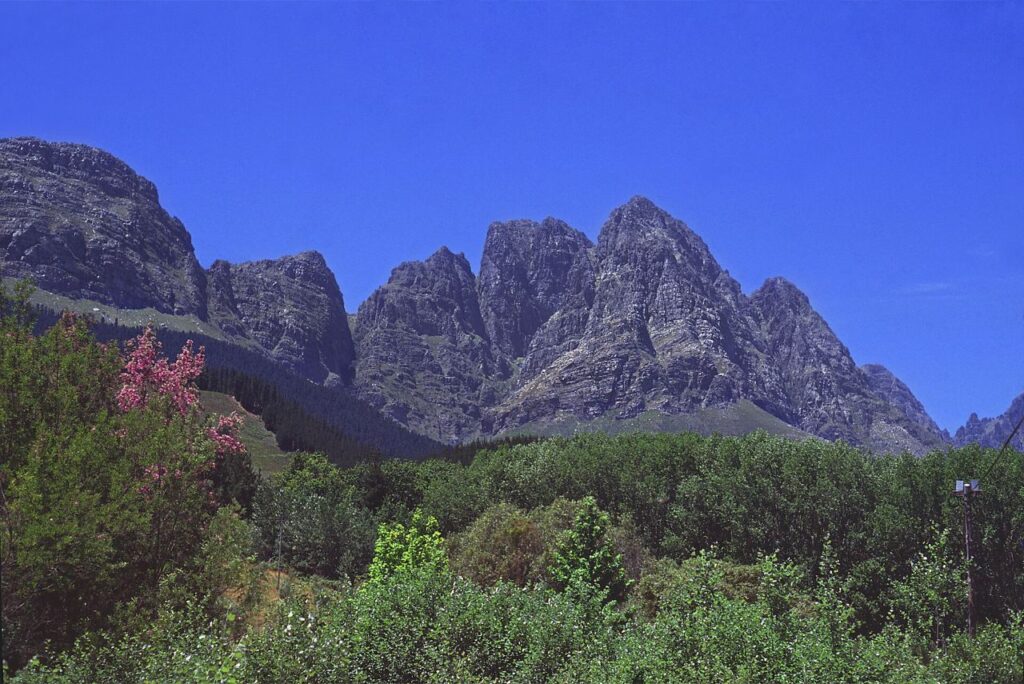
Jonkershoek Nature Reserve, in the valley behind the town, is managed by CapeNature and offers serious mountain hiking and trail running with waterfalls and a circular drive; access may require booking or a permit, so check before setting out. Jan Marais Nature Reserve is a small patch of remnant fynbos within the town itself, and the Stellenbosch University Botanical Garden is the oldest university botanical garden in the country.
The Rupert Museum holds a significant South African art collection. Mountain biking is excellent across the surrounding farms, and the food scene ranges from student-priced to internationally recognised.
Getting there and around
Driving is the practical answer. From Cape Town, take the N1 and R304, or the N2 and R310 — roughly 45 minutes either way. From Cape Town International Airport it is a similar distance on the N2. The R44 runs north to Paarl and south to Somerset West; the R310 over Helshoogte Pass is the scenic link to Franschhoek, climbing past Tokara at the summit, and is popular with cyclists.
Stellenbosch is on the Metrorail Northern Line and service was restored in March 2024 after about four years of suspension, described at the time as limited — roughly every 30 to 60 minutes. Current service levels are not something we can verify from an official source, so do not build a trip around the train without checking first.
Within the historic core, walking is best: the grid is compact, flat and shaded. For the estates you need a car with a sober driver, a tour, or a bike.
Best time to visit
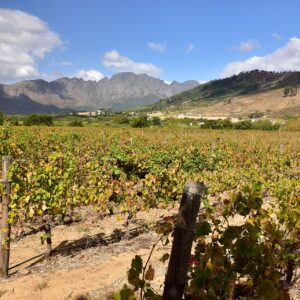
February to April is arguably the sweet spot: harvest, then autumn colour in the vineyards, with warm settled weather. Summer is hot and dry, and December to January is both busiest and most expensive. Winter, June to August, is wet, green and quiet, with fireplaces, low-season rates and the mountains at their most dramatic. Spring, September to November, gives fresh green vines and comfortable walking weather.
One caveat: the Cape’s high fire season runs through the dry summer months, and mountain trails including those in Jonkershoek can close at short notice.
How long to stay
Stellenbosch is often done as a day trip from Cape Town, and that works, but it is a compromise — you will either see the town or taste at a couple of estates, not both properly. Two nights lets you do the historic core on foot and spend a full day on the wine route. Three lets you add Franschhoek or a Jonkershoek hike.
Find accommodation in Stellenbosch
Stellenbosch fills up during harvest season and over South African school holidays, so it is worth checking what is available before you fix your dates.
Browse places to stay in StellenboschAffiliate link. We may earn a commission if you book through it, at no additional cost to you. See our affiliate disclosure.
Nearby destinations
Frequently asked questions
Is Stellenbosch better than Franschhoek?
They serve different purposes. Stellenbosch is bigger, has the historic core and the university, and works better as a base with more choice at every price level. Franschhoek is smaller, more restaurant-focused, and its dead-end valley setting is spectacular. If you are picking one base for the Winelands, Stellenbosch is the more practical choice; Franschhoek is an easy day trip from it over Helshoogte.
Can I visit Stellenbosch without a car?
Yes for the town, which is compact and walkable, and yes for the estates if you use a guided wine tour, a cycling tour or e-hailing. But you will have far more choice with a car and a designated driver.
Do I need to book wine tastings in advance?
For premium seated tastings, cellar tours and vineyard experiences, generally yes — and definitely at weekends, over the December–January peak and at Easter. Some larger cellar doors still take walk-ins.
Is one day enough for Stellenbosch?
It is enough for a taste of it. To walk the historic core, visit the Village Museum and taste at two or three estates without rushing, plan on two nights.
Plan the rest of your trip
Stellenbosch works as a day trip from Cape Town or as a base of its own. These pages help you decide which.
- Cape Winelands tours — guided options focused on Stellenbosch, and what they include.
- Where to stay in the Cape Winelands — how Stellenbosch compares as a base for two or three nights.
- Cape Winelands day trip — how Stellenbosch compares with the other options for a single wine day.
- Cape Winelands — the wider region, including Franschhoek and Paarl.
- Itineraries — the five-day Cape Town and Winelands plan, and longer routes.
- Self-drive guide — driving the wine routes, the passes, and the drinking-and-driving question.
- Travel planning — harvest season, weather and costs.
- Things to do — wine, food, hiking and heritage across the province.
- Accommodation — where to stay in and around the town.
Route guide: see how Stellenbosch fits into a week in our 5 day Cape Town itinerary.
Official sources for Stellenbosch
Opening hours, entry fees, permit rules, park closures and seasonal access all change, and we do not republish them here as fixed facts. Before you travel, check the operators and conservation authorities directly:
- Cape Town Tourism — regional visitor information.
- CapeNature — Jonkershoek and the surrounding mountain reserves.
Plan a Winelands trip
Stellenbosch pairs naturally with Cape Town, Franschhoek and a run east on Route 62.
Where to stay, and what to book
Our Stellenbosch accommodation page carries a short orientation to the area and a live availability map. For experiences, see Cape Winelands Tours.