
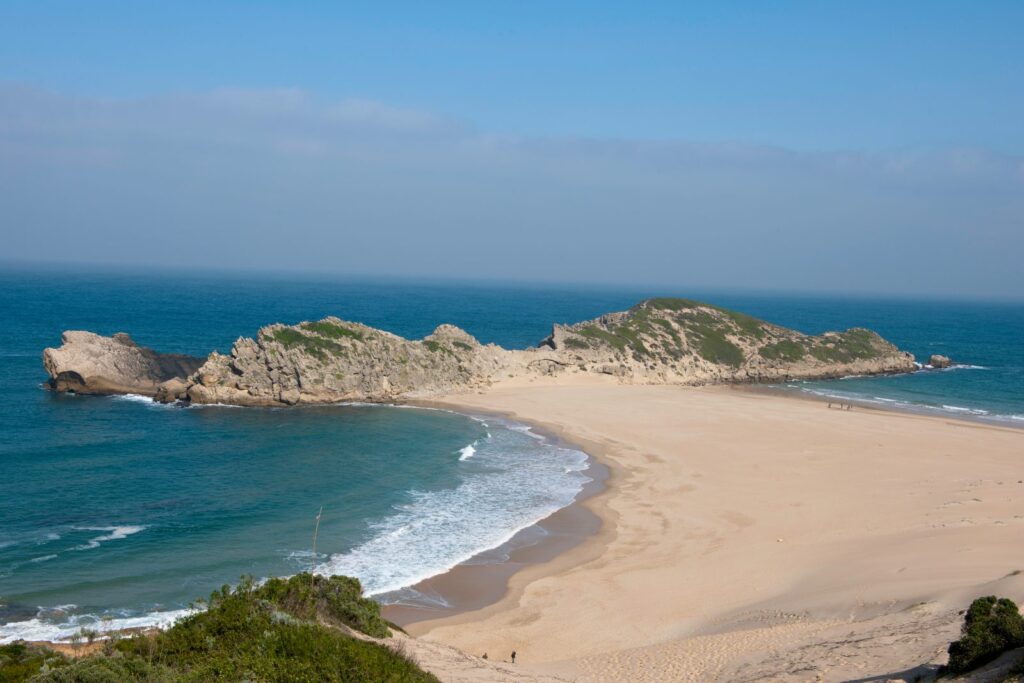
Hero image: The Robberg peninsula, Plettenberg Bay — Photo: Jay Aremac / Wikimedia Commons, CC BY 2.0
Plettenberg Bay is the beach town of the Garden Route. Where Knysna faces inward onto an estuary and Wilderness faces a set of lakes, Plett faces a wide open bay with several kilometres of sand, water warm enough to swim in, and a rocky peninsula on its southern arm that is one of the best coastal walks in South Africa.
It sits half an hour east of Knysna in the Garden Route & Klein Karoo region, about five and a half hours from Cape Town.
Where to stay in Plettenberg Bay
Places to stay near the beaches, the Robberg peninsula and the Bitou river.
Places to stay
The Plettenberg Hotel, Plettenberg Bay
A 35-room hotel on the rocky headland above Plettenberg Bay, with ocean on three sides.
View Property DetailsTsala Treetop Lodge, Plettenberg Bay
Sixteen suites and villas on stilts in the forest between Knysna and Plettenberg Bay, each with an infinity pool.
View Property DetailsEmily Moon River Lodge, Plettenberg Bay
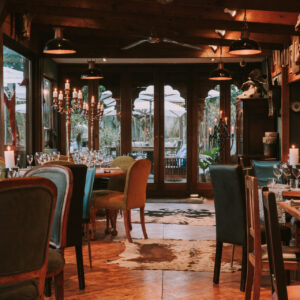
A sixteen-suite lodge above the Bitou River wetlands outside Plettenberg Bay, with a well-known restaurant and a collector’s interior.
View Property DetailsThe Robberg Beach Lodge, Plettenberg Bay
Four beachfront villas opposite Robberg 5 Blue Flag beach in Plettenberg Bay, with four-star and five-star rooms, two pools and…
View Property Details



In this guide
- Plettenberg Bay in brief
- The beaches
- Robberg Nature Reserve
- Seals, whales and dolphins — without the promises
- Beyond the beach
- Plettenberg Bay with children
- Plettenberg Bay, Tsitsikamma and route logic
- Getting there and around
- When to come
- Where to stay in Plettenberg Bay
- Nearby, and what to do next
- Practical notes
- Official sources
Plettenberg Bay in brief
- What it is — a coastal town on a wide bay, with the Robberg peninsula and nature reserve on its southern side.
- The water — Indian Ocean side of the country, and materially warmer than anything in Cape Town. Swimming is a pleasure here.
- Best for — beaches, walking, marine wildlife from the shore and the boat, and families.
- Robberg — a CapeNature reserve with three circular trails from 2.1 km to 9.2 km.
- Time needed — two nights; three if you want a full Robberg day and beach time.
- Peak season — December and early January, when Plett becomes very busy and very expensive.
The beaches
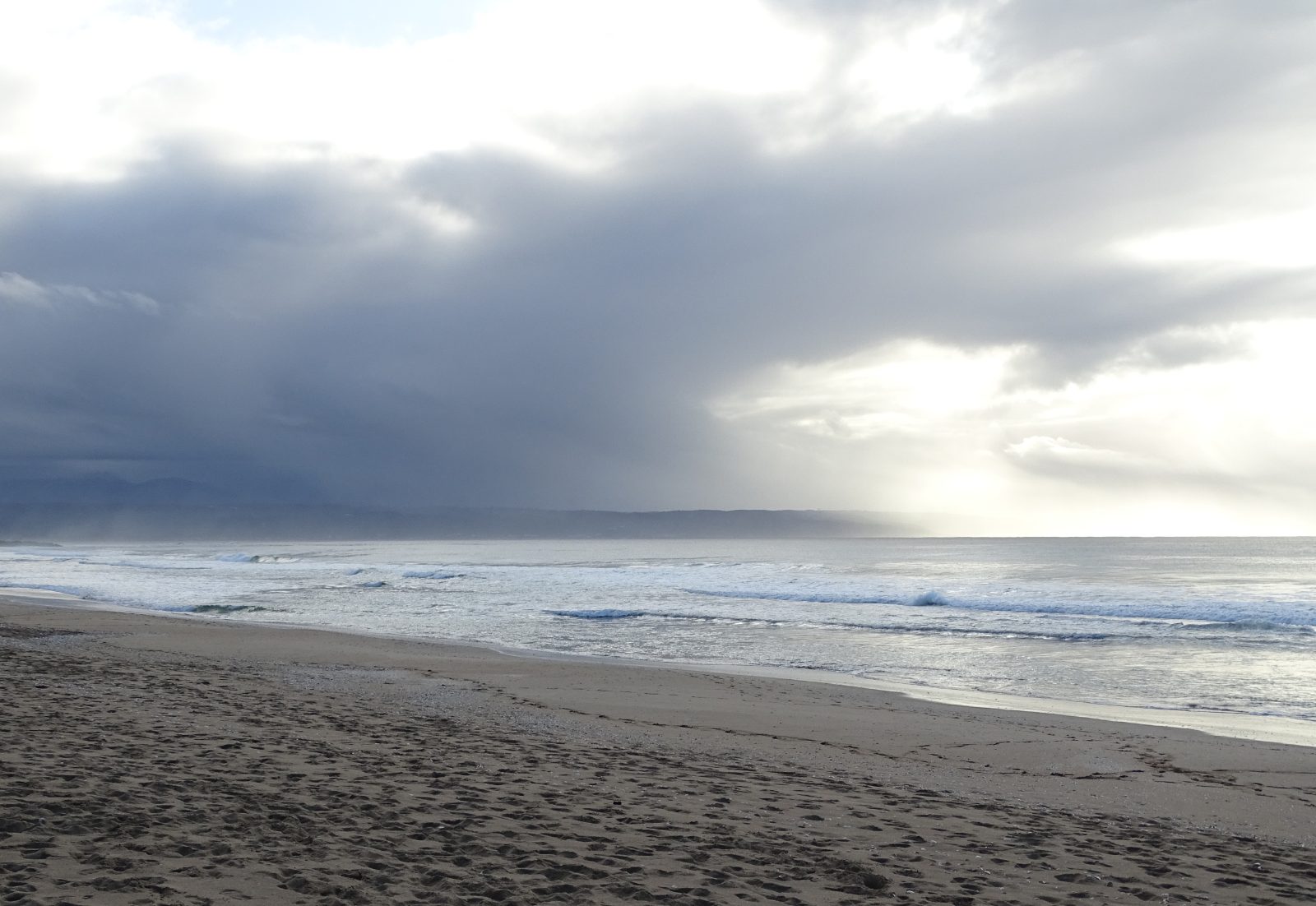
The bay curves for several kilometres and different stretches suit different things.
- Central Beach — below the town, sheltered, with the boat launch and the easiest access. The busiest.
- Robberg Beach (Lookout) — the long main stretch running south towards the peninsula. Good for walking and surfing.
- Keurbooms Beach — the northern arm of the bay, past the river mouth, long and much emptier.
- Nature’s Valley — half an hour east, inside the national park, a beach at the mouth of a lagoon with forest behind it. One of the finest on the coast.
Lifeguard cover is seasonal and concentrated at the main beaches. Swim where there are flags, and be aware that the bay generates rip currents like any open coast.
Blue Flag status. Plettenberg Bay has an unusual concentration of Blue Flag beaches. For the 2025/26 season WESSA, which runs the programme in South Africa, awarded full Blue Flag status to six beaches in the Bitou municipal area: Robberg V, The Dunes, The Waves, Singing Kettle, Nature’s Valley and Lookout Beach. Nature’s Valley additionally holds Green Coast certification. Blue Flag is awarded season by season against water quality, safety, facilities and environmental management criteria, so treat the list as current rather than permanent.
Robberg Nature Reserve
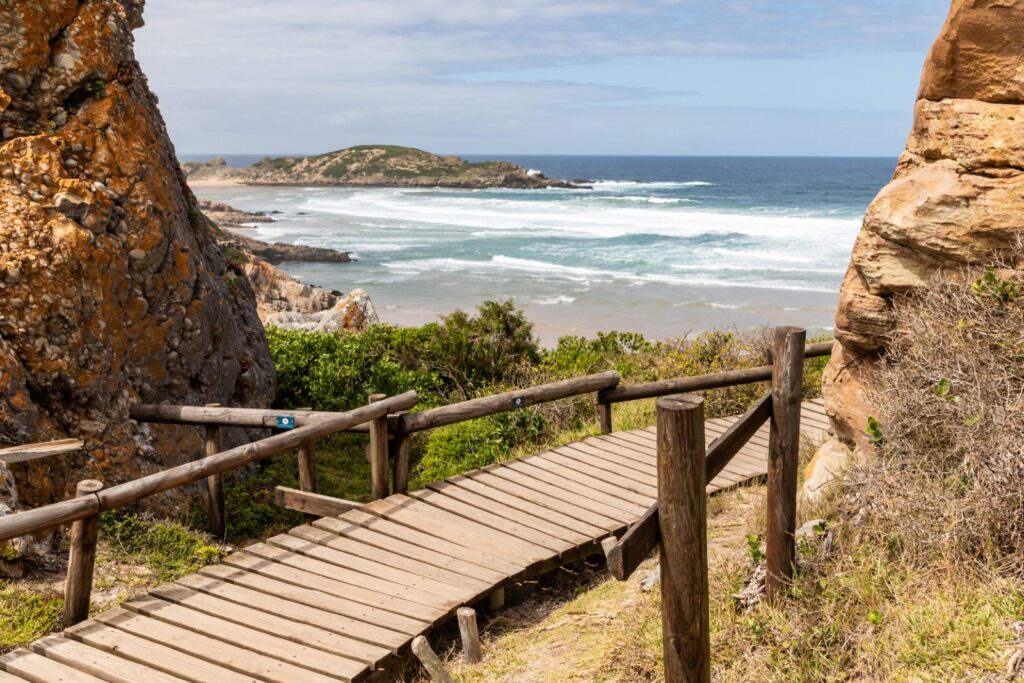
The Robberg peninsula is the reason to prioritise Plettenberg Bay over the other Garden Route towns. It is a CapeNature reserve on a rocky headland running four kilometres out into the sea, with a resident Cape fur seal colony, seabird breeding sites, and archaeology going back to the Stone Age.
CapeNature sets out three circular routes:
- The Gap circuit — 2.1 km, about 30 minutes. The easiest. It takes in a mudstone cleft that exposes evidence of the break-up of Gondwana around 120 million years ago.
- The Witsand circuit — 5.5 km, about 2 hours. Moderate, along the northern ridge, passing above the seal colony and a kelp gull nursery where the boardwalks were repositioned to reduce disturbance.
- The Point circuit — 9.2 km, about 4 hours. The full peninsula, strenuous, and CapeNature states it is not suitable for young children. Hundreds of gannets, cormorants and terns at the tip.
Access: CapeNature currently publishes 07:00 to 18:00 with no entry after 17:00 for both of its stated seasonal periods, alongside a separate 07:00 to 20:00 line — its own page is internally inconsistent, so confirm with the reserve rather than arriving late on the strength of the longer figure. A day conservation fee applies — at the time of writing R75 for adults and R55 for children, with lower overnight rates — and CapeNature reviews tariffs annually. The tariff sheet these figures come from expires on 31 August 2026, so check the current schedule before you budget. Angling requires a permit obtained before you arrive.
Safety: CapeNature’s own guidance is to wear proper walking shoes, carry water and food, use sunscreen and a hat, not to hike alone, and not to stand near the cliff edges, particularly in strong wind. Swimming from the reserve requires supervision because of strong currents. Take all of that literally; people have died here.
Seals, whales and dolphins — without the promises
The bay is genuinely rich. Southern right whales come into it in winter and spring, humpbacks pass through on migration, Bryde’s whales are resident, and bottlenose and common dolphins are seen regularly. Cape fur seals are permanent residents on Robberg.
None of that is a guarantee. These are wild animals in open water and a boat trip can come back having seen nothing but the coastline, which is still a good hour on the water. The legal position is worth knowing. Under the Threatened or Protected Marine Species Regulations of 2017, approaching a whale by vessel or aircraft closer than 300 metres counts as harassment. A Boat-Based Whale and Dolphin Watching permit is the authorisation that allows a licensed operator to close that gap — which is exactly why you should book with a permitted operator rather than someone offering a cheap ride, and why an operator promising sightings is a warning sign rather than a recommendation.
Around the seals: keep well back, stay on the paths and boardwalks, and never get between an animal and the water. Cape fur seals are large, fast on rock and will bite; a bite carries a serious infection risk. Do not approach a seal that has hauled out on a town beach — report it rather than crowding it.
Beyond the beach
- Keurbooms River — canoeing and boat trips up a forested river gorge north of town. One of the best half-days here.
- Nature’s Valley and the Tsitsikamma fringe — the eastern end of the Garden Route National Park, half an hour away, with forest, a lagoon and the start of the Otter Trail.
- Bloukrans — the bridge on the N2 east of town, best known for the bungee operation. A commercial activity; check current operation and conditions directly.
- Wine — a small cool-climate wine district has developed on the hills behind Plett, mostly focused on cap classique and pinot noir.
- Animal sanctuaries — several private facilities operate near Plett. Standards vary enormously. Look for genuine sanctuary practice — no breeding, no interaction with predators, no cub petting — and if an operation lets you touch or walk with a big cat, that is a reason not to go.
Plettenberg Bay with children
Of the Garden Route towns, Plettenberg Bay is the one that works most easily with children, and that is mostly down to the water. Central Beach and Hobie Beach sit inside the bay, where the headland takes the worst off the swell, so the surf is gentler than on the open coast and the walk from car to sand is short. Lifeguards are seasonal and concentrated at the main beaches, so swim at a patrolled one and treat the rest as walking beaches — this is still an open ocean coast and it produces rip currents like any other.
Robberg is the obvious outing, and the reserve is designed for exactly this problem: the Gap circuit is 2.1 km and takes about half an hour, which most children manage happily, while the 9.2 km Point circuit is the one CapeNature specifically says is not suitable for young children. Do the short one, look at the seals from the boardwalk, and do not talk yourself into the long one because you are already there.
Beyond that, Plettenberg Bay has more wet-weather and small-child options than the towns either side of it, which matters on a coast that rains in every month. A boat trip out of the bay is a reasonable family activity provided you book a permitted operator and set expectations honestly beforehand — nobody is promising you a whale.
Plettenberg Bay, Tsitsikamma and route logic
Plettenberg Bay is the last substantial town before the Garden Route runs out into the Tsitsikamma, and that position is the argument for basing here rather than pushing further east. Nature’s Valley is roughly half an hour away down the Groot River pass, and the Tsitsikamma section of Garden Route National Park — Storms River Mouth, the suspension bridge, the coastal boardwalks — is a comfortable day trip. Doing all of that from Plettenberg Bay and coming back to the same bed is easier than adding another one-night stop, and it is what most week-long routes end up doing.
Westward the logic is just as simple. Knysna is about half an hour away, which is close enough that plenty of visitors treat the two as one destination with two bases. If you only have one, Knysna gives you the estuary and the forests, and Plettenberg Bay gives you the beaches and Robberg. Split the week between them rather than choosing, if you can.
Check the park’s current notices before building a day around Tsitsikamma specifically. Sections of it close after storms — the suspension bridge was shut for a stretch in July 2026 — and access arrangements at the newer gates have changed, with several now card-only and taking no cash at all.
Getting there and around
By car — Plett is on the N2, half an hour east of Knysna and about an hour and a half west of Storms River. From Cape Town it is five and a half hours; from Port Elizabeth about two and a half. George, an hour and a half west, has the nearest significant airport.
Around town — the central beaches are walkable from the town centre, but Robberg, Keurbooms and Nature’s Valley all need a car. Distances are short; the parking at Robberg fills in high season, so go early.
When to come
- December and early January — peak South African holiday season. Plett is famously busy, prices roughly double, and Robberg’s car park is full by mid-morning.
- February to April — the best of it. Warm sea, settled weather, schools back, prices normal.
- June to October — cooler, greener, and whale season. Excellent for walking and for shore-based whale watching.
- Rain — possible in any month on this coast. Do not plan around guaranteed sun.
Where to stay in Plettenberg Bay
Check availability in Plettenberg Bay
Plett runs from beachfront hotels and holiday apartments to guesthouses in the streets behind. It is the most seasonal town on this coast: December and early January fill months ahead and prices move sharply.
See Plettenberg Bay stays on Booking.comAffiliate link. We may earn a commission if you book through it, at no additional cost to you. See our affiliate disclosure.
Plett works better than Knysna as a base if your trip is built around beaches and walking, and slightly worse if it is built around forests and the estuary. Many people split two nights each way; if you only have one town, Knysna is more central and Plett is more relaxing.
Accommodation runs from beachfront hotels and apartments on Robberg Beach through guesthouses in the town to self-catering houses at Keurbooms and out towards Nature’s Valley. A beachfront address is worth the premium here because the beach is genuinely usable. December must be booked months ahead.
Nearby, and what to do next
- 10 days: Cape Town and the Garden Route — where Plett sits at the end of a ten-day trip.
- Garden Route with kids — Plett for beach-led family trips, and which Robberg circuit suits which age.
- Cape Town to the Garden Route — the full drive from Cape Town, and why you should not do it in one go.
- Where to stay on the Garden Route — choosing between Mossel Bay, George, Wilderness, Knysna, Plettenberg Bay and Oudtshoorn.
- Knysna — half an hour west, for the estuary, the Heads and the forests.
- Nature’s Valley and Tsitsikamma — half an hour to an hour and a half east, in Garden Route National Park.
- Keurboomstrand and the Keurbooms River — ten minutes north.
- Oudtshoorn — about two hours inland, over the mountains into the Klein Karoo.
- Garden Route & Klein Karoo overview — how the region fits together.
- 7-day Garden Route itinerary — where Plett sits in a full route.
Planning the wider trip: the 7-day Garden Route itinerary gives Plett two nights and a Robberg morning, Self-Drive Western Cape covers the driving, Where to Stay in the Western Cape explains the seasonal pricing you will run into here, and Things to Do covers the wider province.
Further west along the N2: Wilderness for the lakes and lagoon, George for the airport and the mountain passes, and Mossel Bay where the Garden Route begins.
Practical notes
- Go to Robberg early — parking is limited, no entry after 17:00, and the walk is better before the wind.
- Water on Robberg — there is none on the trail. Carry your own.
- Cliff edges — CapeNature warns about them explicitly. In strong wind, stay back.
- Seals — keep your distance, on the reserve and on the beach.
- Sun — the peninsula has no shade for most of its length.
- December — book everything, and expect the N2 to be slow.
Official sources
- CapeNature — Robberg Nature Reserve — the three circuits, hours, conservation fees, permits and safety guidance.
- SANParks — Garden Route National Park — Nature’s Valley, Tsitsikamma and the surrounding protected areas.
- Garden Route & Klein Karoo Tourism — the regional destination body.
- Bitou Municipality — local beach, lifeguard and road notices for Plettenberg Bay.
- Department of Forestry, Fisheries and the Environment — boat-based whale watching permits and marine mammal regulations.
Where to stay, and what to book
Our Plettenberg Bay accommodation page carries a short orientation to the area and a live availability map. For experiences, see Garden Route Tours & Activities.