

Hero image: Michael Fu, CC BY-SA 3.0, via Wikimedia Commons
Constantia is unusual: a serious wine region that happens to sit inside a major city. It is fifteen to twenty minutes from the City Bowl, it has been making wine since 1685, and it is the oldest continuously producing wine area in the southern hemisphere. If your trip has no room for a night in the Cape Winelands, this is the answer.
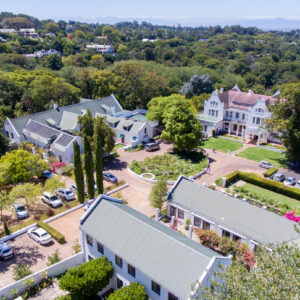
It also gets sold badly. A list of eight estates tells you nothing about what the valley is actually like — a green, wooded, cool suburb on the eastern slopes below the back of Table Mountain, with old white-gabled farms among the oaks and a climate that produces quite different wine from Stellenbosch an hour away.
Where to stay in Constantia
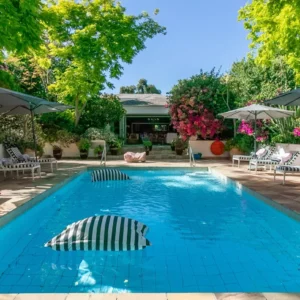
Three country-house hotels in the valley, all within a short drive of the historic wine farms.
Places to stay
Steenberg Hotel & Spa, Constantia Valley
A five-star hotel on a historic working wine estate in the Constantia valley, with golf, a spa and two restaurants…
View Property DetailsThe Cellars-Hohenort, Constantia
A 51-room hotel in nine acres of gardens in the Constantia valley, fifteen minutes from the city centre.
View Property DetailsThe Last Word Constantia
A small boutique hotel on a quiet lane in the Constantia valley, minutes from the wine estates.
View Property Details

In this guide
- Constantia in brief
- Why the wine here is different
- Groot Constantia and the Cape Dutch heritage
- The estates, and how visiting actually works
- Drinking and driving: plan it properly
- Beyond the tasting rooms
- When to come
- Where to stay in Constantia
- Constantia or the Cape Winelands?
- Nearby, and what to do next
- Official sources
Constantia in brief
- What it is — a wine-producing valley and residential suburb in Cape Town’s Southern Suburbs.
- Founded — 1685, by Simon van der Stel, then governor at the Cape.
- The wine route — eight member estates, all within a few minutes of each other.
- Known for — sauvignon blanc, semillon, cool-climate reds, and the sweet Vin de Constance.
- Time needed — half a day for two estates and lunch; a full day with Kirstenbosch added.
- Getting around — you need a car or a driver. There is no useful public transport between the estates.
Why the wine here is different
Constantia sits on the eastern flank of the mountain chain that runs south from Table Mountain, facing False Bay. Cool air comes off the water, the summer south-easter drags cloud over the ridge, and the vineyards sit high enough to hold onto acidity. The result is a cooler-climate style than the inland Winelands: taut sauvignon blanc and semillon, elegant rather than heavy reds, and long-lived sweet wine.
That last category is the historic one. Vin de Constance, the sweet wine made from muscat grapes in this valley, was one of the most sought-after wines in eighteenth and nineteenth-century Europe. It appears in Jane Austen’s Sense and Sensibility and in Dickens, and it is widely reported to have been shipped to Napoleon in exile on Saint Helena. Production lapsed after phylloxera destroyed the vineyards in the late nineteenth century and was revived at Klein Constantia in the 1980s.
Groot Constantia and the Cape Dutch heritage
Groot Constantia is the original farm and the one to visit if you visit only one. It is South Africa’s first wine farm, established in 1685, and it is a heritage site as much as a working estate: a white-gabled Cape Dutch manor house, the Cloete Cellar, formal gardens and old oaks. The manor house and cellar operate as museums alongside the tastings and two restaurants, and the estate is open every day.
The architecture is the point. Cape Dutch is a specific vernacular — whitewashed walls, thatch, symmetrical plan, and an ornate curved gable over the front door — developed at the Cape in the seventeenth and eighteenth centuries, and Constantia has one of the best concentrations of it anywhere. It is worth remembering what these farms were: they were built and worked by enslaved people, and the manor house you photograph is one half of a landscape whose other half was slave quarters. Groot Constantia’s own interpretation covers this.

The estates, and how visiting actually works
The Constantia Wine Route currently has eight member estates: Groot Constantia, Klein Constantia, Buitenverwachting, Steenberg, Constantia Glen, Beau Constantia, Eagles’ Nest and Constantia Royale. They are all within a few minutes of one another, and between them they cover the range from large and historic to small and modern.
Do not assume every estate is simply open. These are private businesses with different arrangements: some take walk-ins, some require a booking for tastings, some open only on certain days, and some have separate booking systems for the cellar, the restaurant and the picnic. Opening hours also change seasonally. Check each estate directly for the day you plan to go, and book anything involving food.
- Two estates is the right number for an afternoon. Three is possible; four is a blur and a driving problem.
- Pair a big one with a small one — the historic scale of Groot Constantia against a compact modern tasting room reads better than two of the same.
- Book lunch — the valley’s restaurants fill, particularly at weekends and over the holidays.
- Picnics usually need ordering a day ahead, and outside food is generally not allowed on the estates.
Drinking and driving: plan it properly
This is the part most wine-route write-ups skip. The estates are spread out, there is no public transport between them, and South Africa enforces a low legal blood-alcohol limit with real consequences. Tasting at two estates and then driving is not a grey area.
- Use a driver. E-hailing works well in Constantia and a hired driver for the afternoon is not expensive split between a few people.
- Or nominate one — and mean it. Most estates are relaxed about a non-drinker joining a tasting.
- Or spit. Every tasting room provides a spittoon and nobody thinks less of you. It is what the trade does all day.
- Or stay in the valley and walk or taxi short distances.
Beyond the tasting rooms
Constantia is more than its estates, and the surrounding area is what makes a full day here work.
- Kirstenbosch National Botanical Garden — ten minutes north, on the eastern slopes of Table Mountain. One of the great botanical gardens, with the tree canopy walkway and direct access to mountain trails. Easily combined with a Constantia morning.
- Tokai — the arboretum and forest paths at the southern end of the valley, good for walking and cycling. Access can be affected by forestry and fire management.
- Constantia Nek — the pass over to Hout Bay, and the start of the contour path walk up towards the Table Mountain reservoirs.
- Silvermine — the next section of Table Mountain National Park to the south, reached over Ou Kaapse Weg.
- Alphen and the village — a small cluster of shops, delis and restaurants at the heart of the suburb.
When to come
Summer, from December to March, is the classic season: long evenings, outdoor tastings, restaurant terraces. It is also when everything is booked and the valley is busiest. Harvest runs roughly from February into April and is the most interesting time to see a working cellar.
Winter, from June to August, is quietly the better visit for some people. The valley is green, fires are lit indoors, tasting rooms are calm enough to actually talk to someone, and prices soften. Bring a jacket and expect rain.
Where to stay in Constantia
Constantia is a genuinely good Cape Town base if you are driving and want quiet, green surroundings rather than a city street. It puts you close to Kirstenbosch, on the right side of town for the M3 south to the peninsula and the N2 east to the Winelands, and about twenty minutes from the city centre outside rush hour.
The trade-off is that you will drive for everything, and the valley is residential rather than lively — there is no walkable evening scene. Accommodation here runs to country-house hotels, guesthouses on old estates and self-catering cottages, and it is generally at the upper end of the market.

Find accommodation in Constantia
Constantia works as a quiet, green Cape Town base if you are driving. Compare guesthouses, estate stays and self-catering in the valley.
Browse places to stay in ConstantiaAffiliate link. We may earn a commission if you book through it, at no additional cost to you. See our affiliate disclosure.
Constantia or the Cape Winelands?
They are not competitors so much as different amounts of commitment. Constantia is a half-day from wherever you are staying in Cape Town, with no driving of consequence and no overnight required. Stellenbosch, Franschhoek and Paarl are forty-five minutes to an hour and a quarter away and reward at least one night.
If you have four days in Cape Town, do Constantia. If you have a week, do both — they taste different, and the inland valleys give you mountains, towns and scale that a city suburb cannot.
Nearby, and what to do next
- Where to stay in the Cape Winelands — the three overnight Winelands towns, and why Constantia is not one of them.
- Cape Winelands day trip — where Constantia fits, and what it does not substitute for.
- Southern Suburbs — the wider cluster, including Newlands, Rondebosch and the museums along the M3.
- Kirstenbosch — ten minutes north, and the natural pairing for a Constantia day.
- Hout Bay — fifteen minutes over Constantia Nek.
- False Bay and the Southern Peninsula — Muizenberg and Kalk Bay are twenty minutes down the M3.
- Table Mountain — the mountain directly above the valley.
- Things to do in the Western Cape — where wine fits among everything else.
Official sources
- Constantia Wine Route — the member estates and current visitor information.
- Groot Constantia — opening times, museums, cellar tours and restaurants.
- SANBI — Kirstenbosch — official garden visitor information.
- SANParks — Table Mountain National Park — Tokai, Silvermine and the trails above the valley.
- Cape Town Tourism — current destination information.
Where to stay, and what to book
Our Southern Suburbs & Constantia accommodation page carries a short orientation to the area and a live availability map. For experiences, see Cape Winelands Tours.