
V&A Waterfront
A working harbour that also happens to be Cape Town’s busiest visitor precinct — and the departure point for Robben Island.
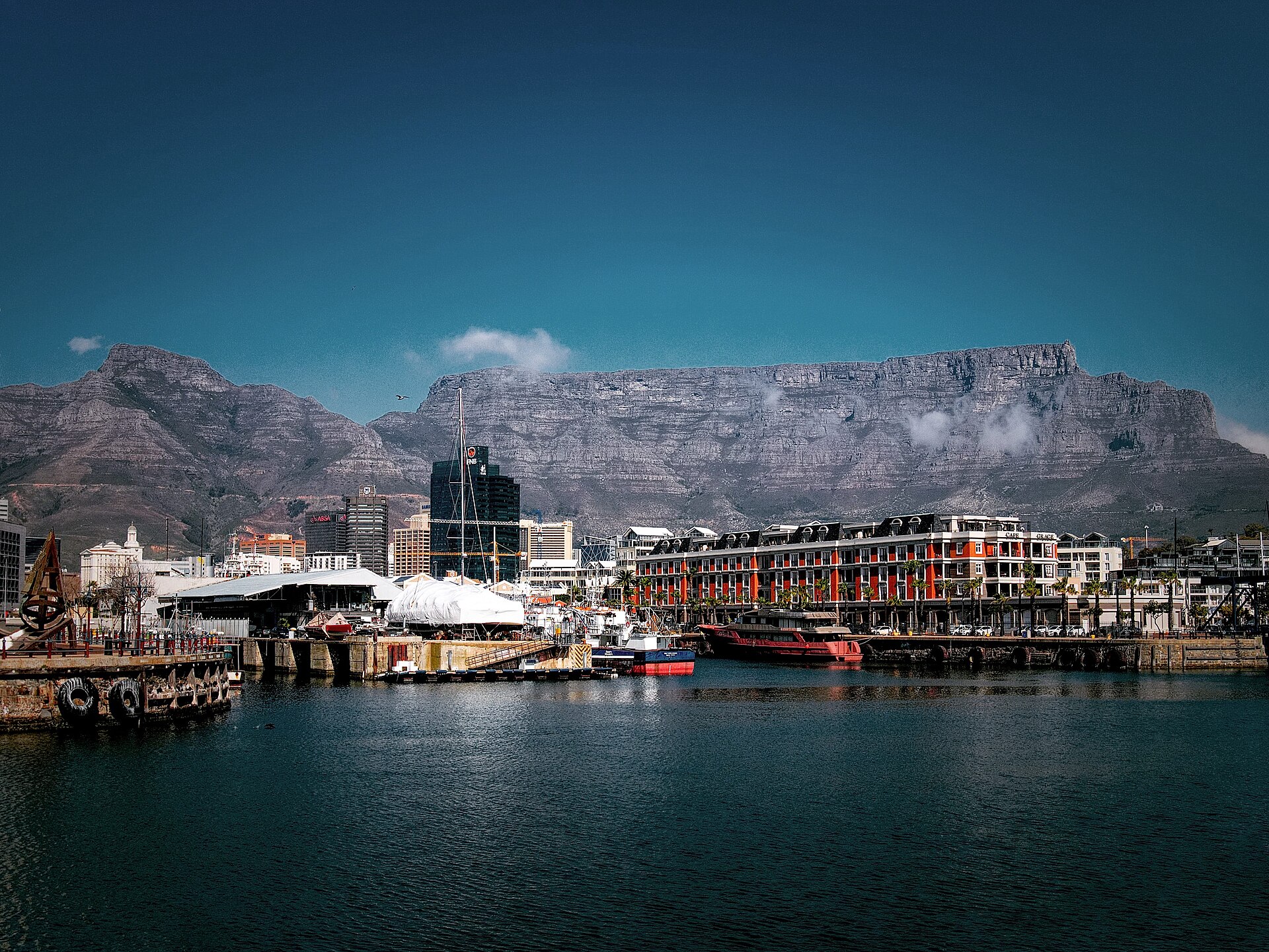
Hero image: Cape Town Table Mountain.jpg by Matthiasmullie, CC BY-SA 4.0, via Wikimedia Commons.
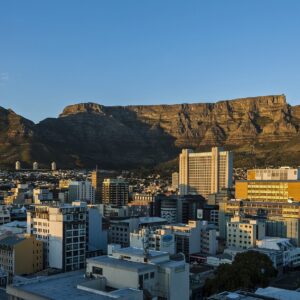
The V&A Waterfront occupies the Victoria and Alfred basins, the oldest part of Cape Town’s harbour, immediately north of the city centre and directly beneath Table Mountain. It is a 123-hectare mixed-use precinct with several hundred shops and restaurants, three significant museums, an aquarium, and the ferry terminal for Robben Island.
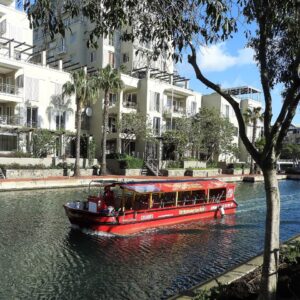
What distinguishes it from a conventional shopping and dining development is that the harbour still works. Fishing vessels and commercial craft move in and out of the basins during the day, cranes operate, and the tugs are real. It is one of the oldest working harbours in the southern hemisphere, and the neighbourhood has been in use for over 160 years.
V&A Waterfront at a glance
- Location
- Victoria and Alfred basins, immediately north of central Cape Town
- Entry
- Free to enter the precinct; museums, the aquarium and the ferry charge separately
- Open
- Every day of the year, including public holidays
- Time needed
- Half a day for the precinct; a full day if you add the aquarium or a museum
- Busiest
- December and January — roughly 3 million visitors came in December 2025 alone
- Ownership
- 50% Growthpoint Properties, 50% the Government Employees Pension Fund via the PIC
- Information centre
- Victoria Wharf, 09:00–21:00 daily, +27 21 408 7600
Where to stay and what to book at the V&A Waterfront
Hotels on the working harbour itself, and the trips that leave from the quays a few minutes away.
Places to stay
The Silo Hotel, V&A Waterfront
Design-led luxury built into the old grain silo above the Zeitz MOCAA, at the working end of the V&A Waterfront.
View Property DetailsCape Grace, V&A Waterfront
A 112-room hotel on a private quay between the V&A Waterfront and the yacht marina.
View Property DetailsLawhill Luxury Apartments, V&A Waterfront
Serviced one to three-bedroom apartments on the marina inside the V&A Waterfront — kitchens, space and walkable everything.
View Property DetailsInterContinental Table Bay, V&A Waterfront
The large full-service hotel at the end of the V&A Waterfront quay, formerly The Table Bay Hotel — space, a…
View Property Details

Browse all Cape Town accommodation
Tours and experiences
Cape Town: Robben Island Ferry Ticket and Guided Prison Tour
The official components — the ferry from the Waterfront and the guided prison tour on the island.
View Tour DetailsV&A Waterfront Marine Life Kayak Tour, Cape Town
A guided sea kayak out of the working harbour, with Table Mountain behind you and seals alongside.
View Activity DetailsCape Town: Table Mountain Cable Car, Hop-On Hop-Off Bus Tour
The open-top bus network combined with a cableway ticket — the standard first-day package.
View Tour DetailsV&A Waterfront Night Kayaking, Cape Town
The harbour after dark, with the city lit behind you and the mountain a silhouette.
View Activity Details


In this V&A Waterfront guide
- A short history of the V&A Waterfront
- Robben Island ferries
- Two Oceans Aquarium
- Zeitz MOCAA
- Other things in the precinct
- The seals
- Getting to the V&A Waterfront
- Safety and practicalities
- When to visit the V&A Waterfront
- Nearby
- Frequently asked questions
- Plan the rest of your trip
- Official sources for the V&A Waterfront
A short history of the V&A Waterfront
The harbour exists because Table Bay was dangerous. Winter storms in June 1858 wrecked more than thirty vessels, and Lloyd’s of London subsequently refused to insure ships wintering in the bay, which forced the construction of a breakwater. Midshipman Prince Alfred, Queen Victoria’s second son, tipped the first load of stone in September 1860. The two basins are named after him and his mother.
The docks worked as docks for more than a century, declined, and were then redeveloped: the Victoria and Alfred Waterfront company was established in November 1988, originally as a Transnet subsidiary, specifically to convert the historic docklands to mixed use while keeping the harbour operational. Victoria Wharf opened in 1992, the same year the former Breakwater Prison became the University of Cape Town’s Graduate School of Business.

Robben Island ferries
Ferries to Robben Island depart from the Nelson Mandela Gateway in the Clock Tower district. This is the only legitimate departure point, and Robben Island Museum is the only official seller of tours.
Departures are at 09:00, 11:00, 13:00 and 15:00 daily. Arrive at least 30 minutes before departure; boarding gates close 10 minutes before. The full experience takes about three and a half to four hours including both crossings — the museum quotes 3.5 hours on some pages and about 4 hours on others, the difference being that the vessels vary in speed. The standard tour includes the maximum security prison, the lime quarry, the leper graveyard and Robert Sobukwe’s house.
Fares published by the museum: South African adults R400, South African children under 18 R210, non-South African adults R600, non-South African children R310.
Buy only through robben-island.org.za. Search results are crowded with resale sites presenting themselves as official. If ferry tickets are gone, entry to the Nelson Mandela Gateway building itself is free and has substantial exhibitions on Mandela’s life and imprisonment.
Two Oceans Aquarium
On Dock Road, and the strongest single attraction in the precinct for families. The major exhibits are the I&J Ocean Exhibit, a 1.6-million-litre tank you can walk beneath; the Save Our Seas Foundation shark exhibit; a kelp forest; and a penguin exhibit. There are daily feeding presentations, and add-on experiences including behind-the-scenes tours and diving for qualified divers.
Open daily, year round, generally 09:30 to 18:00, with last tickets sold 30 minutes before closing. The aquarium’s own pages are inconsistent about whether weekends, public holidays and school holidays open earlier at 09:00, so check if an early start matters. Admission: adults R280, children 14–17 R210, children 4–13 R130, under 4 free, with R210 rates for South African pensioners and students. Tickets are valid 90 days.

Zeitz MOCAA
The Zeitz Museum of Contemporary Art Africa is a not-for-profit institution collecting and exhibiting contemporary art from Africa and its diaspora. It opened in 2017 inside the historic grain silo, and the building is as much of the attraction as the collection.
The silo was built between 1921 and 1924, stood 57 metres high, and was the tallest building in Cape Town for over fifty years. Grain operations ceased in 1995 and it was decommissioned in 2001. The conversion, by the London architect Thomas Heatherwick, carved roughly 6,000 square metres of gallery and atrium space out of the original 42 concrete silo tubes — the central atrium is the cut-away shape of a grain kernel.
Open daily 10:00 to 18:00, last entry 17:30. Adults R265; under-18s free. Free one-hour guided tours run Monday to Friday at 12:30, booked on arrival.
Above the museum, occupying the silo’s elevator tower, is The Silo Hotel, recognisable from outside by its 82 pillow-shaped windows, each made up of dozens of hand-cut glass panes.
Other things in the precinct
- Nobel Square — free, open-air. Bronze sculptures by Claudette Schreuders of South Africa’s four Nobel Peace Prize laureates: Chief Albert Luthuli, Archbishop Desmond Tutu, FW de Klerk and Nelson Mandela. A fifth work, Peace and Democracy by Noria Mabasa, acknowledges the contribution of women and children.
- The Watershed — an indoor market hall with over 150 independent designers, makers and craftspeople. Much better than the average souvenir market.
- Time Out Market Cape Town — in the Old Power Station building, with 13 kitchens, three bars, a wine bar and a performance stage. Open 08:00–22:00 Monday to Wednesday and Sunday, until 23:00 Thursday to Saturday.
- The Cape Wheel — 40 metres, enclosed air-conditioned cabins, a 15-minute ride of four revolutions. Open from 10:00 or 11:00 depending on the day, until 21:00 or 22:00.
- The Clock Tower — built in 1882 as the Port Captain’s Office, Victorian Gothic, with its original Edinburgh-made clock still running. A landmark to look at rather than a museum to enter.
- Oranjezicht City Farm Market — a genuinely good food market at Granger Bay on weekend mornings and Wednesday evenings.
- The swing bridge — the pedestrian bridge across the Alfred Basin cut, which rotates open to let vessels through. It closes to pedestrians while it swings, so allow a minute or two.
The seals
Cape fur seals haul out on the quaysides and pontoons around the basins, and they are a highlight for most visitors. They are also large, powerful wild animals, and the Two Oceans Aquarium Foundation’s advice is unambiguous: never approach a seal yourself — leave that to the professionals. The harbour population is predominantly male.
There is a purpose-built seal rescue platform in the basin beside the aquarium, used to free animals entangled in fishing line, raffia cord and packaging bands. If you see an injured or entangled seal, call the aquarium on +27 21 418 3823; wildlife monitors are stationed there. The most useful thing visitors can do is cut loops in packaging before discarding it, since a great deal of this debris reaches the harbour through stormwater drains.
Getting to the V&A Waterfront
MyCiTi bus
The Waterfront stop is served by routes T01, T01X, D05, 104 and 113. Route 104 — Oranjezicht–Gardens–Adderley–Waterfront — is the most useful for visitors: it links the City Bowl and Adderley Street to the precinct and continues to Sea Point, with stops inside the Waterfront at Silo, Marina, Aquarium, Nobel Square and Breakwater. Remember that MyCiTi does not accept cash; you need a myconnect card.
City Sightseeing bus
The Waterfront is Stop 1 on the Red City Tour, with the Two Oceans Aquarium as the boarding point and the Clock Tower as Stop 2. It runs daily year round and connects to Table Mountain, Camps Bay and Kirstenbosch.
Driving and parking
There are five monitored parking facilities: Breakwater, Dock Road Junction, Granger Bay, the Cruise Terminal and Virgin Active at the Silo. Tariffs start at R10 for the first hour and are capped at R120 for 12 to 24 hours. Clocktower/Silo and Battery parking are free on Saturdays and Sundays. Pick n Pay validates parking at several garages.
Walking from the city centre
Worth being straight about: the Waterfront is physically close to the Foreshore and pedestrian routes exist, but no official source publishes a recommended walking route, distance or time from Cape Town station or the City Bowl, and none endorses the walk. The approach crosses the Foreshore highway interchanges and the industrial edge of the port. Take route 104, the City Sightseeing bus or a ride-hail instead. Once you are inside the precinct, walking is easily the best way to get around.
Safety and practicalities
The V&A operates 24-hour on-site security with camera monitoring, controlled access points and lit walkways, and describes itself as one of the safest pedestrian spaces in Cape Town after dark. That last claim is the precinct’s own assessment rather than an independent finding, but the underlying facts — permanent security presence, constant footfall, good lighting — are real, and it is the part of the city where visitors most commonly walk around comfortably in the evening. Security can be reached on +27 21 408 7708.
The precinct is designed for wheelchairs and pushchairs, with level routes and clear wayfinding. The aquarium has accessible flooring and dedicated parking bays. Robben Island publishes no accessibility statement, and the walking tour explicitly requires fitness, so contact the museum directly if this matters.
When to visit the V&A Waterfront
December and January are the busiest by a wide margin. Outside those months the precinct absorbs crowds well because it is large. The obvious fixed points to plan around are the four Robben Island sailings and Zeitz MOCAA’s 17:30 last entry. Evenings are pleasant and the Table Mountain view across the basin is at its best in late afternoon.
Places to stay around the V&A Waterfront
Staying in the precinct is convenient, secure and easy with luggage, and it is the departure point for the Robben Island ferry. It is also the most expensive part of the city, so it is worth comparing against Green Point and the City Bowl.
Browse places to stay around the V&A WaterfrontAffiliate link. We may earn a commission if you book through it, at no additional cost to you. See our affiliate disclosure.
Nearby
Frequently asked questions
Is the V&A Waterfront worth visiting if I do not want to shop?
Yes. Zeitz MOCAA, the Two Oceans Aquarium, Nobel Square, the Nelson Mandela Gateway and the Robben Island ferry are all reasons to come that have nothing to do with retail, and the working harbour itself is interesting to walk around.
How far in advance should I book Robben Island?
As early as you can, and preferably for the first part of your stay so that a weather cancellation can be rebooked. Tickets regularly sell out.
Do I need to pay to enter the Waterfront?
No. The precinct is free and open every day of the year. You pay only for individual attractions and for parking.
Can I see Table Mountain from the Waterfront?
Yes — the precinct sits directly beneath it, and the view across the Alfred Basin is one of the most photographed in the city. The Cape Wheel gives a raised 360-degree version.
Plan the rest of your trip
The Waterfront is easy to combine with the rest of the city and with a wider route.
- Robben Island tours — the ferry leaves from the Nelson Mandela Gateway here; how the products differ.
- Cape Town without a car — how the Waterfront works as a car-free base, and what it costs you.
- Where to stay in Cape Town — whether the Waterfront is the right base for your trip, and what the alternatives are.
- Cape Town with kids — what actually works with children, how age changes the plan, and wet-weather fallbacks.
- Cape Town — the full city guide and how the areas fit together.
- Table Mountain — the obvious pairing on a clear day.
- Itineraries — three, five and seven-day plans that include a Waterfront afternoon.
- Self-drive guide — parking here, and driving onward from the city.
- Travel planning — practical basics before you arrive.
- Things to do — what else is worth your days.
- Accommodation — staying in and around the precinct.
Official sources for the V&A Waterfront
Opening hours, entry fees, permit rules, park closures and seasonal access all change, and we do not republish them here as fixed facts. Before you travel, check the operators and conservation authorities directly:
- V&A Waterfront — the official precinct site for tenants, events and opening hours.
Build the Waterfront into your Cape Town days
It pairs naturally with Robben Island in the morning and the city’s museums in the afternoon.
Where to stay, and what to book
Our V&A Waterfront & Green Point accommodation page carries a short orientation to the area and a live availability map. For experiences, see Robben Island Tours.