
Yes — you can visit Cape Town without a car, and a large number of people do it well. But the honest answer has a boundary in it, and knowing where that boundary falls is the whole point of this page. Central Cape Town is manageable car-free. The Cape Peninsula, the Winelands and the wider Western Cape are not.
This guide is about that distinction: where car-free travel works comfortably, where it becomes inconvenient rather than impossible, and where you should stop pretending and hire something.
In this guide
The short answer
- A city-only trip of three or four days: no car needed. Stay in the City Bowl, the V&A Waterfront or Sea Point, and you can walk, bus and e-hail everything you are likely to want.
- A week that includes the Peninsula: a car for part of it. Hire for two or three days rather than the whole trip, or take a tour on those days.
- Anything beyond Cape Town — Winelands, Whale Coast, Garden Route, Cederberg: hire a car. This is not a preference. Public transport does not go to those places in any useful form.
Cape Town is not a walkable city
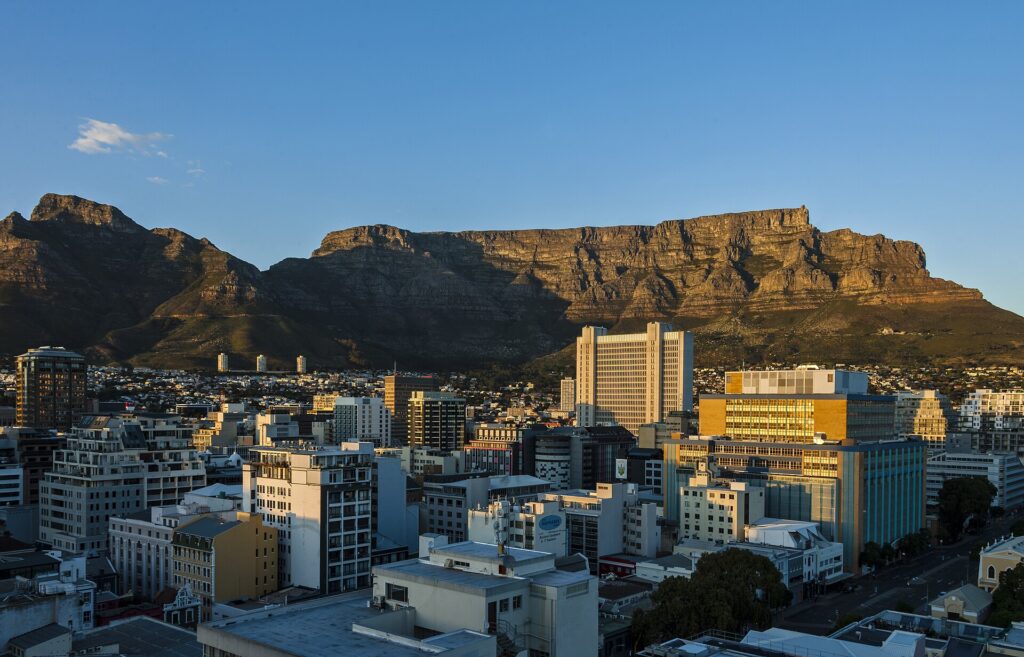
Parts of it are very walkable. The city as a whole is not, and the difference catches people out. Cape Town is spread along a mountain and two coastlines: the City Bowl to Camps Bay is a mountain in between, not a stroll, and the Southern Suburbs and the Peninsula are a long way south of everything. Plan neighbourhood by neighbourhood, not city-wide.
Where to stay if you have no car
Where you sleep matters more without a car than with one, because it decides how much of your day is spent getting places. Three areas work; the rest of the city is harder.
City Bowl
The strongest all-round choice. You can walk to the city centre, the Company’s Garden, the museum district, Bo-Kaap, Kloof Street and most of the restaurants you have read about. MyCiTi runs from here, e-hails are quick and cheap because you are central, and the Table Mountain cableway is a short ride rather than an expedition. The trade-off is that the CBD empties in the evening, so pick your street with some care and read the Cape Town guide’s safety section rather than assuming.
V&A Waterfront
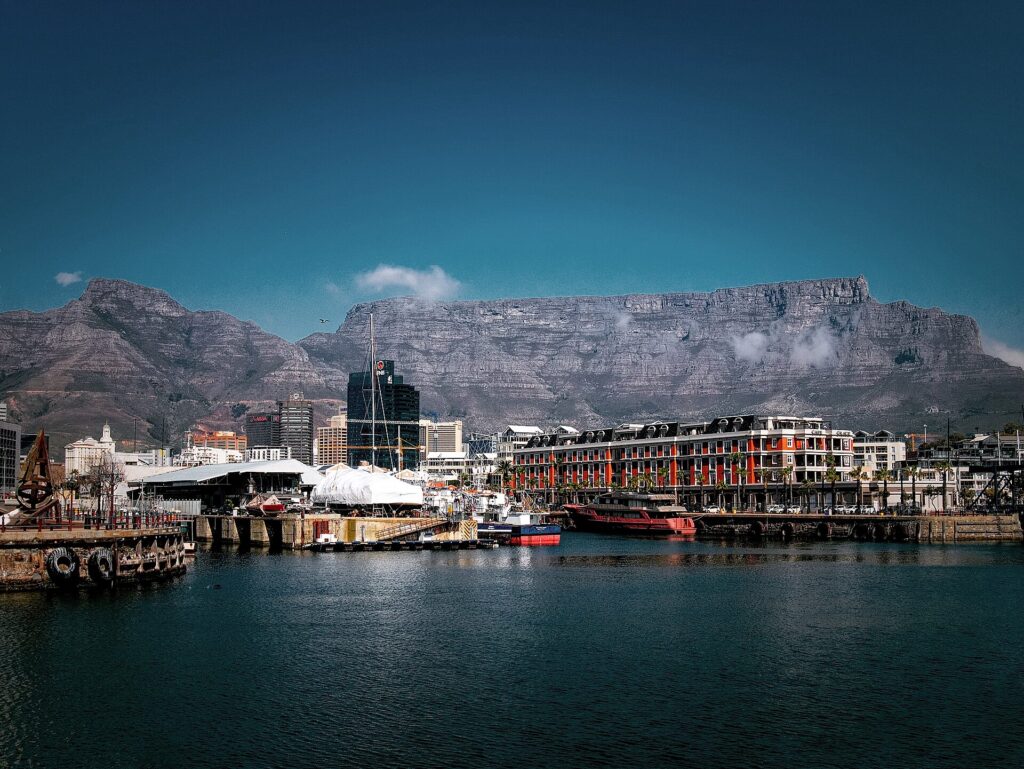
The easiest and the most insulated. Everything within the precinct is walkable and secure, the aquarium and the Robben Island ferry are on site, and MyCiTi connects it to the city and Sea Point. It is also the most expensive, the least like the rest of Cape Town, and the option most likely to leave you feeling you visited a development rather than a city.
Sea Point and Green Point
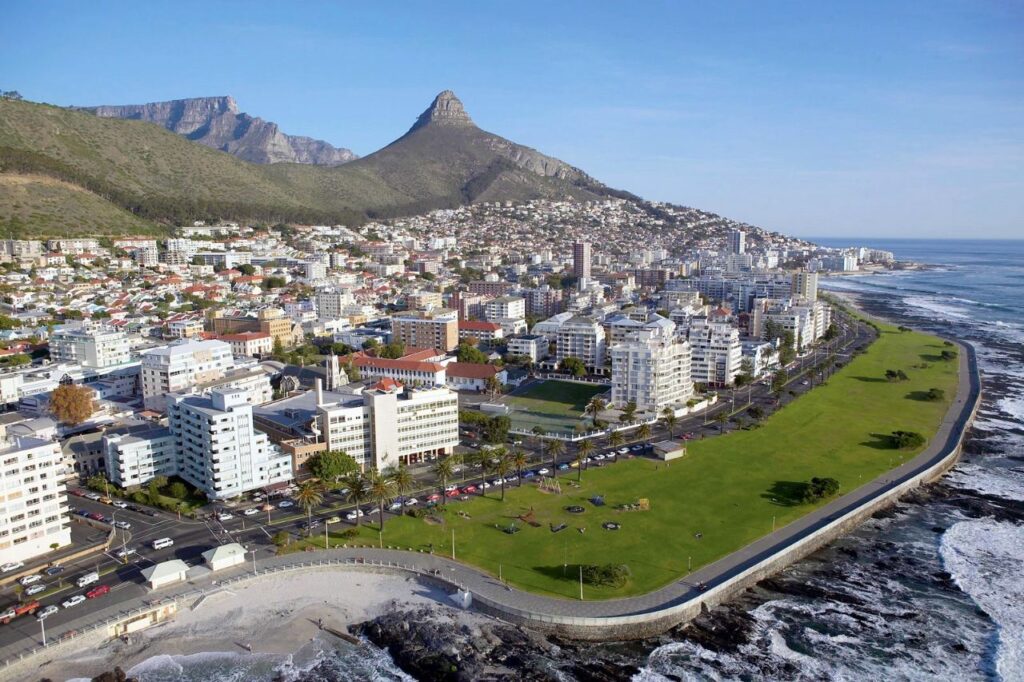
The best compromise of the three. The promenade is genuinely flat, genuinely long and genuinely used by locals, and you can walk it for miles. Sea Point has ordinary shops, ordinary restaurants and ordinary prices alongside the sea views, MyCiTi runs along it, and you are ten minutes from both the Waterfront and the City Bowl. If we had to pick one base for a car-free week, this would be it.
Read where to stay in Cape Town for the full neighbourhood-by-neighbourhood comparison, including the areas this page rules out. That guide covers the accommodation decision properly; this one only covers the transport consequences of it.
Live accommodation in walkable Cape Town
If you are travelling without a car, staying inside the walkable core matters more than anything else on this page. The map is centred on the City Bowl; keep your search tight to the areas described above rather than drifting out to places that assume you can drive.
Affiliate disclosure: the map below is supplied by Stay22 and shows live availability and prices from independent booking sites. Cape Town Travel Guide may earn a commission on a qualifying booking, at no extra cost to you. We do not set these prices, do not take payment, and are not the merchant of record.
Getting from the airport
There is no airport bus. The MyCiTi A01 airport service has been suspended since December 2022, and the official MyCiTi airport page still carried the notice “the Airport service is temporarily suspended” when we checked it on 21 August 2026. A great many guides — and occasionally official-looking pages — still tell visitors to take it. Do not plan around it.
Cape Town International is about 20 km from the centre on the N2. Without a hire car your options are a metered taxi from the rank, a pre-booked shuttle, or e-hailing, which has a designated pickup area at the airport. Any of the three is straightforward; the shuttle is usually the calmest choice after a long-haul arrival.
Walking: what is actually walkable
Cape Town rewards walking in pockets. These are the ones that work:
- The City Bowl core — the CBD, Company’s Garden and museum district, Bo-Kaap and Kloof Street form a connected, walkable area. Bo-Kaap is a steep few blocks up; the rest is flat.
- The Sea Point promenade — flat, continuous and several kilometres long, running to Mouille Point and the lighthouse at one end and towards Bantry Bay at the other.
- The V&A Waterfront — entirely walkable within itself, and walkable to Green Point, though the stretch between them is dull rather than difficult.
- Individual neighbourhoods elsewhere — Kalk Bay’s main street, Simon’s Town’s waterfront, Camps Bay’s beachfront strip. Each is walkable once you are there. Getting there is the question.
What does not work is walking between these areas. The City Bowl to Camps Bay means crossing Kloof Nek; the City Bowl to the Waterfront is about twenty minutes through a stretch that is fine by day and not recommended after dark. Treat each pocket as a destination you arrive at.

MyCiTi
The city’s bus rapid transit system is clean, safe and genuinely useful — within its footprint. That footprint is the point.
- It covers the City Bowl and CBD, the V&A Waterfront, Sea Point, Camps Bay and Hout Bay — which is to say, most of what a car-free visitor wants.
- It does not cover the Southern Suburbs or the southern Peninsula. You cannot reach Kirstenbosch, Boulders or Cape Point by MyCiTi. This is the single most important limitation and it is the one most often glossed over.
- Cash is not accepted. You need a myconnect card, which costs R40 and is sold at station kiosks and some retailers. Fares are distance-based and you tap in and out. Multi-day unlimited packages exist and suit visitors doing several trips a day.
- The airport route is suspended — see above.
Used within its area, MyCiTi is the cheapest way to move around Cape Town and there is no reason for a visitor to avoid it. Used as a plan for seeing the Peninsula, it will fail.
Trains
The Southern Line down the False Bay coast is the one rail route with real visitor use. It runs from Cape Town past Observatory and the Southern Suburbs, then along the shoreline through Muizenberg and Kalk Bay to Fish Hoek, and it is cheap and properly scenic — for part of the route the sea is directly outside the window.
It has also improved. Service to Fish Hoek is reasonably dependable, with trains through the day rather than a skeleton timetable, and guards on the carriages on that section.
The Simon’s Town question, honestly
For years the last stretch from Fish Hoek to Simon’s Town ran only as an unreliable shuttle, or not at all. In February 2026 the Simon’s Town Civic Association reported, citing PRASA, that direct weekday trains between Cape Town and Simon’s Town had resumed, with a Fish Hoek shuttle on Saturdays and no regular Sunday or public holiday service. Checked 21 August 2026, we could not find a PRASA statement confirming that this still holds. Do not build a day around reaching Simon’s Town by train without checking current timetables first. This line has changed repeatedly.
More broadly: this is a commuter railway, not a tourist product, and it should not be described as one. Ticketing is cash-based, ticket offices are sometimes closed, many stations have no gates, and phone theft is reported on this line. The sensible way to use it is in daylight, in a busy carriage, with nothing visible. Used that way it is a good experience and a cheap one. It is not a substitute for a transport network.
E-hailing and taxis
E-hailing is how most car-free visitors actually get around Cape Town, and within the city it works well: coverage is good, waits are short in the central areas, and fares are low by European or North American standards. It is the natural way to reach Constantia, Kirstenbosch, the Southern Suburbs and Camps Bay, none of which MyCiTi serves usefully.
Two caveats worth carrying. First, the sector is in the middle of a national re-registration process, so which apps are operating could shift — do not arrive with only one installed. Second, coverage thins with distance: getting out to the far Peninsula is usually possible, getting a car back from Cape Point or a Winelands estate late in the day is much less dependable. Metered taxis exist and are fine from ranks and hotels.
Minibus taxis are how most Capetonians travel and are not a curiosity. They are also unmetered, often overloaded, and the US State Department explicitly advises visitors against using them. That conflict is worth knowing about rather than being told one side of.
Organised tours
For a car-free visitor, a day tour is not a compromise — it is the efficient answer to exactly the places public transport does not reach. A Peninsula day tour covers Chapman’s Peak or its alternative, Cape Point and Boulders in one day, which is otherwise the single hardest thing to do without a car. The same applies to a Winelands day: someone else drives, which also solves the drinking problem.
The trade-off is fixed itineraries and fixed pace. Read the Cape Peninsula day trip for what a good version of that day contains, so you can judge whether a given tour is offering it.
Where a car becomes useful
This is the boundary. Everything above is comfortably car-free. Everything below gets progressively harder, and at some point stops being sensible.
| Destination | Without a car | Verdict |
|---|---|---|
| Cape Peninsula — Cape Point, Boulders, Chapman’s Peak | No public transport reaches Cape Point or Boulders. E-hail out is possible; back is unreliable. | Tour or hire car. The clearest case on this list. |
| Constantia and Kirstenbosch | Not on MyCiTi. E-hail works well — you are still inside the city. | Fine without a car. |
| Cape Winelands | No useful public transport. Getting between estates is the problem, not getting there. | Tour, hired driver, or the Franschhoek Wine Tram. |
| Whale Coast and Hermanus | Shuttles exist; moving around once there does not work. | Hire a car. |
| De Hoop | Three hours out, last stretch on gravel, no transport of any kind. | Car essential. |
| Cederberg | Remote, gravel access, nothing to hail. | Car essential. |
| Garden Route | Intercity buses connect the towns; everything worth stopping for is between them. | Hire a car unless you genuinely only want the towns. |
| Route 62 | The road is the attraction. | Car essential. There is no car-free version of a scenic drive. |
City trip or road trip?
The distinction that resolves most of this: a Cape Town city trip and a Western Cape road trip are two different holidays, and a great many itineraries are quietly both without admitting it.
If your trip is four days in Cape Town with a mountain, some beaches, the museums, good food and one day tour, you do not need a car and hiring one will mostly cost you parking and stress. If your trip includes the Winelands, the Whale Coast or anything east of Somerset West, you need a car for that portion — and the neat solution is usually to hire for part of the trip only, picking the car up on the morning you leave the city and dropping it when you return.
That split is worth planning deliberately. It keeps the car-free days car-free, avoids paying for a vehicle to sit in a City Bowl parking garage, and means the days you are driving are the days you actually want to drive. Driving in South Africa covers what to expect once you do, and self-drive Western Cape covers hire, fuel, passes and gravel.
What to do next
- Where to stay in Cape Town — the full neighbourhood comparison. Read this next: without a car, the base decision is the trip.
- Cape Town — the city guide, including the safety section this page refers to.
- City Bowl, V&A Waterfront and Atlantic Seaboard — the three areas that work car-free, in detail.
- Cape Peninsula day trip — the day you will need a car or a tour for.
- Cape Winelands day trip — including the options that remove the driving problem entirely.
- Driving in South Africa and self-drive Western Cape — for the part of the trip where you do hire.
- Travel planning — costs, seasons, safety and what to pack.
Sources
- MyCiTi — airport services — the official page carrying the suspension notice.
- MyCiTi — routes, fares and the myconnect card.
- Cape Town Tourism — the official visitor site, including its TravelWise safety section.
- Simon’s Town Civic Association — the February 2026 report on direct Southern Line services, cited above with its limitations.