

Hero image: Photo: Stefan Schäfer, Lich / Wikimedia Commons, CC BY-SA 3.0
Muizenberg and Kalk Bay sit within a few minutes of each other on the warm side of the Cape Peninsula, and most people end up seeing both in the same outing. They are not the same kind of place. Muizenberg is a wide, shallow, south-facing beach that has become the place almost everyone in Cape Town learns to surf, fronted by a row of painted bathing boxes that has become one of the city’s most photographed things. Kalk Bay is a working fishing harbour with a village built up the mountainside behind it, and boats still land and sell fish on the quay.
This guide covers both together because they work as one half-day, and because separating them would give you two thin pages instead of one useful one. If you are going further down the peninsula, Simon’s Town and the penguins are twenty minutes on.
What to book in Muizenberg and Kalk Bay
Tours and experiences
Muizenberg Surfing Experience, Cape Town
A group lesson at Surfers Corner, the gentlest and most forgiving beginner beach in Cape Town.
View Activity DetailsMuizenberg Private Surf Lesson, Cape Town
One-to-one coaching at Surfers Corner — the fastest way to actually stand up.
View Activity DetailsFrom Cape Town: Cape Point and Boulders Beach Half-Day Tour
The compressed version of the classic peninsula run: the penguin colony and the Cape itself, back in the city by…
View Tour Details

In this guide
Muizenberg and Kalk Bay in brief
- Where — on the False Bay coast at the top of the Cape Peninsula, about 25 km from central Cape Town. Muizenberg first, Kalk Bay about 5 km further along the coast road.
- Muizenberg is for — learning to surf, long flat walks, swimming in water noticeably warmer than the Atlantic side, and the beach huts.
- Kalk Bay is for — the harbour, eating fish, browsing a genuinely good strip of secondhand and antique shops, and tidal pools.
- How long — half a day for both, comfortably. A full day if you are having a surf lesson and then lunch.
- Getting there — the Southern Line railway runs along the sea to both, and the coast road is one of the better short drives in the city.
- The thing to know — False Bay is shark-spotted water. Read the flag section below before you swim.
Muizenberg beach and the surf
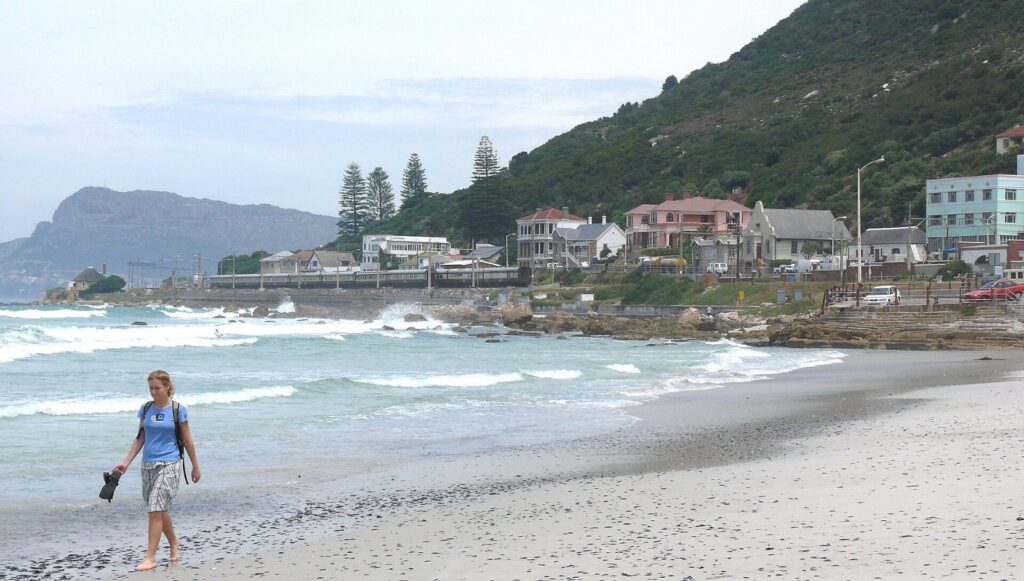
Muizenberg is a long, straight, gently shelving beach facing into False Bay, and the stretch at the northern end — Surfers’ Corner — produces small, slow, forgiving waves that break a long way out and roll in without much power. That combination is why it has become the default learn-to-surf beach for Cape Town, and why on a warm Saturday the water is full of people standing up for the first time.
Surfing has been happening here for well over a century; it was already being written about as a Muizenberg activity by around 1910. There are several surf schools and board hire operations along the beachfront road, and the barrier to entry is genuinely low. If you have never surfed, this is a reasonable place to try.
If you are an experienced surfer, adjust your expectations. Muizenberg is a beginner wave and it is crowded. The peninsula has better waves elsewhere, and they are less friendly.
The water in False Bay is usually several degrees warmer than the Atlantic seaboard beaches at Camps Bay or Clifton, which is the other reason people come here. Warmer is relative — it is still cold. A wetsuit makes a long session possible; most rental places include one.
Safety in the water
False Bay is white shark habitat, and Muizenberg and Kalk Bay are both covered by Shark Spotters, a Cape Town programme that posts spotters on the mountainside above the beaches to watch the water. Muizenberg and Kalk Bay are among the beaches spotted every day of the year. Some other beaches in the programme are only covered seasonally.
The system is a set of flags flown at the beach, and it is genuinely worth understanding before you get in:
- Green flag — spotting conditions are good.
- Yellow flag — spotting conditions are poor. The spotters are there, but they cannot see well.
- Red flag — high shark alert.
- Black flag and a siren — a shark has been spotted. Leave the water immediately.
- No flag at all — no spotter on duty.
Read this before you swim
A green flag means the spotters can see, not that there is nothing there. Shark Spotters is explicit that it is not responsible for anyone’s safety and that use of the ocean is at your own risk. If a siren sounds, get out without waiting to see why. Details checked 20 August 2026 — confirm current beach coverage with Shark Spotters.
Sharks are not the only thing to think about, and for most swimmers they are not the main thing. Muizenberg has rip currents, the beach is long and only patrolled in parts, and conditions change with wind and tide. Swim where other people are swimming and where lifeguards are on duty. This is not a beach where it is safe to assume that because it looks flat it is harmless.
The beach huts
The row of small wooden bathing boxes on the sand, painted in flat primary colours, is the most photographed thing in Muizenberg and probably one of the most photographed things in Cape Town. They are a survival of the Victorian and Edwardian resort era, when Muizenberg was where Cape Town society came to bathe and changing in public was not done.
They are still working structures rather than a display, and the City has been reconstructing and relocating some of them as part of coastal resilience work, keeping the historic design and colours. If a few are missing or fenced when you visit, that is why.
Photographing them is uncontroversial. They are on a public beach and everyone does it. Early morning gives you the light from the right side and far fewer people in frame.
How Muizenberg got here
The Dutch established a post here in 1743 to watch False Bay, and the name comes from Wynand Willem Muijs, the sergeant who commanded it. In 1795 it was the site of the Battle of Muizenberg, when British forces landed and took the Cape from the Dutch — the battlefield landscape is a declared provincial heritage site.
The village that mattered most, though, was the Victorian and Edwardian seaside resort. Cape Town’s wealthy built along this shoreline, the railway brought day trippers, and a strip of substantial buildings went up along the beachfront. Cecil John Rhodes bought a cottage here three years before he died, and died in it in 1902; it is now a small museum.
Muizenberg went through a long decline in the later twentieth century and much of the grand beachfront architecture is still in mixed condition. What has come back is the beach itself, driven largely by surfing. It is worth looking up as you walk the main road — a good deal of the Edwardian detail is still there above the shopfronts.
Kalk Bay harbour
Kalk Bay is a working harbour, not a heritage reconstruction of one. Boats go out, come back, and sell what they have caught on the quay, and the harbour has its own rhythm that has nothing to do with visitors. That is the appeal, and it is also the thing to be careful about: the people working there are working, not providing atmosphere.
The name comes from the Dutch for lime. The settlement began in the seventeenth century around lime-burning — shell and limestone burned for the mortar that built Cape Town — and after 1806 it grew into a fishing village and whaling station. By the 1860s it had also become a seaside resort. The steep stone staircases running from the harbour up the mountainside date from the late 1800s and are still the quickest way between the harbour and the houses above.
If you want to see the harbour working, go in the morning. Whether boats are landing, and what they have, depends on the sea and the season — snoek runs are a Cape winter fixture but nothing is guaranteed on any given day. Ask before photographing people at work.

The village, the shops and eating
Kalk Bay’s main road is one short strip and it carries an unusual density of secondhand bookshops, antique and bric-a-brac dealers, small galleries and independent shops. It is genuinely browsable rather than a manufactured craft market, and it is the reason a lot of Capetonians come out here on a Sunday.
Eating is the other reason. There is a well-known fish restaurant on the harbour wall and a row of cafés and bakeries along the main road. Booking is sensible at weekends. If you would rather eat what was landed that morning, buy from the quay.
There is a tidal pool at Dalebrook, between Kalk Bay and St James, and another at St James beside the St James bathing boxes — which are a different set from the Muizenberg ones and are frequently mislabelled online. Both pools are sheltered and much calmer than the open beach.
Getting there
By train
The Southern Line runs from Cape Town along the False Bay shore to Simon’s Town, and the section from Muizenberg onwards runs right beside the water — it is one of the better rail journeys in the country simply as a piece of coastline. Both Muizenberg and Kalk Bay have stations metres from the beach and the harbour.
Train service checked 20 August 2026
Direct weekday trains between Cape Town and Simon’s Town resumed on 3 February 2026, running Monday to Friday. On Saturdays the service uses a Fish Hoek to Simon’s Town shuttle arrangement. There is no regular Sunday or public holiday service. Metrorail schedules on this line have changed repeatedly in recent years — check current times before relying on the train, and do not plan a Sunday trip around it.
By car
From the city the quickest route is the M3 through the Southern Suburbs and over to Muizenberg, roughly 30 to 40 minutes without traffic. From Muizenberg the coast road runs on through St James to Kalk Bay and Fish Hoek. Parking at Muizenberg is along the beachfront and fills at weekends; Kalk Bay parking is limited and tight, and the main road is narrow.
The coast road onward is also the route to Simon’s Town, Boulders and Cape Point, so this pairs naturally with a peninsula day. See the self-drive guide for the loop.
When to come
Summer, roughly December to March, gives the warmest water and the busiest beach. The south-easter that batters the Atlantic side in summer is often less punishing here, which is part of why False Bay works as a wind fallback.
Winter is quieter, the light is better, and it is snoek season in the harbour. The water is cold but people surf through it in wetsuits. Kalk Bay’s shops and restaurants are open year-round and are arguably nicer out of season.
For the beach huts and the harbour, early morning beats midday in every season — better light, fewer people, and at Kalk Bay a better chance of seeing boats come in.
Practical notes
- Check the flag before you swim, at either beach, every time.
- Take cash for the harbour. Buying fish on the quay is not a card transaction.
- Ask before photographing people working at the harbour, and do not photograph inside boats without being invited.
- Kalk Bay parking is genuinely difficult at weekends. The train solves this on weekdays.
- Wetsuits are worth it even in February.
- Muizenberg and St James beach huts are different sets. If you specifically want the Muizenberg row, it is the one at Surfers’ Corner.
- The beachfront strip is a working suburb, not a resort. Normal city awareness applies, particularly after dark.
Featured activities at Muizenberg
Muizenberg is where Cape Town learns to surf: warmer water than the Atlantic side, a slow-breaking wave and a long sandy beach. Both lessons below have their own page explaining conditions, safety and what to check.
Nearby, and what to do next
- Cape Peninsula tours — guided ways to see the False Bay side and Cape Point in one day.
- Cape Town beaches — where Muizenberg and Kalk Bay sit among the city’s beaches.
- Cape Peninsula day trip — how Muizenberg and Kalk Bay fit into the full-day circuit.
- Cape Town with kids — what actually works with children, how age changes the plan, and wet-weather fallbacks.
- False Bay & the Southern Peninsula — how the whole False Bay coast fits together.
- Simon’s Town — naval history and the Boulders penguin colony, twenty minutes further.
- Cape Point — the end of the peninsula, and the obvious pairing for a full day.
- Southern Suburbs & Constantia — Kirstenbosch and the wine valley, on the way back to town.
- Self-drive Western Cape — the Cape Peninsula loop and how to drive it.
Official sources
- Shark Spotters — beach coverage, flag meanings and current shark activity. The authority for whether a beach is spotted.
- City of Cape Town — beach management, lifeguards and the beach hut works.
- Metrorail Western Cape / PRASA — Southern Line timetables and service changes.
- South African History Online — documented history of Muizenberg and Kalk Bay.
Water safety information and train services on this page were checked on 20 August 2026. Both change. Confirm the flag at the beach on the day and the timetable before you travel.
Where to stay, and what to book
Our False Bay & Southern Peninsula accommodation page carries a short orientation to the area and a live availability map.