

Hero image: Photo: South African Tourism / Wikimedia Commons, CC BY 2.0
Robben Island lies about seven kilometres off the Cape Town shoreline, low and flat and unremarkable to look at. That is part of the point. For most of four centuries it was used by whoever controlled the Cape as a place to put people they wanted removed from society — prisoners of war, enslaved people, the sick, the exiled, and finally the men who opposed apartheid. It is now a museum and a UNESCO World Heritage Site, and the standard visit is a guided tour that includes the ferry from the V&A Waterfront.
This is not a sightseeing stop in the ordinary sense, and it is worth going with some sense of what happened here. It is also one of the harder Cape Town experiences to plan around, because the ferry depends on the sea and the museum can cancel at short notice. Both of those things are covered below.
Where to stay and what to book for Robben Island
Ferry tickets and guided visits, plus hotels beside the Nelson Mandela Gateway the boats leave from.
Places to stay
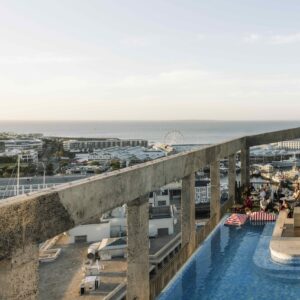
The Silo Hotel, V&A Waterfront
Design-led luxury built into the old grain silo above the Zeitz MOCAA, at the working end of the V&A Waterfront.
View Property DetailsCape Grace, V&A Waterfront
A 112-room hotel on a private quay between the V&A Waterfront and the yacht marina.
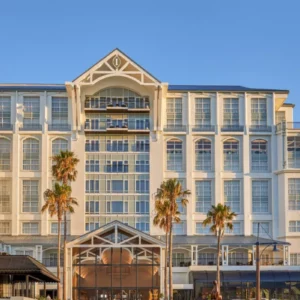
View Property DetailsInterContinental Table Bay, V&A Waterfront
The large full-service hotel at the end of the V&A Waterfront quay, formerly The Table Bay Hotel — space, a…
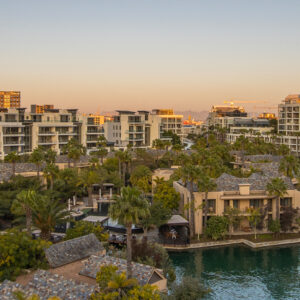
View Property DetailsLawhill Luxury Apartments, V&A Waterfront
Serviced one to three-bedroom apartments on the marina inside the V&A Waterfront — kitchens, space and walkable everything.
View Property Details

Browse all Cape Town accommodation
Tours and experiences
Cape Town: Robben Island Ferry Ticket and Guided Prison Tour
The official components — the ferry from the Waterfront and the guided prison tour on the island.
View Tour DetailsCape Town: Robben Island Prison Tour from The V&A Waterfront
The island trip framed around its departure point — the Nelson Mandela Gateway at the V&A Waterfront.
View Tour DetailsCape Town: Robben Island Guided History Sightseeing Day Tour
The island set in its context — the prison alongside the city history that produced it.
View Tour DetailsCape Town: Robben Island, Table Mountain & Bo-Kaap Tour
The city’s three headline stops in one day — island, mountain and the Bo-Kaap.
View Tour Details

In this guide
- Robben Island in brief
- Why the island is a World Heritage Site
- Four centuries before the prison
- The maximum security prison
- The lime quarry
- What the tour actually involves
- Getting there and booking
- Tickets and current prices
- When the ferry does not sail
- Practical notes
- Nearby, and what to do next
- Official sources
Robben Island in brief
- What it is — a former maximum security prison and place of banishment, now a national museum.
- Where — in Table Bay, roughly 7 km off the Cape Town coast. Ferries leave from the V&A Waterfront.
- Status — declared a National Monument and a National Museum in 1996, an associated institution of the national arts and culture department in 1997, a UNESCO World Heritage Site in 1999, and a National Heritage Site in 2006.
- How long — the museum describes the standard tour as about three and a half hours including both ferry crossings; its own frequently asked questions page says about four hours. Allow the longer figure.
- How you see it — guided throughout. A bus tour of the island, then a walking tour of the prison, part of it led by a former political prisoner.
- The catch — sailings depend on sea and weather conditions, and the museum states plainly that it may cancel voyages or change departure times without notice.
Why the island is a World Heritage Site
UNESCO inscribed Robben Island in 1999 under criteria (iii) and (vi). The first recognises that the buildings themselves are evidence — in UNESCO’s words, they “bear eloquent witness to its sombre history”. The second recognises what the island came to stand for: the triumph of the human spirit, of freedom and of democracy over oppression.
That second criterion is unusual, and it is the reason the site is listed at all. Robben Island is not architecturally distinguished. The prison is a plain mid-century complex of concrete and wire. What is inscribed is the meaning that attached to it — that a place built to break political opposition instead became the place where much of the country’s future leadership was formed, and that the men held there walked out and governed.

Four centuries before the prison
The prison most visitors come to see occupied barely thirty years of the island’s use. The pattern is much older. From 1652, under Dutch rule, enslaved people and prisoners of war were sent here to cut stone and burn shell for lime, material that went into building Cape Town. Political prisoners from the Dutch colonies in the east were exiled here too, and one of them is commemorated by the kramat, a Muslim shrine that the tour passes.
The British took the Cape in 1795 and kept using the island as a prison. From 1846 it was turned into a place of medical isolation, holding people with leprosy and people judged mentally ill, while still receiving prisoners. The leper graveyard on the island dates from this period, as does the church designed by Sir Herbert Baker. In the Second World War the island was fortified as part of the defence of Table Bay.
The through-line is consistent: for almost every regime that held the Cape, Robben Island was where inconvenient people went. The apartheid prison was the last and most systematic version of a very old idea.
The maximum security prison
The maximum security prison opened in 1959 and held both political prisoners and men convicted of ordinary crimes, in separate sections. Conditions were racially graded — the food, the clothing and the privileges a man received depended on how he was classified — and the regime was deliberately designed to be degrading rather than merely punitive.
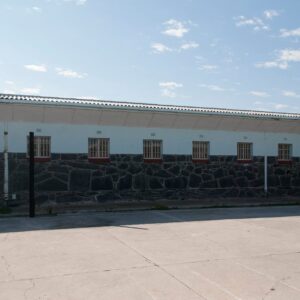
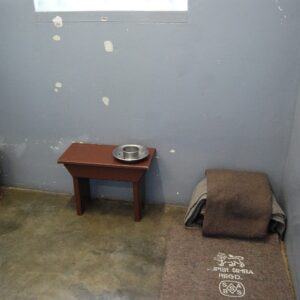
Nelson Mandela was held here for eighteen of the twenty-seven years he spent in prison, in a single cell in B Section. He was not alone: B Section held much of the senior leadership of the liberation movements, among them Walter Sisulu, Ahmed Kathrada and Govan Mbeki. Robert Sobukwe, founder of the Pan Africanist Congress, was held separately in a house of his own on the island under a law written specifically to keep him there after his sentence expired.
The last prisoners left in 1991 and the prison closed formally in 1996. The museum opened the following year. Many of the guides who take visitors through the prison were themselves imprisoned in it.

The lime quarry
The tour stops at the lime quarry, where political prisoners were made to dig for years in glare so severe that it permanently damaged the eyesight of some of them. What the museum emphasises about the quarry is not the labour but what the prisoners made of it: it became the place where they taught each other, argued politics, passed information and composed songs about their treatment. The work was meant to be pointless and grinding. It became, in the prisoners’ own accounts, something closer to a university.
What the tour actually involves
There is one standard visit and you cannot wander the island on your own. The shape of it is: a ferry crossing of roughly half an hour each way, a bus tour around the island, and a walking tour of the maximum security prison led by a former political prisoner.
The bus route passes the lime quarry, the kramat, the leper graveyard, the Herbert Baker church and the prison complex, with commentary. The prison section is on foot and includes B Section and Mandela’s cell. The ferries carry up to about 150 passengers, so this is not a small-group experience, and the pace is set by the schedule rather than by you.
Photography is allowed for personal use. Commercial photography is not, and drones and tripods are not permitted.
Getting there and booking
Ferries leave from the Nelson Mandela Gateway, at the Clock Tower precinct of the V&A Waterfront. The Gateway is also a small museum in its own right and is where you check in. Book through the Robben Island Museum’s own website rather than a reseller — there are a large number of third-party sites selling Robben Island tickets, and the museum is the authority on availability and cancellations.
Book well ahead. This is one of the most heavily booked experiences in Cape Town and sailings fill, particularly over December and January. If your trip is short, book it early and build the rest of your Cape Town days around the sailing you get rather than the other way round.
Checked 20 August 2026
The museum’s own frequently asked questions page lists ferries at 09h00, 11h00 and 13h00, with a 15h00 departure also appearing on its site. Its published operating days and the V&A Waterfront’s listing do not currently agree with each other. Treat departure times and operating days as something to confirm at the point of booking, not as fixed.
Tickets and current prices
Prices published by the Robben Island Museum, checked on 20 August 2026:
- South African citizens — R400 adult, R210 child.
- Non-South Africans — R600 adult, R310 child.
The ferry is included in the ticket. Rescheduling requires at least 48 hours’ notice and attracts an administration fee. Prices change, and this is a museum-set tariff rather than a market rate, so confirm the current figure when you book.
When the ferry does not sail
This is the part that catches people out, and it is worth planning for rather than hoping about. The crossing is open water in Table Bay, and the museum states that it reserves the right to cancel voyages or to change departure times without notice. It refunds tickets where it cancels for adverse weather or where the ferry has operational difficulties.
In practice that means two things. First, do not book Robben Island for your last day in Cape Town, because if it is cancelled you have no second chance. Second, have a plan for the morning if it does not sail — the V&A Waterfront is right there, and the City Bowl is fifteen minutes away.
If you are prone to seasickness, the museum suggests taking something for it an hour before boarding. It also advises pregnant visitors to check with a medical practitioner before booking.
Practical notes
- Allow half a day. Between check-in, the crossing, the tour and the return, three and a half to four hours is realistic, and that is before you get back through the Waterfront.
- Take a hat, sunglasses and sunscreen. The island is exposed and much of the bus tour involves getting out in the open.
- Wear shoes you can walk in. The prison section is on foot on hard surfaces.
- There is little shelter and limited catering. Bring water.
- It can be cold and wet on the crossing even when Cape Town is warm. Take a layer.
- Go with some preparation. The tour assumes a little background. Reading about the Rivonia Trial or about Robert Sobukwe before you go changes what the buildings mean.
Nearby, and what to do next
- Robben Island tours — what a third-party product genuinely adds, given the Museum controls access.
- V&A Waterfront — where the ferry leaves from, and the obvious place to be before and after.
- City Bowl & Historic Centre — the District Six Museum, the Slave Lodge and the Company’s Garden cover much of the same history on the mainland.
- Cape Town — how the city fits together and how long to give it.
- 5-day Cape Town itinerary — where a Robben Island morning fits in a short trip.
- Travel planning — getting around, timing and practicalities.
Official sources
- Robben Island Museum — tours, ferry departures, tariffs, booking and cancellation policy. The only authority for whether a sailing is running.
- UNESCO World Heritage Centre — Robben Island — the 1999 inscription and the statement of outstanding universal value.
- Department of Sport, Arts and Culture — the museum’s status and heritage designations.
- South African History Online — documented history of the island and the prison.
Operational details on this page — prices, departure times and operating days — were checked on 20 August 2026. They change, and the museum can cancel a sailing on the day. Confirm with Robben Island Museum before you travel.
Book the ferry and the tour
Robben Island bookings work differently from other Cape Town experiences – see Robben Island tours for how the ferry side actually works, and the Robben Island Tours listings for what is currently bookable. See also Cape Town food and city tours.