

Hero image: Photo: Charlesall (talk) / Wikimedia Commons, CC BY-SA 3.0
Prince Albert sits on the northern side of the Swartberg, at the point where the mountains stop and the Great Karoo begins. It is one of the most attractive villages in the country — water furrows down the streets, deep verandas, mountains filling the end of every road — and it has built a reputation on food, architecture and silence that is entirely deserved.
It also has a serious access problem at the moment, and this page is going to lead with that rather than bury it, because it changes whether the trip works at all.
Both mountain routes to Prince Albert are closed — status checked 20 August 2026
Prince Albert’s two scenic connections to Oudtshoorn and the Garden Route are the Swartberg Pass and Meiringspoort. On the most recent official notices, both are closed.
- Swartberg Pass (MR 369) — Garden Route District Municipality announced on 9 August 2026 that the pass was closed to all traffic from both the Oudtshoorn and Prince Albert sides after heavy snow, asking the public not to travel to it. Three days earlier the Western Cape Department of Infrastructure had it open but under stop-and-go control for four weeks of repairs. We have found no reopening notice since.
- Meiringspoort (N12) — closed since the May–June 2026 floods. On 17 July 2026 the province indicated temporary reopening might be possible within about six months, weather permitting, with full reconstruction taking at least two years.
Neither closure is permanent and both roads have reopened after worse. But do not plan a Swartberg crossing without checking on the day with the Western Cape Department of Infrastructure and Garden Route District Municipality. The reliable approach to Prince Albert at present is from the N1 at Prince Albert Road, not over the mountains. Conditions change; verify with the official authority before travelling.
In this guide
Prince Albert in brief
- What it is — a small Great Karoo village on the northern foot of the Swartberg, in the Cape Karoo.
- Known for — Karoo and Cape Dutch architecture, olives and figs, food, dark skies and the Swartberg Pass.
- Best for — doing very little for two days, eating well, and looking at the sky.
- Time needed — two nights. It is too far from anywhere to be a day trip and the point of it is the evening.
- Getting there — from the N1 at Prince Albert Road, about 45 minutes on the R407. The mountain routes from Oudtshoorn are closed at the time of writing.
- The catch — access, and heat. Summer here is severe.
The village
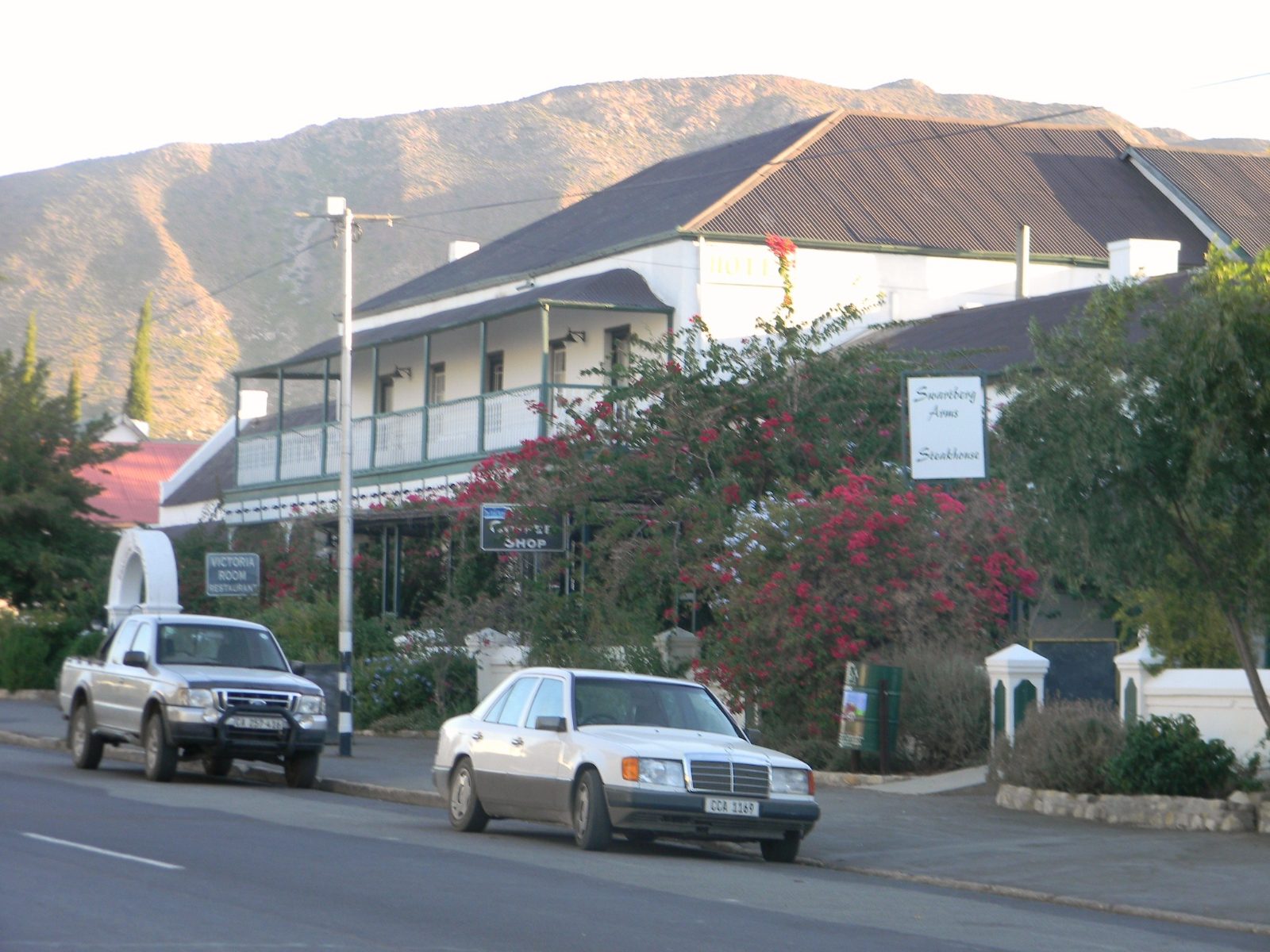
Prince Albert Municipality dates the settlement to 1762, on the farm Queekvalleij, and records that it was officially named Prince Albert in 1845 after Queen Victoria’s consort. The municipality describes a rich architectural heritage of Cape Dutch and Victorian buildings, and that is what you actually see: a long main street of gabled and verandaed houses, water furrows running beside it, and the mountain closing the view at the southern end.
You will see it claimed that Prince Albert has the second-largest number of declared heritage buildings in South Africa. We are not publishing that. No heritage authority states it — the national heritage register was unreachable throughout our checks, and no official source ranks towns by declaration count. The architecture is genuinely fine and does not need a league table.
The Fransie Pienaar Museum in Church Street covers local cultural and natural history, nineteenth-century gold mining, fossil footprints, Stone Age material and a forced-removals exhibit, and distils witblits once a year in March. The Western Cape Government’s listing gives hours of Monday to Friday 08:00 to 16:00, Saturday 09:30 to 12:00 and Sunday 10:30 to 11:30 — but that page was last updated in 2022, so phone 023 541 1172 rather than trusting it.
Olives, figs and what actually grows here
Prince Albert Municipality identifies the local economy as resting on sheep farming and the cultivation of olives and figs, and the town has recently gained a first commercial pistachio venture. That is the verifiable version. You will find a good deal of copy calling the town an olive capital with impressive hectare figures attached; the Western Cape Department of Agriculture publishes no commodity-level data for Prince Albert, and the olive and fig numbers that circulate belong to a different study area further south. We are not repeating them.
What this means in practice is straightforward and pleasant: there are olive farms that welcome visitors for tastings, there is good bread, there are figs in season, and there is a farmers-market culture out of proportion to the size of the place. The eating is a genuine reason to come, not a filler paragraph.
Dark skies, without the marketing
Prince Albert is promoted hard as a stargazing destination and the promotion is not wrong — it is a small town in a dry, high, sparsely populated part of the country with very little light around it. Wesgro, the provincial tourism agency, describes it as having the least light pollution in the area and recommends winter.
What it is not is a certified dark-sky site. DarkSky International lists exactly two accredited places in South Africa — Lapalala Wilderness and the !Ae!Hai Kalahari Heritage Park — and neither is here. So enjoy the sky, which is superb on a moonless winter night, but treat “dark sky reserve” language on any brochure as marketing rather than designation.
The Swartberg, and Gamkaskloof
CapeNature manages the Swartberg Nature Reserve, roughly 121,000 hectares between the Klein and Groot Karoo, declared part of the Cape Floral Region Protected Areas World Heritage Site in 2004. That designation belongs to the reserve — not to the pass road, and not to the town, both of which you will see described as World Heritage in tourism copy.
Gamkaskloof, known as Die Hel, is closed. CapeNature states it is shut until further notice on safety grounds, and the Ou Tol hut with it. The 4×4 route to the Bothashoek hut remains bookable and other reserve activities continue. The Otto du Plessis road into Gamkaskloof is 37 km of gravel taking around three hours with high clearance or 4×4 strongly advised — which is worth knowing even for when it reopens.
Getting to Prince Albert
There are three ways in, and at the time of writing only one of them is reliable.
- From the N1 at Prince Albert Road — the R407, about 45 minutes. This is the route that works, and it is how most visitors should currently plan to arrive. Prince Albert Road is a station siding on the N1, not a town; do not plan to buy anything there.
- Over the Swartberg Pass from Oudtshoorn — around 111 km and an hour and a half by routing, and by far the finest drive. Closed on the most recent notice.
- Through Meiringspoort via De Rust — the tarred gorge alternative. Also closed.
Cape Town to Prince Albert is roughly 393 km and just under five hours by routing on the N1, which realistically means five and a half to six with a stop. Beaufort West is about 146 km and just under two hours north. Those are free-flow figures with no stops, and they say nothing about whether a mountain route is open or suitable — that is a separate question, and on the passes the answer is currently no.
When to come
This is the Great Karoo and the seasons are emphatic. Summer, roughly December to February, is very hot — plan around the middle of the day rather than through it. Winter nights are properly cold and the skies are at their best. Spring and autumn are the comfortable windows, and autumn in particular is when the light here is extraordinary.
On water: the province reported in February 2026 that Prince Albert was more stable than other Central Karoo towns but relies heavily on groundwater that can come under rapid pressure in dry spells. No current municipal restriction notice is published. Use water carefully regardless — this is a village in a semi-desert.
Where to stay in Prince Albert
Prince Albert has an unusually good supply for a village of its size: guesthouses in restored Karoo and Victorian houses along the main street, a handful of country places on the farms, self-catering cottages, and the old hotel. Because the village runs on weekend and festival trade rather than through-traffic, the good places fill on Fridays and Saturdays and are often wide open midweek.
Check availability in Prince Albert
Prince Albert runs on weekend and festival trade, so midweek availability is usually good and Fridays and Saturdays are tight. Note the current road closures before you commit to dates.
See Prince Albert stays on Booking.comAffiliate link. We may earn a commission if you book through it, at no additional cost to you. See our affiliate disclosure.
Nearby, and what to do next
- Beaufort West — about two hours north, for the Karoo National Park and the N1.
- Oudtshoorn — an hour and a half over the Swartberg when the pass is open, for the Cango Caves and the Klein Karoo.
- Klaarstroom and De Rust — small settlements on the eastern approach, and the way to Meiringspoort when it reopens.
- Route 62 — the inland road west towards Calitzdorp, Barrydale and the Winelands.
- Gamkaskloof (Die Hel) — closed until further notice, but the reason many people plan a Swartberg trip in the first place.
Planning the wider trip: the Cape Karoo regional guide sets out how this part of the province fits together, Self-Drive Western Cape covers mountain-pass and long-distance driving, Where to Stay in the Western Cape covers accommodation, and Things to Do covers the rest of the province.
Practical notes
- Check the passes before you commit — Swartberg Pass and Meiringspoort were both closed on their most recent official notices. The N1 approach via Prince Albert Road is the dependable one.
- Buy fuel and supplies before you arrive — this is a village, and Prince Albert Road is not a town.
- Phone the museum — its published hours date from 2022.
- Plan around the heat in summer, and bring warm clothes in winter. Karoo nights are cold in any season.
- Gamkaskloof is closed until further notice.
- No dark-sky certification — the skies are excellent, the designation does not exist.
Official sources
- Prince Albert Municipality — town information and public notices.
- Western Cape Department of Infrastructure — provincial roads, Swartberg Pass and Meiringspoort.
- Garden Route District Municipality — pass closure notices.
- CapeNature — Swartberg Nature Reserve and Gamkaskloof.
- Western Cape Government — Fransie Pienaar Museum.