
Most of what makes the Western Cape worth visiting is reached by car, and driving in South Africa is straightforward once you know the rules, and most of the anxiety about driving in South Africa is concentrated in the fortnight before you collect one. This article is about that fortnight: what you actually need to hire a car, what to ask about insurance, and the road conditions that catch visitors out once they leave the motorway.
It is deliberately not a route guide. The self-drive Western Cape guide covers distances, passes and which roads to drive. This covers the decision before that one.
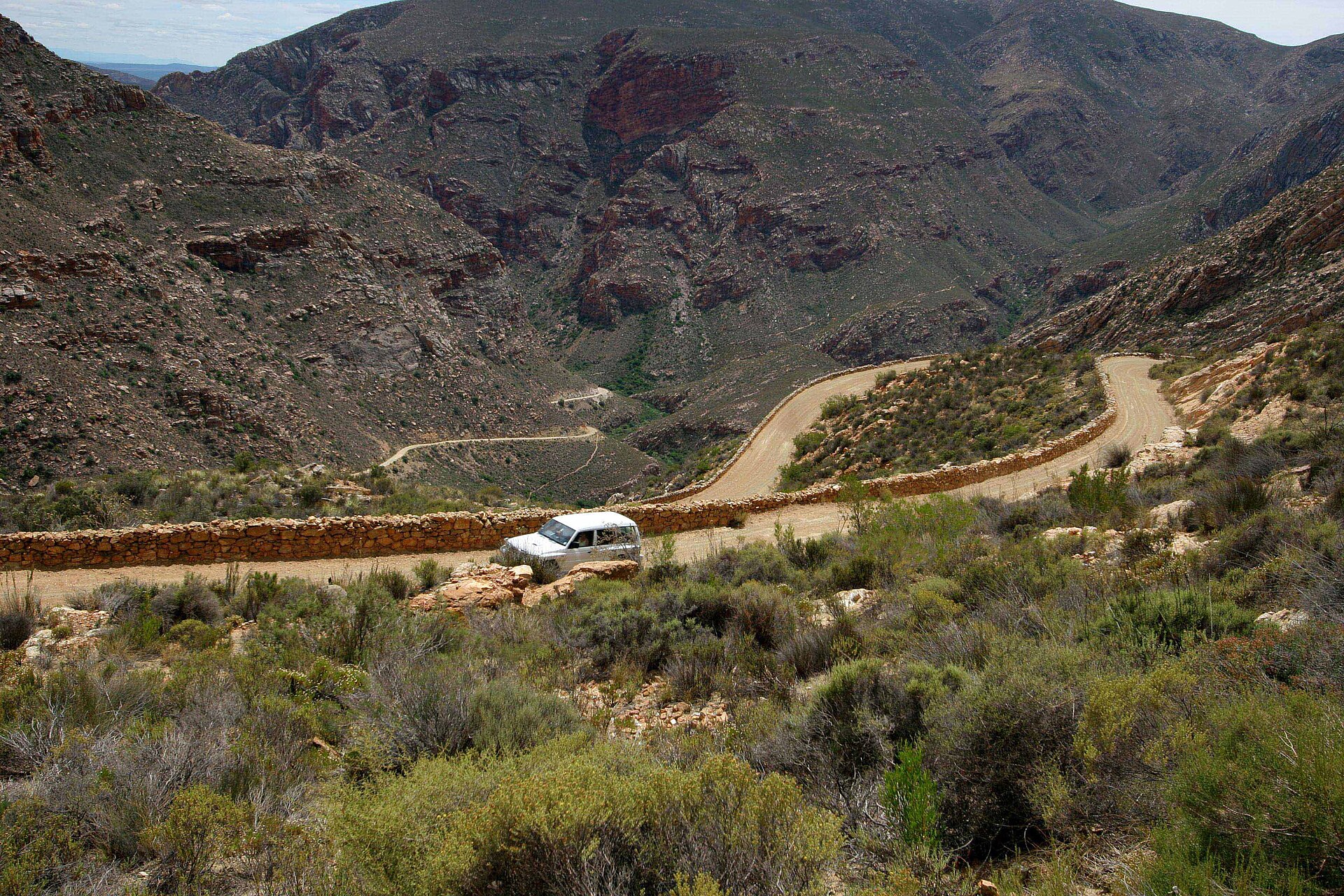
In this guide
- The licence you legally need
- Rental-company policy is a separate question
- Automatic or manual
- Insurance and excess
- Collecting the car
- Driving on the left
- Fuel and filling stations
- Tolls
- Parking and car guards
- Gravel roads, and why they matter here
- Mountain passes and closures
- Night driving and remote roads
- Planning a Western Cape road trip
- Read next
- Sources
Driving in South Africa: the licence you legally need
There is a lot of confusion about International Driving Permits, so start with what the law on driving in South Africa actually requires. According to the national traffic information service, a foreign driving licence is valid for driving in South Africa if:
- it is in English, or has an English translation or a certificate of authenticity or validity in English attached, issued by a competent authority; and
- it contains, or has attached to it, the photograph and signature of the holder.
An International Driving Permit is not required under those rules — it is an alternative way of satisfying them. If you do use one, it must be carried together with the licence it was issued against, and both must be valid. The foreign licence is also only valid on the basis that its holder was not permanently or ordinarily resident in South Africa when it was issued.
In practice: if your licence is a photo card in English, you are legally covered for driving in South Africa. If your licence is not in English, or is a paper document without a photograph, sort out an IDP or an official translation before you travel.
Two different things
The rules above are the legal requirement to drive. They are not the same as the rental company’s conditions of hire, which are contractual and vary between companies. Some hire companies ask for an IDP even where the law does not. Check your specific rental terms — the legal minimum does not override a company’s own policy.
Rental-company policy is a separate question
Everything in this section varies by company, and none of it is a universal rule. Confirm each point with the company you are actually booking:
- Minimum age and young-driver surcharges, which commonly apply below a threshold age.
- Minimum licence-held period — many companies require the licence to have been held for a stated number of years.
- Cross-border travel, if you intend to drive into Namibia, Botswana, Lesotho or Eswatini. This normally requires prior authorisation and paperwork, and is often excluded on cheaper rates.
- Gravel-road and off-road restrictions. Some contracts limit or exclude cover on unsurfaced roads. This matters a great deal in the Cape — see below.
- Additional drivers, one-way drop-off fees and after-hours collection charges.
Automatic or manual
Manual transmission is the default in South Africa and automatics are generally the more expensive and less numerous option. If you need an automatic — and if you have never driven a manual on the left, you probably do — book it explicitly and early rather than assuming one will be available on arrival. Automatics in the smallest and least expensive categories are the first to go.
Insurance and excess
Insurance is where visitors driving in South Africa most often get an unpleasant surprise, and it is also where we can least responsibly give you a single rule. Rental insurance in South Africa is sold in tiers that differ by company and by rate. What follows is a description of the concepts, not a statement about what your booking includes.
- The excess (or deductible) is the amount you remain liable for after a claim. On a basic rate this can be a very large figure relative to the rental cost. It is the number to find out before anything else.
- Collision damage waiver and theft waiver typically reduce liability rather than remove it. “Included insurance” on a quote rarely means zero liability.
- Excess-reduction products are sold to lower that figure, sometimes to nil. Whether they are worth it depends on the excess and the trip.
- Commonly excluded items. Tyres, wheels, windscreen and glass, undercarriage and water damage are frequently outside standard cover, or covered only by a separate product. On Cape gravel roads, tyres and windscreens are precisely what gets damaged.
- Third-party cover from a credit card or travel policy may duplicate or replace what the desk is selling — but check whether it covers South Africa, whether it covers gravel, and whether the rental company will still block a deposit on your card.
Read your own contract
Do not rely on any general article, including this one, for what your rental includes. Policies differ between companies, between rate types and over time. Ask specifically: what is the excess, is gravel-road use permitted, and are tyres and glass covered?
Collecting the car
Most visitors collect at Cape Town International. Allow more time than you expect at peak arrival hours, and note that the MyCiTi A01 airport bus was suspended when we checked on 20 August 2026, so if you are not hiring immediately you will need a metered taxi or e-hailing.
Before you drive away, do the boring things: photograph the car from all four corners and the roof, photograph existing damage on the checkout sheet, check that the spare wheel and jack are actually present, and confirm the fuel policy. In a country where gravel punctures are routine, an absent or flat spare is a real problem rather than a theoretical one.
Driving on the left
Driving in South Africa means driving on the left, with the driver on the right of the car. If that is new to you, the two things that cause trouble are junctions and drifting.
- Turning across traffic is the hardest habit to rewire. Take the first day slowly and say the direction out loud at junctions if it helps.
- Lane drift happens most when tired or distracted. Keeping the centre line on your right side is the reference.
- Roundabouts run clockwise; give way to the right.
- Four-way stops are common and work on order of arrival — first to stop is first to go.
- Slower vehicles pull onto the shoulder on single-carriageway roads to let faster traffic pass, and it is normal to acknowledge with hazard lights. Do it only where the shoulder is clear and safe, and never on a blind bend.
Speed limits are posted in kilometres per hour, generally 60 in built-up areas, 100 on rural roads and 120 on motorways unless signed otherwise. Seat belts are compulsory and drink-driving limits are strictly enforced.
Fuel and filling stations
Filling stations in South Africa are attended — you stay in the car and an attendant fills it, checks oil and water and cleans the windscreen if you ask. You do not pump your own fuel. A small tip for the attendant is customary.
Cards are widely accepted, but carry some cash anyway: card systems go down, and in small towns and on remote routes the margin for error is thin. The practical rule for the Karoo, the Cederberg and the West Coast is to fill up in the last substantial town rather than the next one — the gaps are long and stations in small towns keep short hours.
Tolls
Some national routes are tolled at plazas where you pay as you pass, by card or cash. In the Western Cape the ones visitors meet most often are the Huguenot Tunnel on the N1 through the mountains east of Paarl, and Chapman’s Peak Drive on the peninsula, which is a tolled concession road rather than a national route. Budget a little cash for them; the amounts are modest.
Parking and car guards
In cities and towns you will usually be approached by a car guard — someone, often in a high-visibility vest, who watches parked cars in a street or lot in exchange for a tip. It is an informal occupation rather than an official one. The convention is a few rand on your return, more if the car was there for hours. It is not compulsory and it is not a threat; it is simply how street parking works here.
Formal parking areas and shopping centres use pay-on-foot machines or attendants. Beyond that, the standing advice from the City of Cape Town and every local you will meet is the same: leave nothing visible in the car, ever, including in the boot if someone watched you put it there.
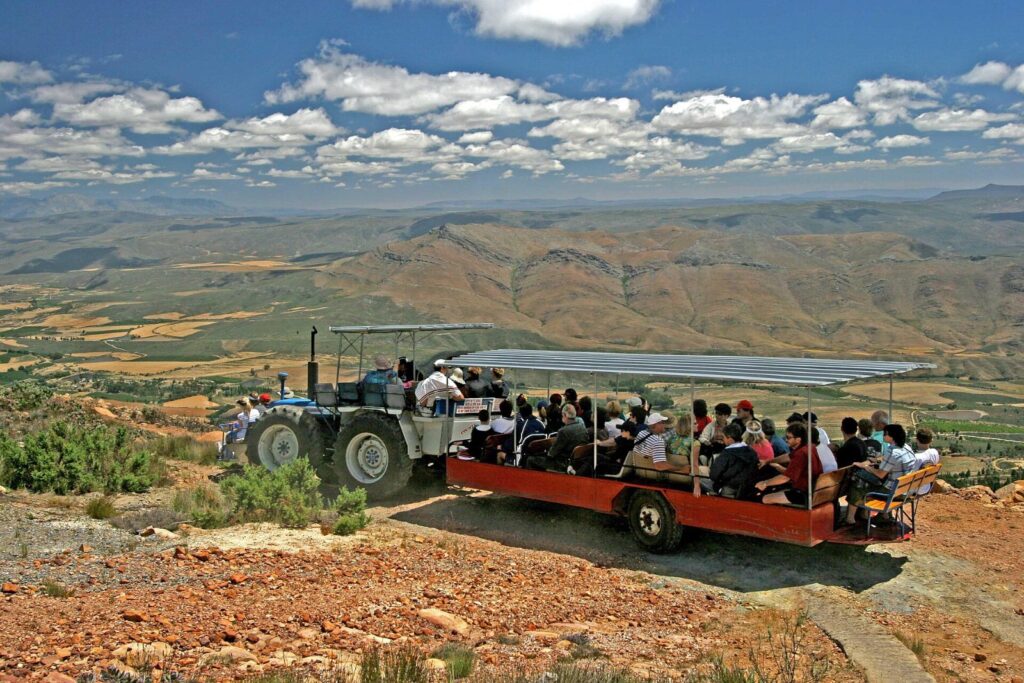
Gravel roads, and why they matter here
This is the part that most often goes wrong, and it is worth stating the principle plainly because it now governs how this site writes about roads:
Route calculation does not prove road suitability
A mapping app will give you a distance and a time for almost any line on the map. It will not tell you the surface, whether the road is open, whether it has been washed away, or whether your car can do it. A time estimate is not evidence that a road is drivable. Check the road, not the routing.
The concrete version: the direct road from Clanwilliam to Algeria in the Cederberg routes in under an hour. It is closed. Traffic apps have routed people over the Swartberg Pass while it was shut. This is not a hypothetical problem.
What gravel actually demands
- Speed is the main variable. Most gravel incidents are loss of control at speed on loose surface, particularly in corners and on corrugations. Slower is not a suggestion.
- Tyres are the weak point. Sidewall cuts from sharp stone are the classic gravel failure, and they are the item most often excluded from rental cover. Check the spare before you leave the tar.
- Clearance matters on some roads and not others. Well-maintained district gravel is fine in an ordinary car driven carefully. Rutted farm tracks and washaway-damaged roads are not.
- Rain changes everything. A gravel road that was fine yesterday can be badly rutted or washed out today, and river crossings are where people get into serious trouble.
- Dust means distance. Hang well back from the vehicle in front; you cannot see through the cloud, and neither can oncoming traffic.
There is no single vehicle recommendation that covers the Western Cape. De Hoop is reached by long but ordinary gravel; parts of the Cederberg currently require high clearance according to CapeNature’s own guidance; the Route 62 corridor itself is tarred throughout. Match the car to the specific roads on your route, and check each one.
Mountain passes and closures
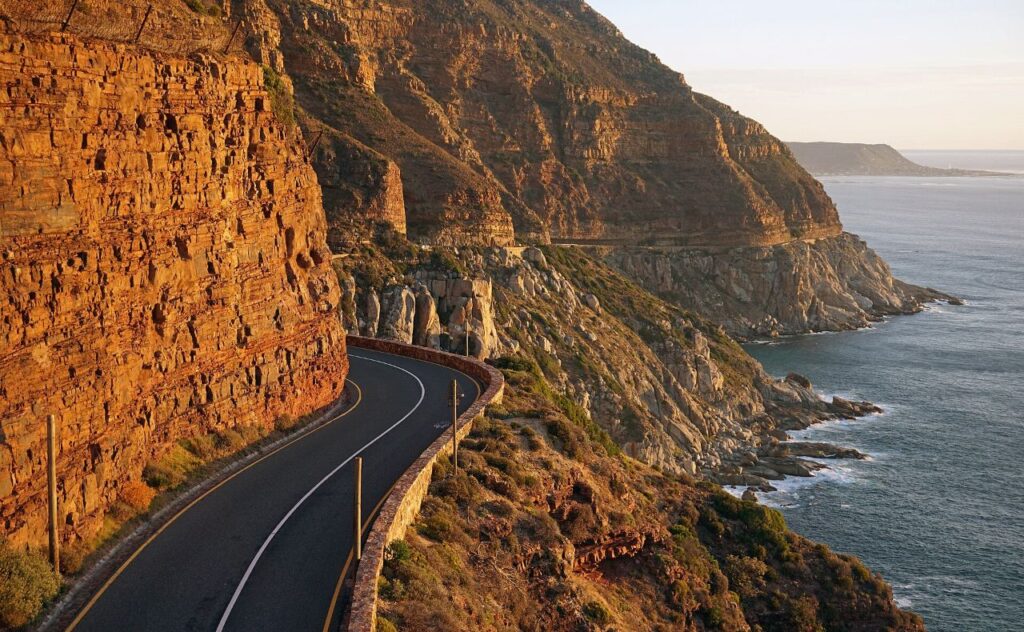
The Cape’s scenic driving is largely mountain-pass driving, and passes close — for snow, rockfall, fire, flood and repair. Several of the best are shut as this is written, which is a useful reminder that pass status is a thing to check rather than assume.
Pass status checked 20 August 2026
Swartberg Pass is closed from both the Oudtshoorn and Prince Albert sides after snow on 9 August 2026. Meiringspoort (N12) is closed following the May–June 2026 floods. Montagu Pass near George has been closed since the 2023 storms. Chapman’s Peak Drive was closed on its official status page, following an April 2026 rockfall. Confirm current status with the Western Cape Department of Infrastructure before relying on any of them.
Driving the passes that are open: use a low gear on long descents rather than riding the brakes, pull over at the designated viewpoints instead of stopping on the road, and expect gravel passes to be single-lane in places with blind corners. In winter, snow and ice on the high passes is a real possibility, not a novelty.
Night driving and remote roads
The general advice on driving in South Africa is to avoid long distances at night, and it is sound for practical reasons as much as any other. Rural roads are unlit and unfenced; livestock and wildlife on the road are common; pedestrians walk on road shoulders; and pothole and washaway damage is very hard to see in headlights. Breakdown assistance is a long way off on remote routes.
Plan legs to arrive before dark, particularly in winter when the light goes early. On remote roads carry water, keep the tank fuller than you think you need, and be aware that mobile coverage drops out for long stretches in the Karoo and the Cederberg — download offline maps before you leave.
Planning a Western Cape road trip
Once the car is sorted, the route logic is the interesting part of driving in South Africa. A few principles that hold across the province:
- Distances are longer than they look and average speeds lower than the map suggests, especially on passes and gravel.
- Build in weather slack. Coastal fog, winter fronts and summer wind all change what is worth doing on a given day.
- Fewer bases, longer stays. Two nights minimum per stop turns a driving holiday into a trip.
- Check the specific roads on your route before you commit to a plan that depends on one of them.
Where to go with it: Self-drive Western Cape for distances, routes and the passes; Route 62 for the inland run to the Klein Karoo; the Garden Route itinerary for the coastal week; Cape Karoo and the Cederberg for the routes where gravel and clearance genuinely matter; and Cape Overberg and De Hoop for the coastal detours. Travel planning covers the rest of the practicalities.
Read next
- Cape Town without a car — the case for not hiring one at all, and where that stops working.
- Cape Winelands day trip — the day trip where the drink-driving rules matter most.
- Cape Town to the Garden Route — the specific drive most visitors make, broken down properly.
Sources
- NaTIS — the national traffic information service, for the legal validity of foreign driving licences.
- Western Cape Department of Infrastructure — provincial road and pass status.
- Chapman’s Peak Drive — the official status page for the toll road.
- MyCiTi — current status of the airport bus service.
- CapeNature — reserve road conditions and vehicle requirements.
Licence rules are current as published by NaTIS. Road and pass statuses were checked on 20 August 2026 and are temporary conditions — confirm before you travel. Rental terms are set by individual companies and are not covered by any of the above.