
Whale season in the Western Cape is one of the few wildlife events anywhere that you can watch properly from dry land, without a boat, a guide or a ticket. Southern right whales come into the shallow bays of the Cape coast each winter to calve and mate, and in the right places they come close enough to the shore that a cliff path is a better vantage point than a vessel.
This guide to whale season in the Western Cape covers when the season runs, where the land-based watching is genuinely reliable, how the coast differs from Hermanus to De Hoop to False Bay, and what the rules are for boat-based trips. It does not promise you whales. Nobody can.
In this guide
When whale season in the Western Cape runs
There is no single official start date, and authoritative sources give slightly different ranges. That is not sloppiness on their part — it reflects that whales arrive gradually and that different species and locations peak at different times.
- CapeNature, writing about De Hoop, describes the season as “between June and November”, when southern right whales migrate to the coast to breed and care for their young.
- The International Whaling Commission’s whale watching handbook gives a broader window for the South African south coast, noting that southern right and humpback whales can be seen between June and December.
The practical synthesis for whale season in the Western Cape, and the way to plan: the season runs roughly from June to November, numbers build through winter, and the most reliable weeks are usually September and October, when mothers and calves are in the bays. Hermanus holds its whale festival in late September, which is a reasonable proxy for when the town expects sightings to be at their best.
Three different things get muddled here, and it helps to keep them apart:
| Term | What it means | What it does not mean |
|---|---|---|
| Season | The months in which whales are present on this coast | That they are present on any given day in any given bay |
| Peak | The weeks when numbers are usually highest — broadly September to October | A guarantee, or an official designation |
| A sighting | What you personally see on the day | Something anyone can promise you in advance |
If your dates are fixed and fall inside June to November you have a reasonable chance. If you can choose, choose September or October. If you are here in January, this article is not for your trip — see the best time to visit instead.
Which whales you are looking at
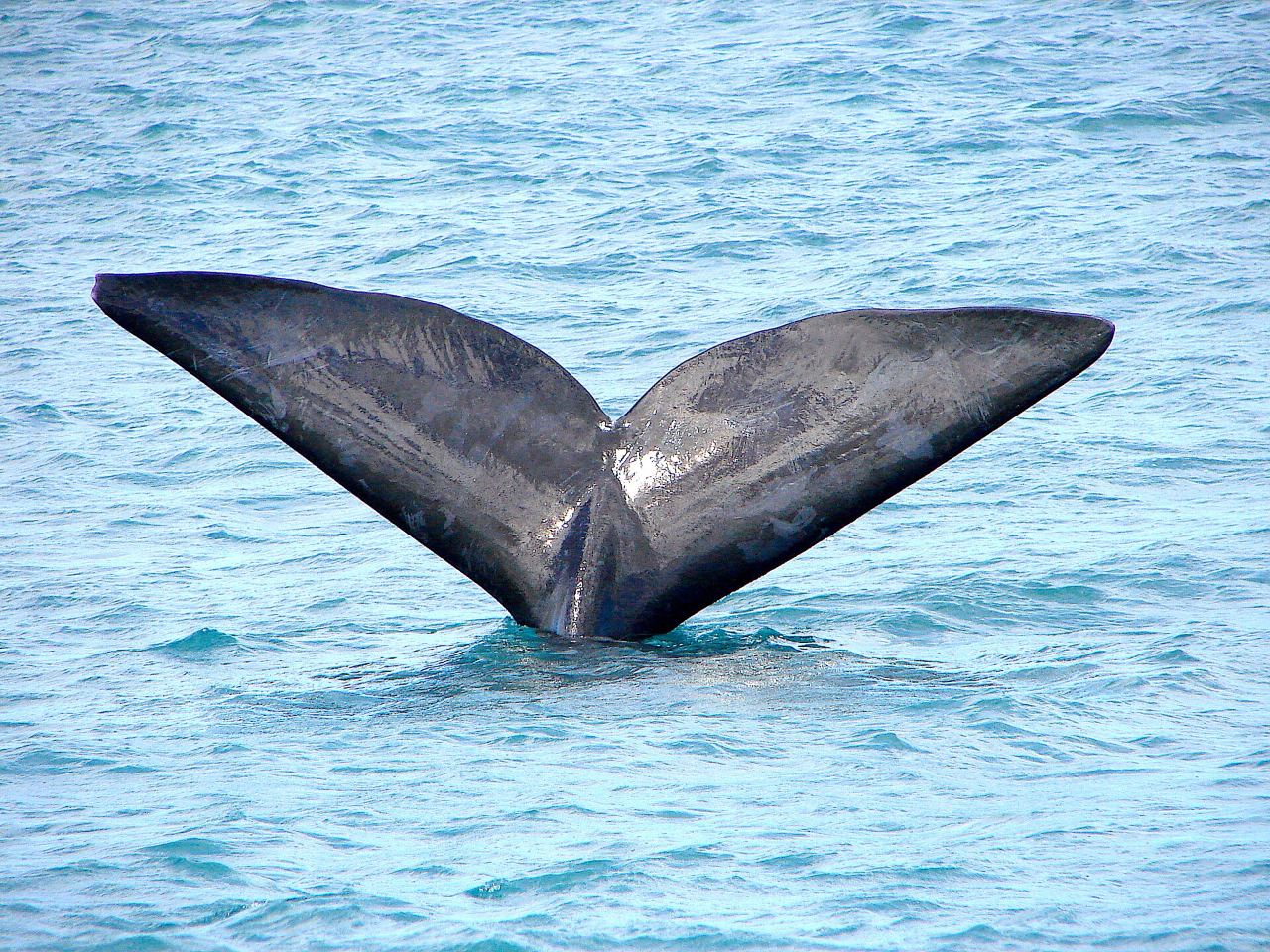
Southern right whales are the reason the Cape season exists. They come into shallow, sheltered bays to calve and mate, they are slow, they spend long periods at the surface, and they have no dorsal fin — a broad black back with pale callosities on the head. They are the species you will see close inshore, and the species that makes cliff-top watching work.
Humpback whales pass along the coast on migration and are more often seen further out, frequently moving rather than resting. They have a dorsal fin and very long pectoral fins, and they are the more acrobatic of the two.
Bryde’s whales are present off this coast year-round rather than seasonally, and are less predictable to see. Dolphins — common, bottlenose and the endangered Indian Ocean humpback dolphin — are also part of what you may encounter.
Hermanus
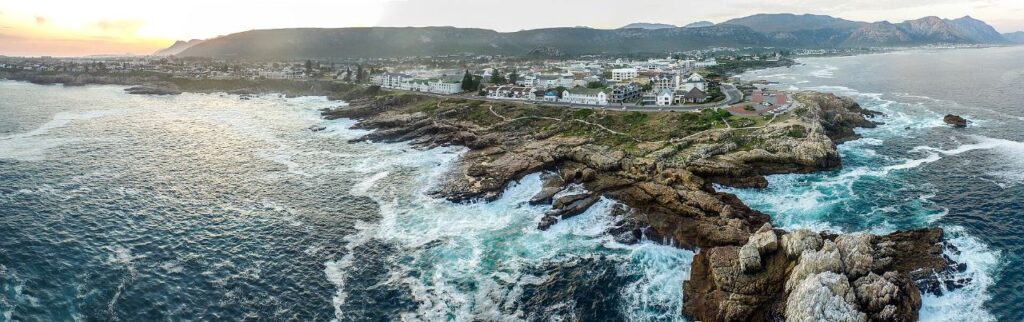
Hermanus is the main land-based whale-watching town on this coast and, for once, the reputation is deserved for a structural reason: the cliffs at Walker Bay drop straight into deep water, so whales that come in to calve are genuinely close to the shore rather than a speck on the horizon. They are often within about fifty metres of the cliff path.
The cliff path runs almost twelve kilometres along the shoreline, it is free, and it is the main event. You do not need a boat, a ticket or a tour to use it. Walk it slowly, stop often, and treat any bench with a view over deep water as a viewing platform.
The season here runs from about June to late November, with the densest sightings usually around September and October. The town’s whale festival falls in late September.
Hermanus is about ninety minutes from Cape Town and works as a long day trip, though two nights is a much better trip. Stanford, ten minutes inland, is a quieter base in the same area.
Gansbaai and De Kelders
Gansbaai sits on the far side of Walker Bay, and De Kelders — the cliff-top stretch just north of it — faces back across the bay towards Hermanus. It offers the same fundamental advantage: elevated ground above deep water where whales come inshore, with far fewer people on it than the Hermanus cliff path.
This is also marine-tour country, and it is worth being clear about what that means. Gansbaai’s marine tourism industry was built substantially on great white sharks, and the sharks have not been reliably present in these waters for several years. Operators have adapted, and marine trips here now cover a wider range of species. If you are booking a boat trip, book it for what is actually offered and currently permitted rather than for what the area was once famous for — the Gansbaai guide covers this in detail.
De Hoop
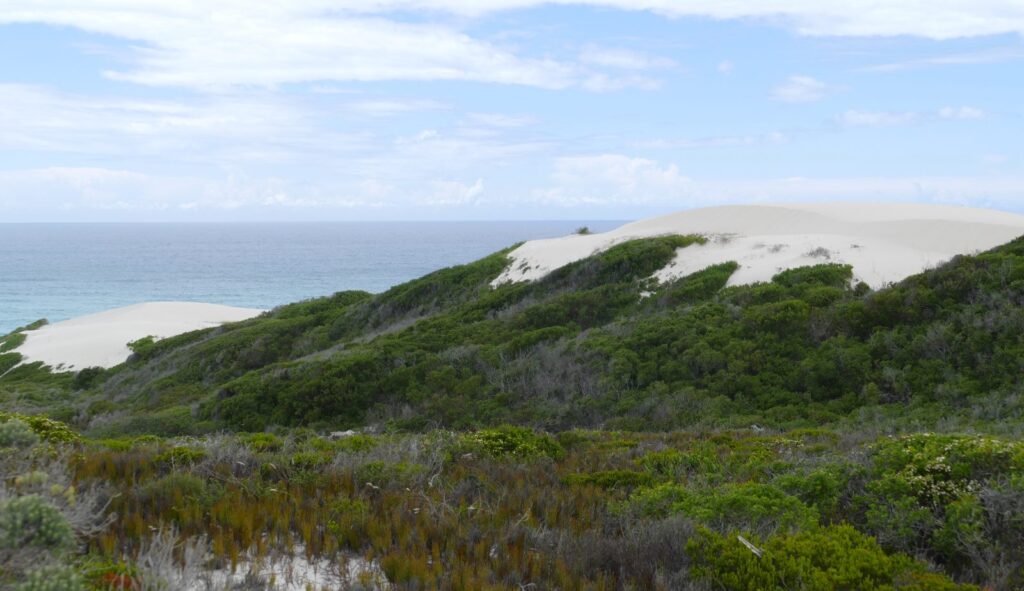
De Hoop Nature Reserve, further east along the Overberg coast, is the quietest of the major whale-watching locations and in some ways the most striking, because there is essentially nothing else there — no town, no promenade, no traffic.
CapeNature, which manages the reserve, describes De Hoop as “one of the best land-based whale-watching spots in the world”, and says that “about 120 whales return to these waters every year to mate and calve”. The high dunes at Koppie Alleen are the vantage point it points visitors to.
What that claim is and is not
“One of the best land-based whale-watching spots in the world” is CapeNature’s own description of the reserve. It is a reasonable characterisation of the site — and it is still a statement about the place, not a forecast about your morning. Whales are wild animals in open water. There is no location on this coast where sightings are guaranteed on a given day.
Practical notes: De Hoop is a long way from anywhere and both approaches end in extended gravel, so read the reserve guide before setting off. It is a stay-over destination rather than a day trip from Cape Town.
False Bay and Cape Town
You can see whales from Cape Town, and people regularly do. Southern rights come into False Bay in winter and spring, and they can be seen from the coast road on the False Bay side — between Muizenberg and Kalk Bay, along the road to Simon’s Town, and from the higher ground in the Cape Point section of the national park.
But be realistic about the difference. False Bay is very large and much of its shoreline is shallow and set back, so whales are frequently further off than they are at Hermanus, and the roadside vantage points are lower. Cape Town is a place where you may encounter whales while doing something else. The Whale Coast is where people go specifically to watch them, and it is more reliable for the simple reason that the geography is better.
If whales are a significant reason for your trip and you are basing yourself in the city, plan at least one day out to the Overberg rather than counting on the peninsula.
Boat-based whale watching
Boat-based whale watching in South Africa is a permitted activity, not an open market. Operators hold permits issued under national biodiversity legislation for periods of up to ten years, renewable annually subject to compliance, and permitted operators work to a code of conduct that sets minimum approach distances and maximum speeds.
Two consequences matter to you as a visitor:
- Non-permitted vessels and people are prohibited from approaching whales closer than 300 metres. If a boat is taking you closer than that, it should be a permit holder. It is reasonable to ask.
- Non-permitted operators may not advertise or offer whale watching. A trip sold as something else that then approaches whales is not the same product.
Beyond the legal position, the practical realities of any boat trip on this coast:
- Trips are weather-dependent and are cancelled routinely. Swell, wind and visibility all stop sailings, and winter is when the weather is least cooperative.
- Build in a spare day if a boat trip matters to you, and do not book it for the morning of your departure.
- Sightings are never guaranteed, and a reputable operator will say so before taking your money.
- Seasickness is a genuine factor on a small vessel in winter swell.
We do not publish an operator directory, and we would treat any operator’s own marketing claims about sighting rates with caution. Book through the local tourism office or check the permit position directly.
None of this is an argument against going out on the water — it is a different and often extraordinary experience. It is an argument for treating the boat as the optional extra and the cliff path as the reliable core of a whale-season trip.
How to actually look
- Look for the blow, not the whale. A southern right’s exhalation makes a distinctive V-shaped spout that is visible far further than the animal itself.
- Go early. Morning light and calmer water make surface activity much easier to pick out.
- Higher is better. Elevation beats proximity almost every time — a cliff path or a dune outperforms a beach.
- Stop moving. Most people scan for two minutes and walk on. Sit down and watch one patch of water for twenty.
- Binoculars change everything, far more than a long camera lens will.
- Calm days are better than sunny ones. Chop hides blows and backs.
Planning a trip around whale season in the Western Cape
The obvious shape for whale season in the Western Cape is a Cape Town base plus two or three nights on the coast: Cape Town, then Hermanus or Stanford, then either back or on east towards De Hoop and Cape Agulhas. The 7-day Cape Town, Winelands and Whale Coast itinerary is that trip written out, and how many days you need covers whether your trip is long enough to include it.
Winter accommodation on the Whale Coast is cheaper than summer, but September and October are the exception — Hermanus in particular fills around the festival, so book ahead for those weeks. The Cape Overberg guide covers the region; Western Cape accommodation covers where to base yourself.
Read next
- Best time to visit the Western Cape — where whale season sits against the other regions’ seasons.
- Cape Town to Hermanus — planning the drive around whale season, and how long to give it.
- Where to stay on the Cape Whale Coast — choosing a base for whale season, and when to book it.
Sources
- CapeNature — De Hoop Nature Reserve — the season, the whale numbers and the Koppie Alleen vantage point.
- IWC Whale Watching Handbook — South Africa — the permit system, approach distances and season ranges.
- City of Cape Town — coastal management and beach information.
Whale season in the Western Cape information was checked on 20 August 2026. Whales are wild animals and this page does not predict sightings. Boat trips are weather-dependent and permit conditions can change — confirm with operators and local tourism offices before booking.
Whale watching from the water
Whale Coast Tours & Activities · Marine & Wildlife Experiences
The cliff path at Hermanus needs no booking. Boat-based trips do – the Whale Coast and marine listings show what is currently bookable. See also Winelands or Whale Coast? and where to stay on the Whale Coast.